What Coastal Minimalist Decor Actually Is
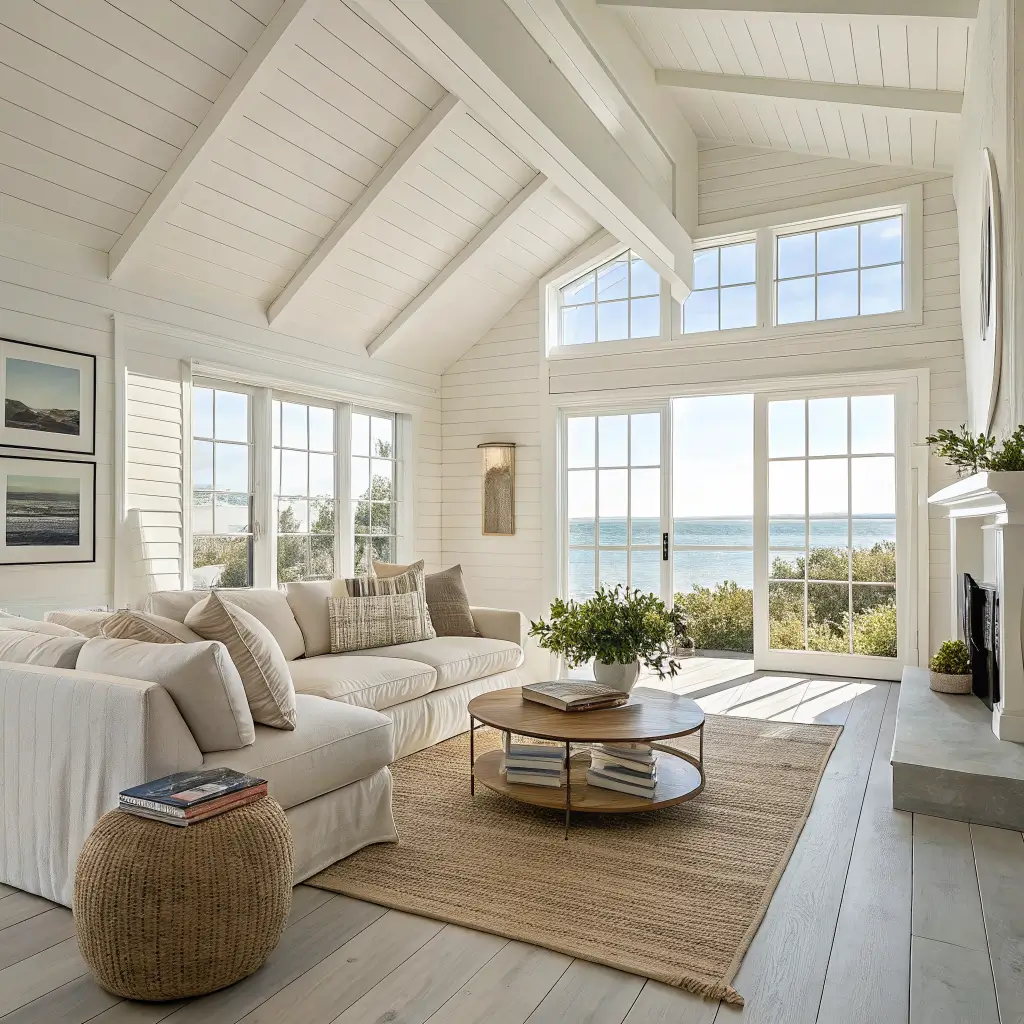
You want coastal minimalist decor because your house feels either too cluttered or too cold, and every “beachy” room on Pinterest looks like a Cape Cod gift shop threw up on it. I’ve been there. My first attempt at this style involved a rope-wrapped lamp, a sign that said “Beach This Way,” and a navy anchor pillow. It looked like a TJ Maxx clearance aisle. The version I live with now — soft white walls, a slubby linen sofa, one big horizon-line painting over the console — is what I should have done from the start.
Here’s how to actually pull it off.
Strip “coastal” down to its quietest parts — light, sand, weathered wood, the color of sea glass at dusk — and pair it with the editing discipline of minimalism. That’s the style. No anchors. No starfish. No driftwood lettering.
It’s airy. It’s calm. It leans on negative space (intentional empty areas on walls, shelves, and surfaces) to make rooms feel bigger and quieter.
Who this is for: anyone who wants a room that reads as relaxed and uncluttered without going full nautical. It works whether you live two blocks from the ocean or in a third-floor walkup in Chicago.
Where it shines: living rooms, bedrooms, bathrooms, entryways, sunrooms, and small home offices. Anywhere natural light can do the heavy lifting.
Time and cost: A weekend, if your furniture is roughly right. A styling refresh — pillows, baskets, a rug, one piece of art — runs $150 to $500. Replacing the sofa, rug, lighting, and tables with quality pieces lands closer to $1,500 to $6,000. One thing I’ll say upfront: this style rewards spending more on fewer things. A good linen-slipcovered sofa earns its keep for ten years. Five cheap throw pillows do not.
The Palette and Materials That Make It Work
Get these two right and you’re 80% there.
Colors:
– Base: soft white, ivory, cream, sand, warm gray, pale taupe
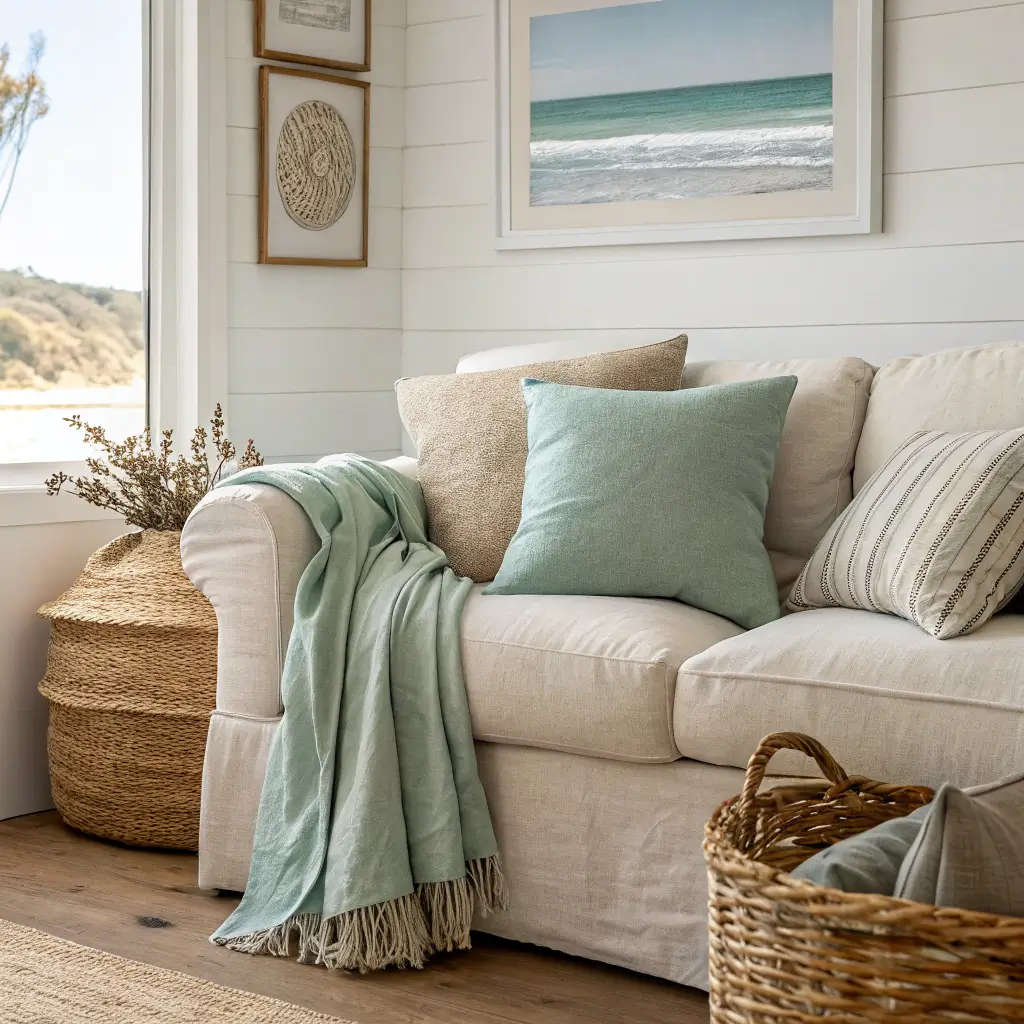
– Accents (use restraint): muted blue, sea-glass green, faded aqua
Skip bright primary blue. It reads cartoon-nautical. The blues you want look like they’ve been sun-bleached for a season.
Materials:
– Linen, washed cotton, gauze
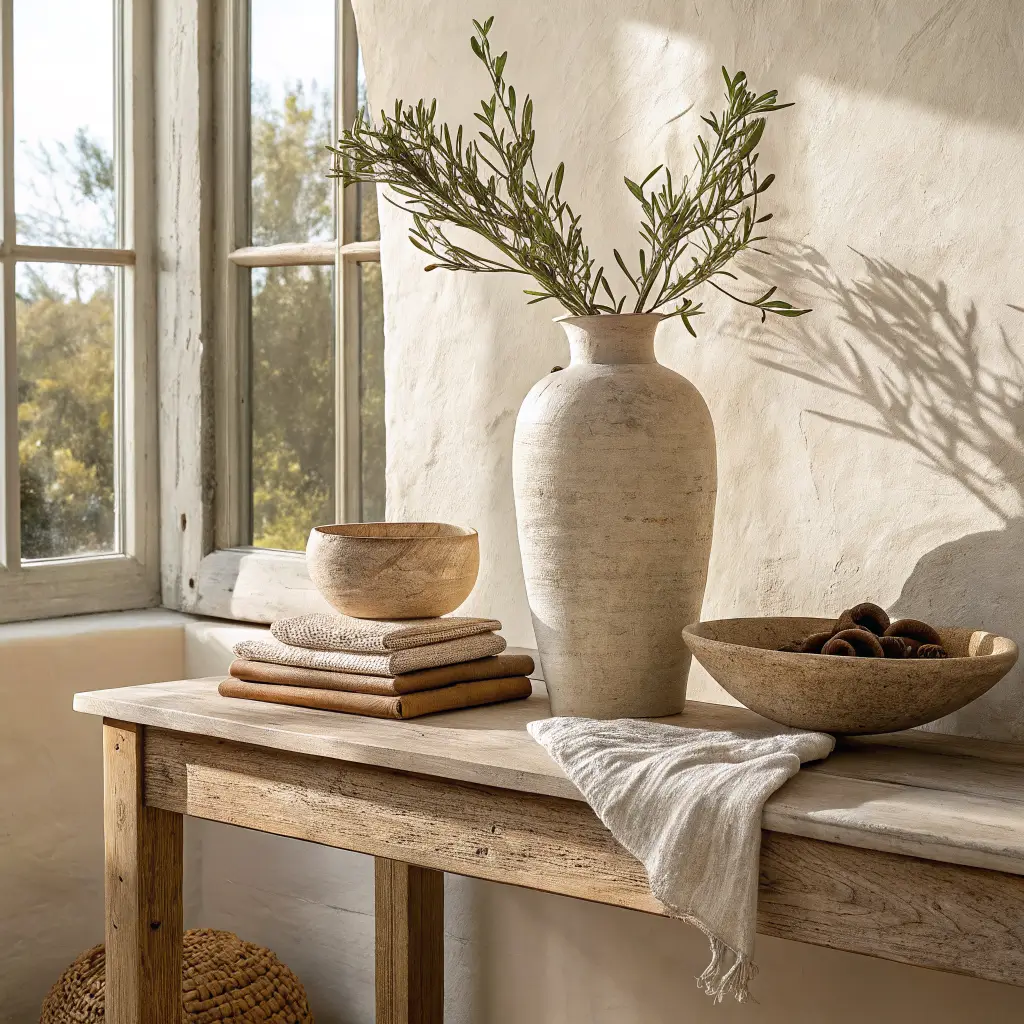
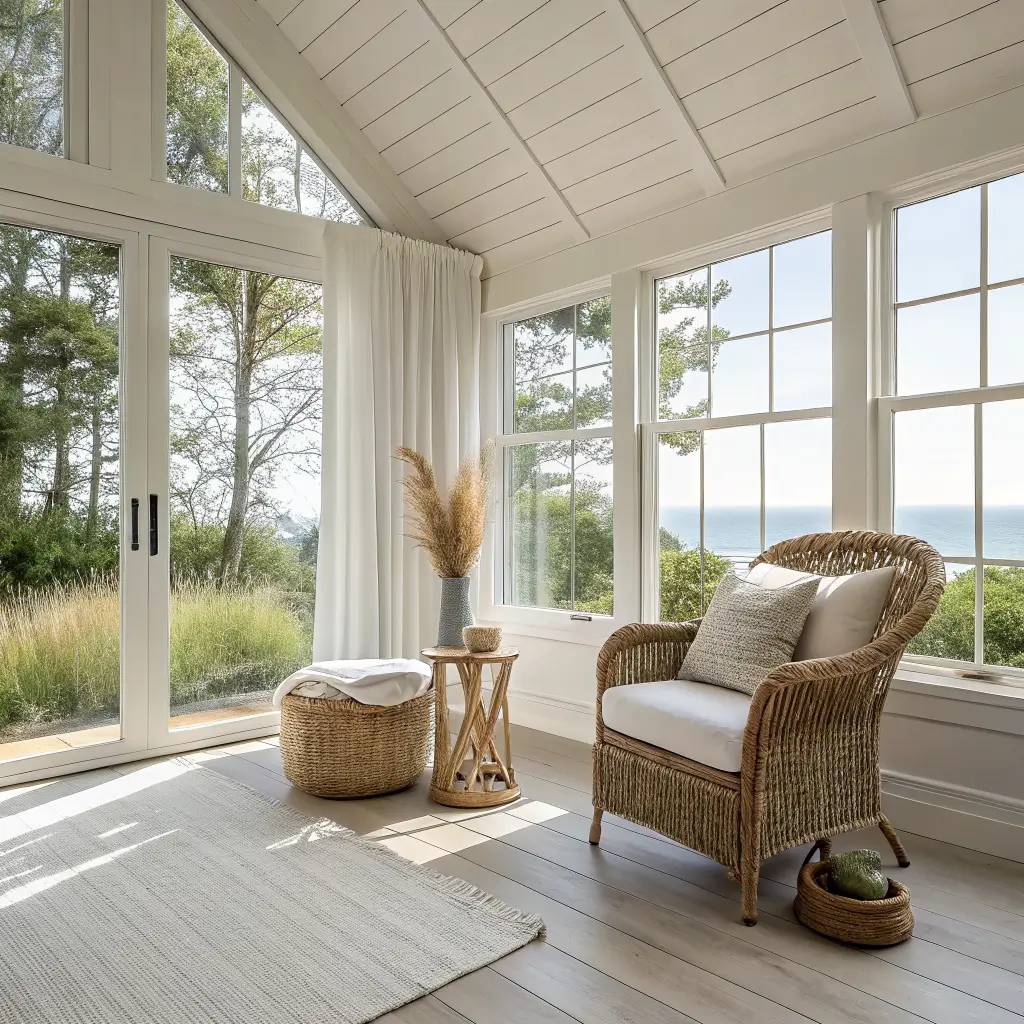
– Rattan, wicker, seagrass, jute
– Light oak, ash, bleached or reclaimed wood
– Matte ceramic, stoneware, unpolished glass
– Driftwood (one piece, not a collection)
The mix matters more than any single item. Linen against jute against oak against ceramic — that’s the recipe.
The Hero Pieces Worth Buying
If I were starting a living room from zero, I’d build it around these:
– A linen or washed cotton slipcovered sofa in oatmeal, white, or soft gray. Slipcovers matter because they wash. I have a dog.
– A light wood coffee table — oak, ash, or limed wood. Round or oval softens a room dominated by rectangles.
– A natural fiber rug. Jute for softness underfoot, sisal for durability, seagrass for the most coastal feel. Go one size bigger than you think. For most living rooms that’s 8×10, not 5×7. The front legs of your sofa and chairs should sit on it.
– Sheer or semi-sheer curtains in white or ivory, hung 4–6 inches above the window frame and puddling slightly at the floor. Cafe-length rod-pocket curtains kill this style.
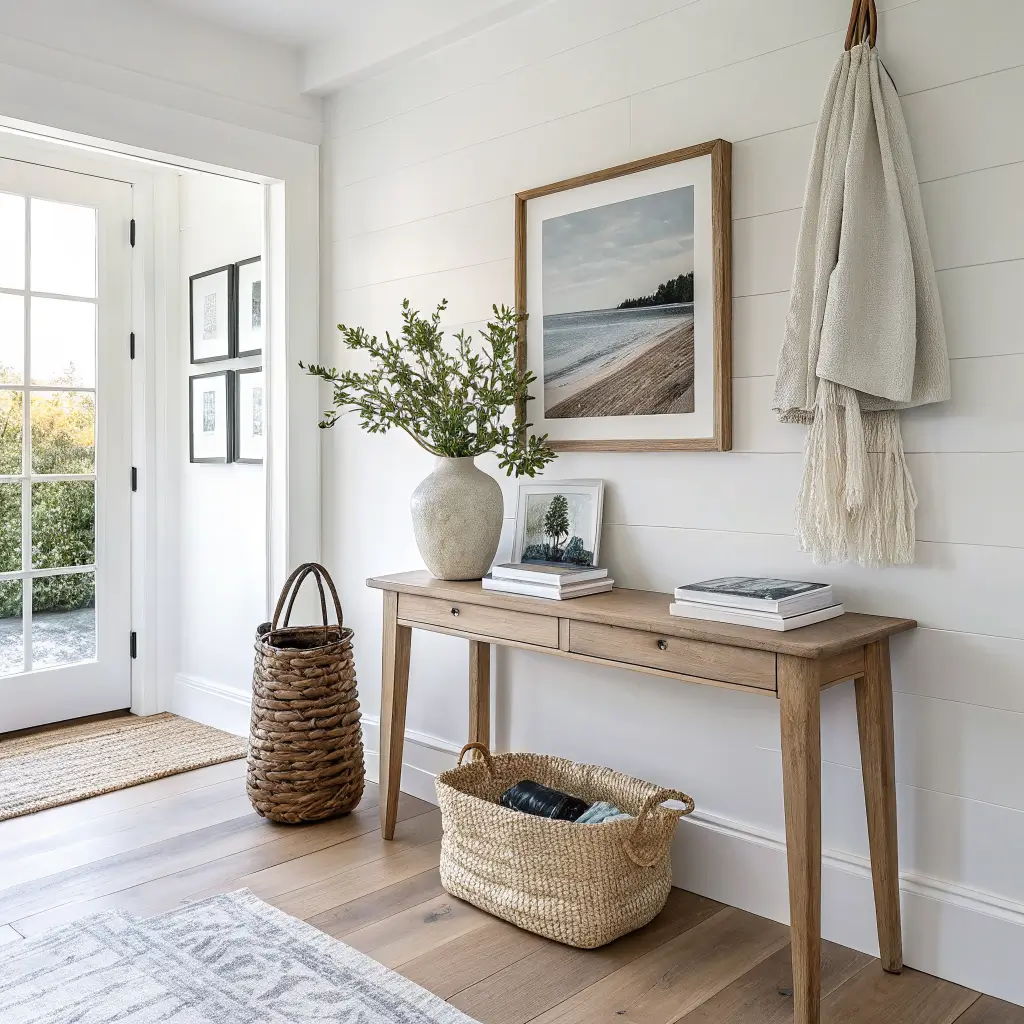
– One large piece of art instead of a gallery wall. Abstract seascape, soft horizon line, muted shoreline photography. Mine is a 40×60 inch hazy ocean print I found on Minted for around $200.
– Two or three woven baskets for blankets, mail, kid clutter — whatever needs to disappear.
– Matte ceramic vases in white, sand, or stone.
– Textured throws and pillows in linen, waffle cotton, or chunky knit.
That’s it. That’s the list. Resist adding more.
How to Actually Style the Room
I rearranged my own living room three times before it clicked. Here’s the order that finally worked:
1. Edit first, decorate second. Pull everything decorative off surfaces and walls. Everything. Put it in a box. Live with the empty room for a day. Then only put back what you genuinely like and use.
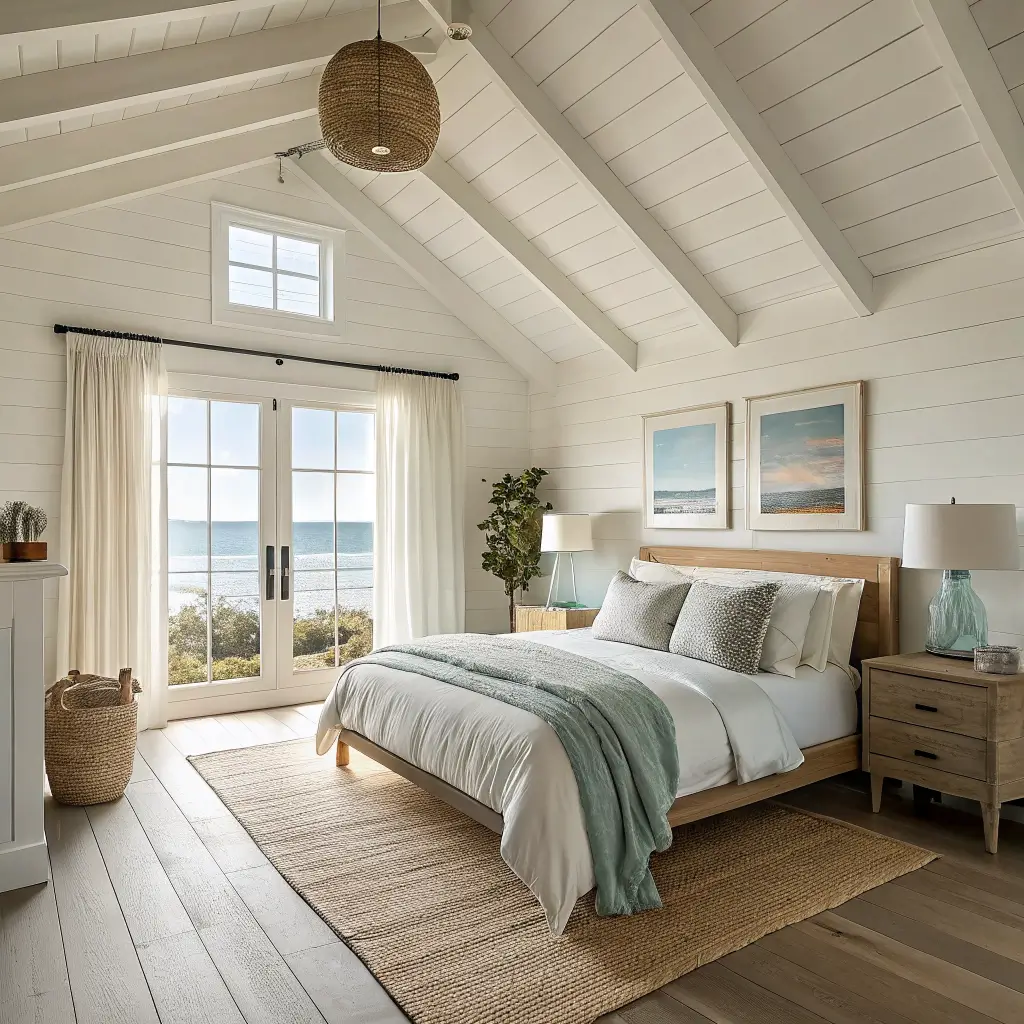
2. Place the big anchor. Sofa or bed, in your lightest neutral. Float it if the room allows — pushing every piece against a wall flattens the space.
3. Lay the rug. This defines the zone and adds the first layer of texture.
4. Add the wood and woven pieces. A coffee table, a side table, maybe a rattan accent chair. Don’t put rattan everywhere. Repeat each material two to three times, max. One rattan chair, one rattan basket, one rattan pendant. Done.
5. Hang the one big piece of art. Center it over the sofa, with the bottom edge 8–10 inches above the back of the sofa.
6. Style accessories in groups of one or three. A vase. A stack of two books with a small ceramic bowl on top. A candle. Never line things up evenly across a surface.
7. Stop one step before you think you’re done. Leave the empty corner. Leave the bare shelf section. That blank space is the style.
The 80/20 Rule I Live By
About 80% of the visible palette stays neutral. The remaining 20% is your coastal accent. One sea-glass green pillow, one muted blue art detail, a few stems of eucalyptus. That’s the entire color story.
Texture Is the Whole Game
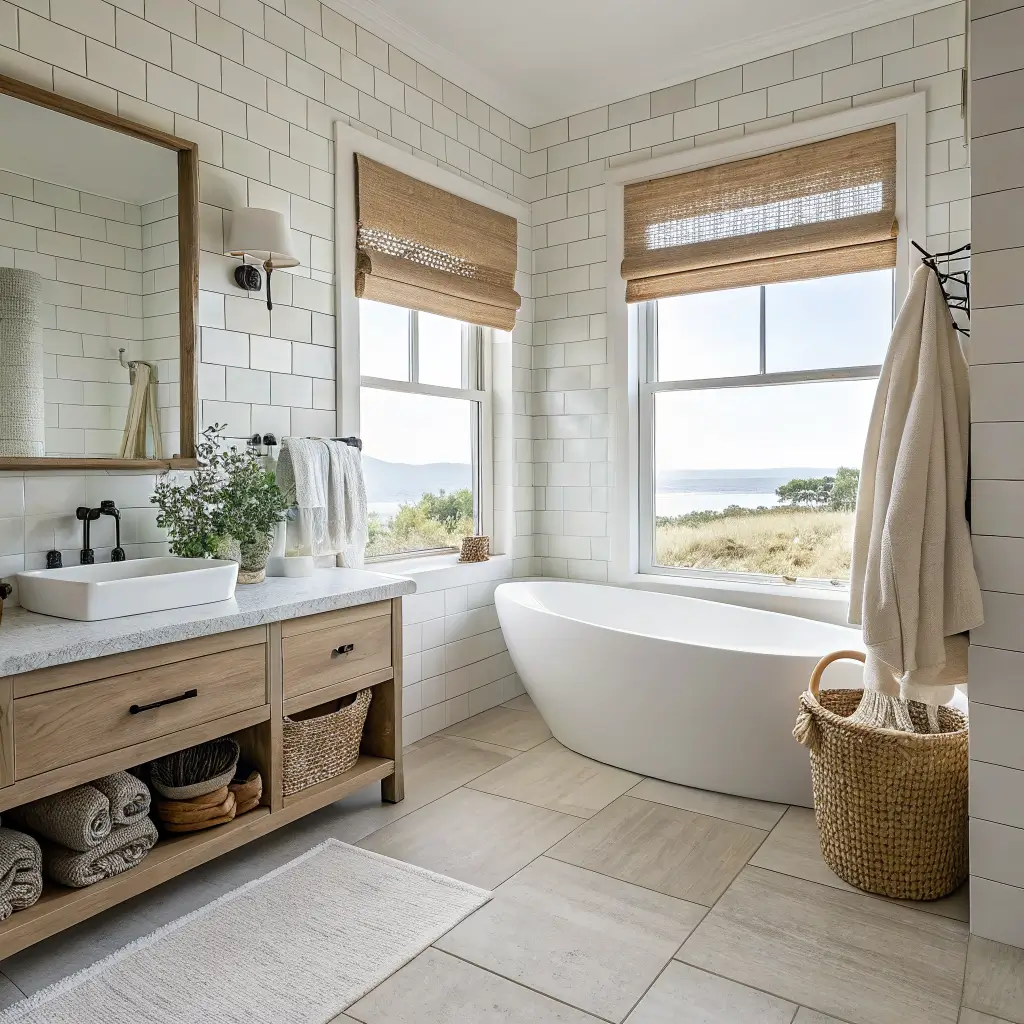
Without texture, this style goes from minimalist to sterile in a hurry. Pair smooth with rough on every surface:
– Linen pillow against a leather book
– Ceramic vase on an oak table
– Glass lamp base next to a rattan tray
– Jute rug under a washed cotton slipcover
Where to Spend, Where to Save
Spend on:
– The sofa. A quality linen slipcover ($1,500–$3,000) outlasts three budget sofas.
– The rug, if you’ll have it for years. A real wool-jute blend runs $400–$900 in 8×10.
– One good light fixture. A rattan pendant or oversized linen drum shade does a lot of work.
Save on:
– Baskets. HomeGoods, Target, thrift stores. Mine are mostly $15–$40 finds.
– Ceramic vases. Thrift stores are full of beautiful matte stoneware nobody wants.
– Art. Open-edition prints from Minted, Etsy, or even framed thrifted oil paintings of foggy coastlines.
– Throw pillows. H&M Home and Target’s Threshold line do linen-look covers for $15–$25.
The driftwood piece on my mantel? Found it on a beach in Oregon. Free, and it’s the most-complimented thing in my house.
Common Mistakes I See (and Made)
– Going nautical instead of coastal. No anchors. No ropes. No “Gone Fishing” signs. One coral sculpture or a single bowl of weathered shells is fine. A collection of them is not.
– Bright saturated blue. It fights the soft palette. Choose muted, sun-washed tones.
– Overfilling shelves. If a shelf looks “done,” remove one more thing.
– Forgetting texture. All-white linen, white walls, white ceramic, white rug — congratulations, you’ve made a hospital. Add jute, oak, woven anything.
– Heavy dark furniture. A walnut sideboard or a chocolate leather sofa kills the airy feel. Save those for a different style.
– Decor with no purpose. If you can’t say why something is on the table, take it off.
Easy Seasonal Updates
The point of this style is that you don’t redecorate — you swap small things.
– Spring/summer: Gauze curtains if you want them lighter, a linen throw replacing the chunky knit, fresh olive branches or eucalyptus, a sea-glass green pillow cover.
– Fall/winter: Heavier linen and a chunky cream knit throw, a pair of stoneware candleholders, dried wheat or pampas in a tall vase, swap in a warm taupe pillow.
A whole seasonal refresh costs me about $60–$100 because I’m only changing covers, stems, and one or two small objects.
Blending With Other Styles
Coastal minimalism plays well with others:
– Boho: add more weaving, a fringed throw, more plants. Keep the palette neutral.
– Scandi: lean harder into pale oak and white walls. Lose the rattan if it starts to feel too tropical.
– Warm minimalism: bring in mushroom, taupe, and more oak tones. This is the most current evolution of the style and where I’d push if you’re starting today.
– Modern: cleaner lines, more glass and brushed brass, fewer woven pieces.
Real Questions People Ask
Is coastal minimalism still in style?
Yes, and it’s actually leaned more current in the last couple of years by blending with warm minimalism and organic modern. The literal beach-cottage version is dated. The sand-and-linen version is everywhere.
Coastal vs. nautical — what’s the difference?
Nautical uses literal sea symbols: anchors, ropes, navy and red, ship wheels, signal flags. Coastal evokes the feeling of being near water through light, color, and natural materials. Minimalist coastal pushes that even further by stripping out anything decorative that isn’t earning its place.
How do I do this in a small space?
This style was practically built for small rooms. Light walls, sheer curtains, one bigger rug instead of a small one, leggy furniture you can see under, and ruthless editing. A small room with three things in it feels bigger than a small room with thirty.
How do I keep it from feeling boring or sterile?
Texture, texture, texture. And one piece with personality — a sculptural lamp, an interesting vintage stool, that weird piece of driftwood. Minimalism without character is just empty.
What if I rent?
Almost all of this works in a rental. Slipcovered sofa, rugs, curtains hung with tension rods or removable hooks, art on adhesive strips. The only thing you can’t easily do is wall color, and white-leaning walls are usually already there.
The biggest shift in my own house came when I stopped trying to decorate every surface and started protecting empty space like it was a piece of furniture itself. Once you see negative space as the design choice, the whole style clicks.
Conclusion
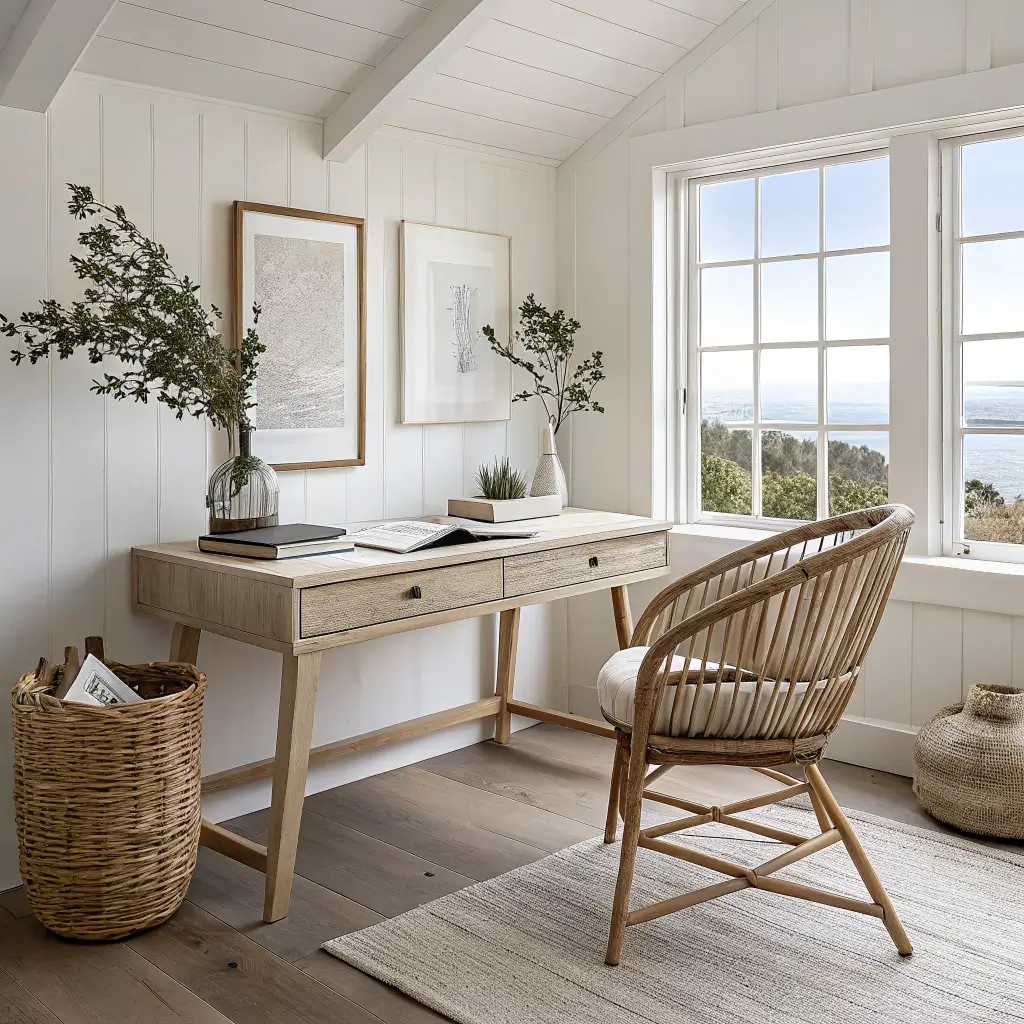
The coastal minimalist decor I aspire to lives in a house where the walls are white, the floor is bleached oak, and the only furniture is a low sofa, a single ceramic lamp, and a window that looks directly at the water. The owner has one painting — a small watercolor of a wave — and a stack of books about sailing. There are no shells, no anchors, no signs. The view is the decoration, and the room knows enough to stay quiet.
More Decor Ideas to Explore
- Boho Coastal Decor: A Real Guide to Getting the Layered, Beachy Look Right
- Coastal Farmhouse Decor: How to Mix Beach and Rustic Without It Looking Like a Souvenir Shop
- The Complete Guide to Modern Coastal Home Decor (Without the Beach-Theme Cheese)
- Very Tiny Bathroom Ideas: How to Style a Micro Bath That Actually Works