What the Look Is and Who It’s For
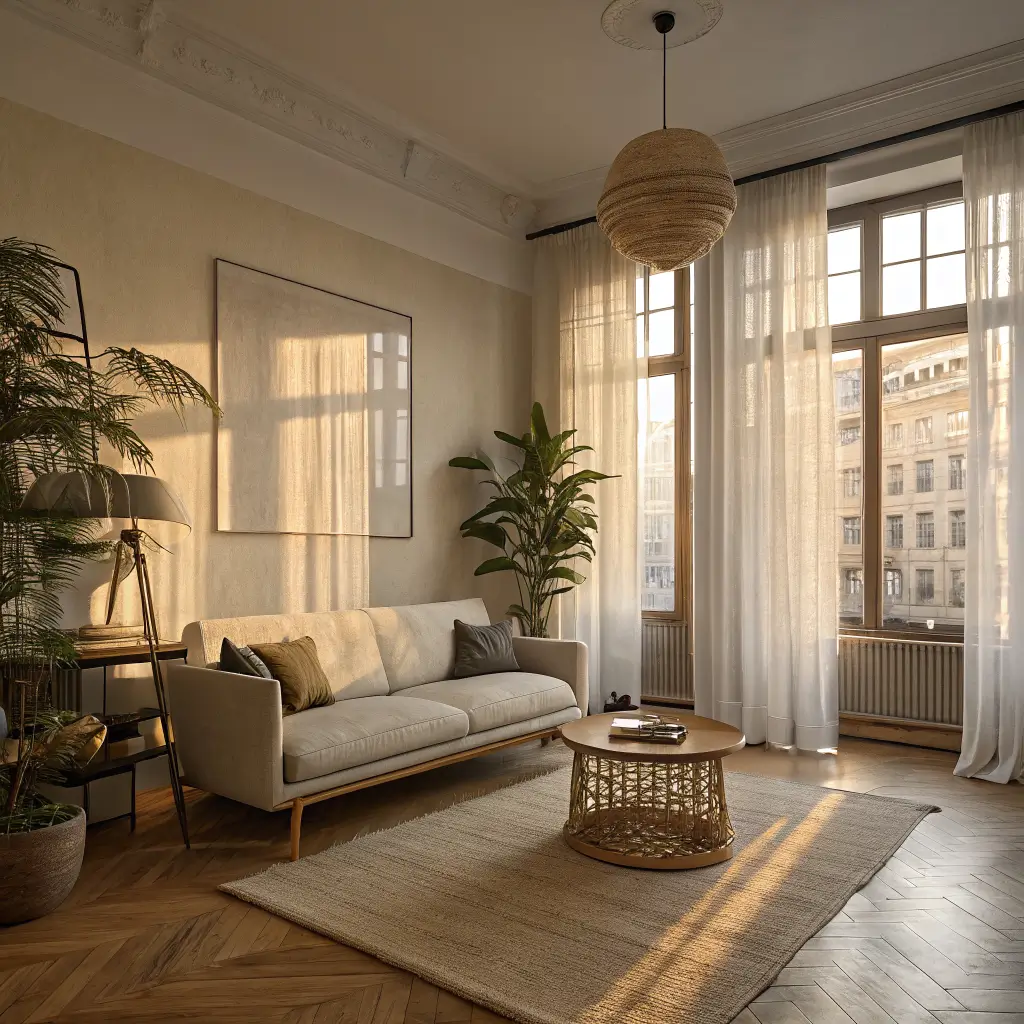
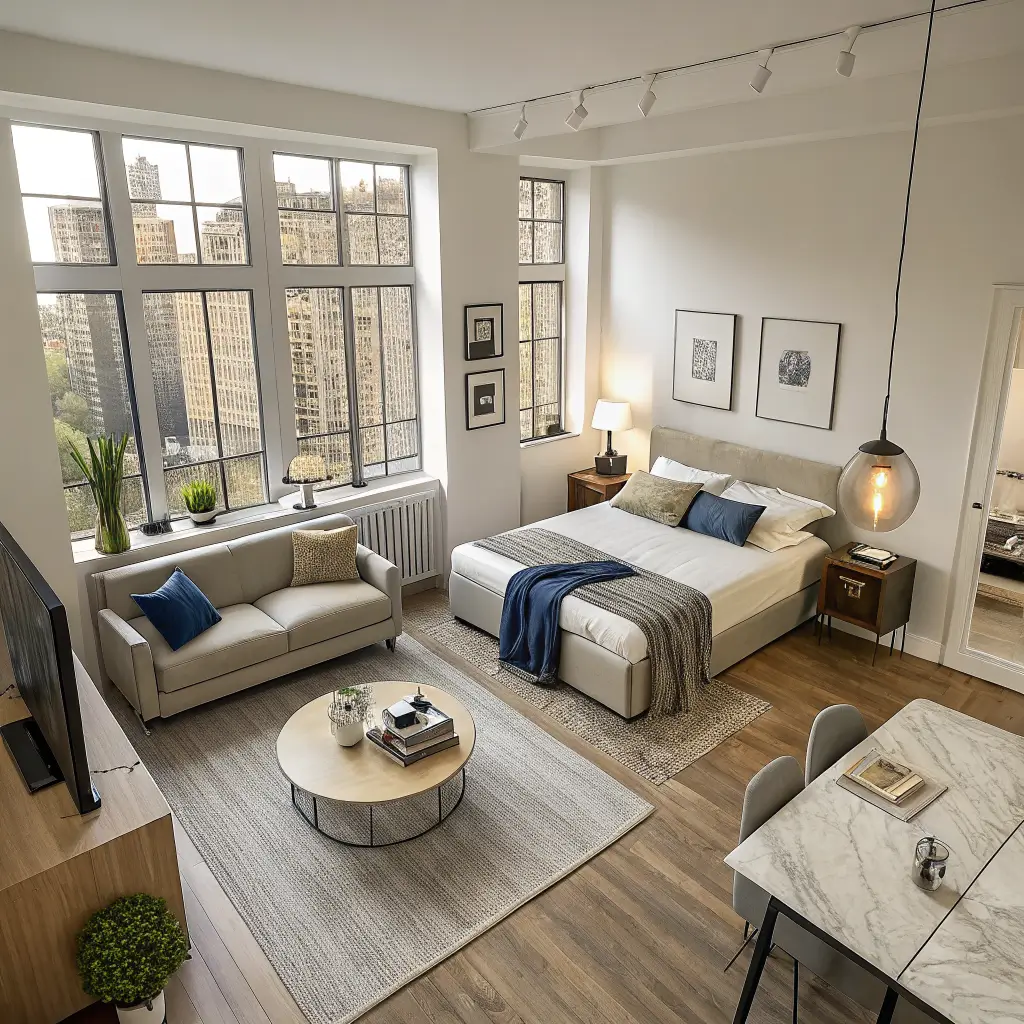
It’s a hybrid: soft minimalist bones, Scandi warmth, and the layered, lamp-lit thing you’ve been scrolling past on TikTok. Uncluttered surfaces. Rounded furniture. Warm neutrals instead of cold greys. Lighting low and everywhere except the ceiling.
It’s for renters, first apartments, studios, and anyone in 250–650 sq ft who wants the place to feel bigger and softer without renovating anything.
Where it lands best:
– Studios where living and sleeping share a room
– Small living rooms or “living corners” inside a bigger room
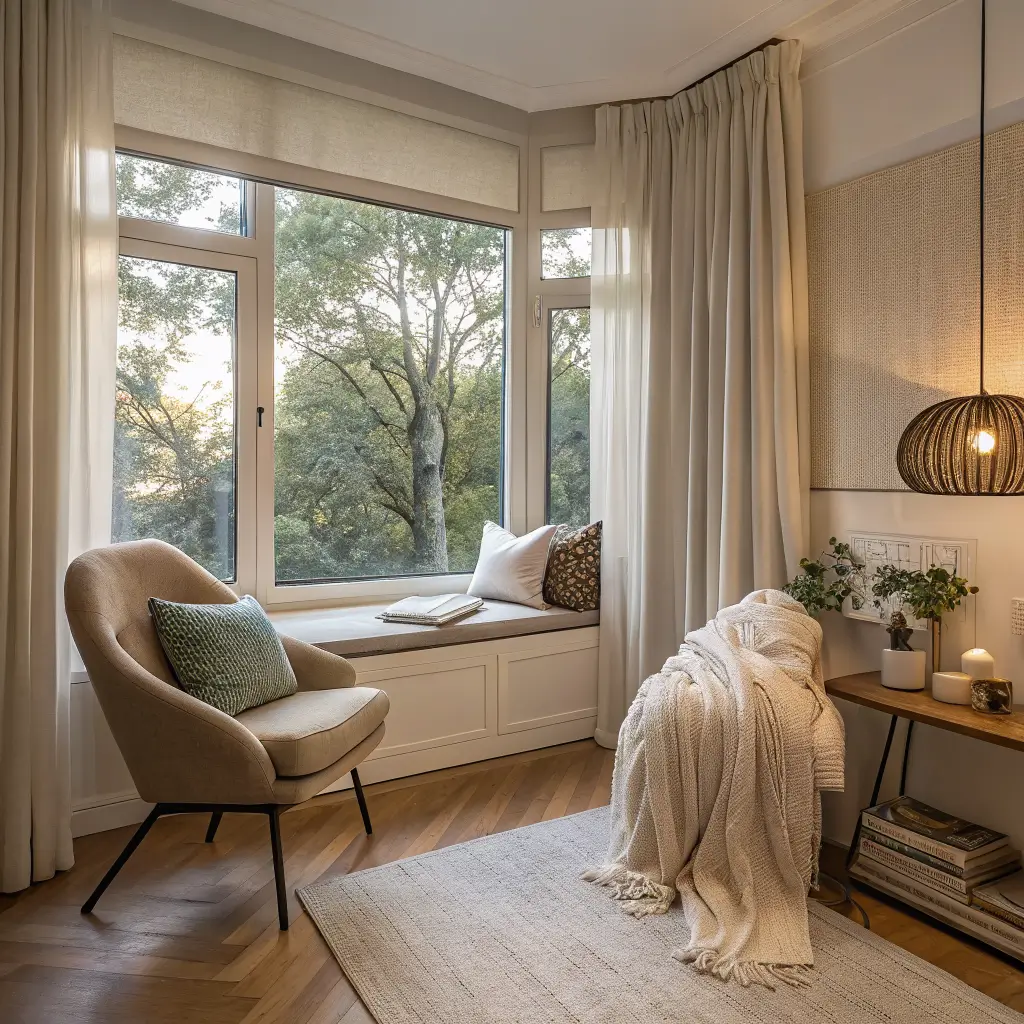
– Bedroom-plus-nook setups (window bench, reading chair)
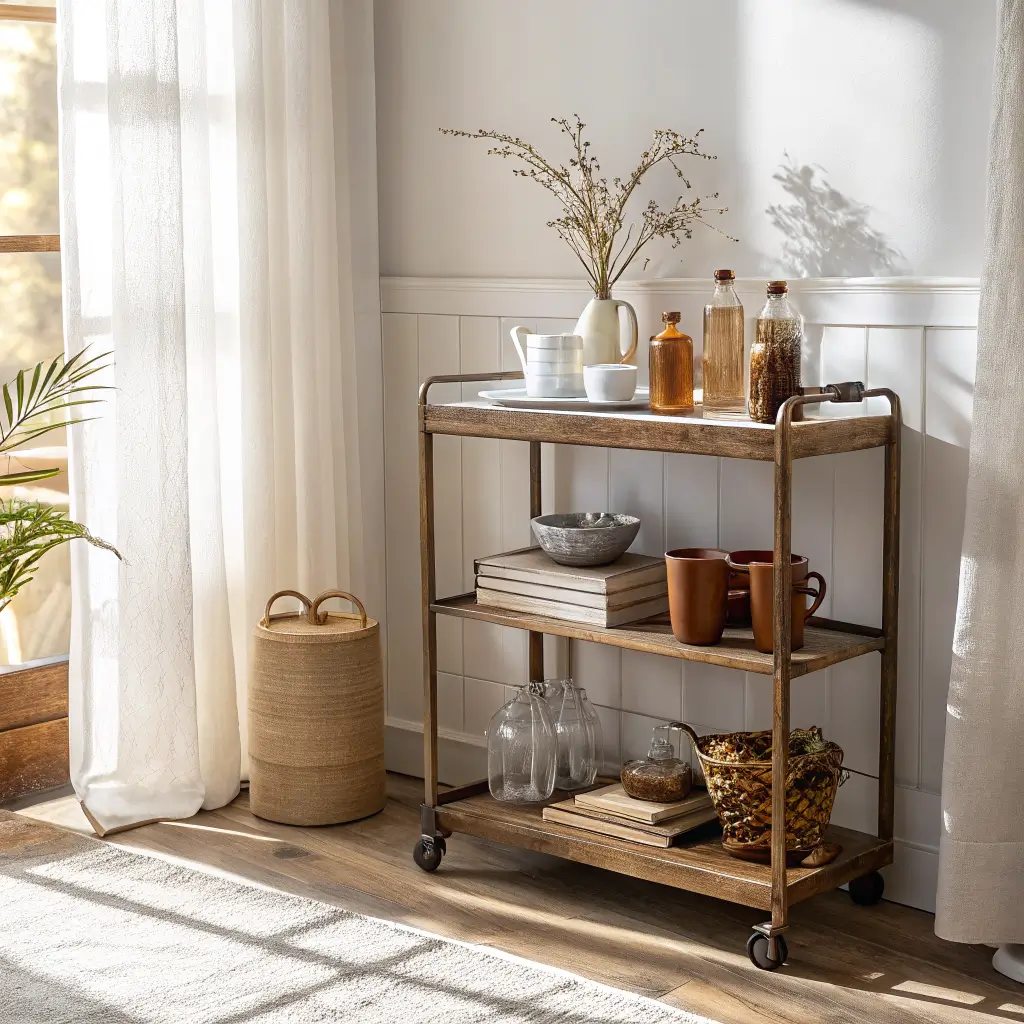
– Tiny kitchens with one open shelf or a styled bar cart
Time, Money, and Skill Level
A mini refresh, the kind where you swap pillow covers, add string lights, change out a lampshade and rehang art, takes 3–5 hours in a weekend afternoon.
A full overhaul — rearranging, adding a sofa or storage piece, building a gallery wall — runs one to two weekends depending on how much you assemble yourself.
Budget tiers, based on what I’ve actually spent or seen people spend:
– $150–$400 (budget refresh): Pillow covers $12–25 each from H&M Home or IKEA, fairy lights $10–25, poster prints $15–35 from Desenio or Target, IKEA LILL sheer curtains $9 a pair. Yes, $9.
– $400–$1,000 (mid-range): Compact sofa $300–700, storage coffee table $90–250, 5’×7′ washable rug $80–200 (Ruggable holds up, my Rugs USA jute did not), floating shelves $40–180.
– $1,000–$2,500 (upgrade): Design-forward loveseat or daybed $900–1,500, armless accent chair $180–450, slim media console $250–600.
Skill-wise: beginner for textiles, peel-and-stick, plug-in sconces, LED strips. Intermediate if you’re doing wall anchors, gallery walls, and curtain rods.
The Palette: Warm Neutrals, Not Grey-on-Grey
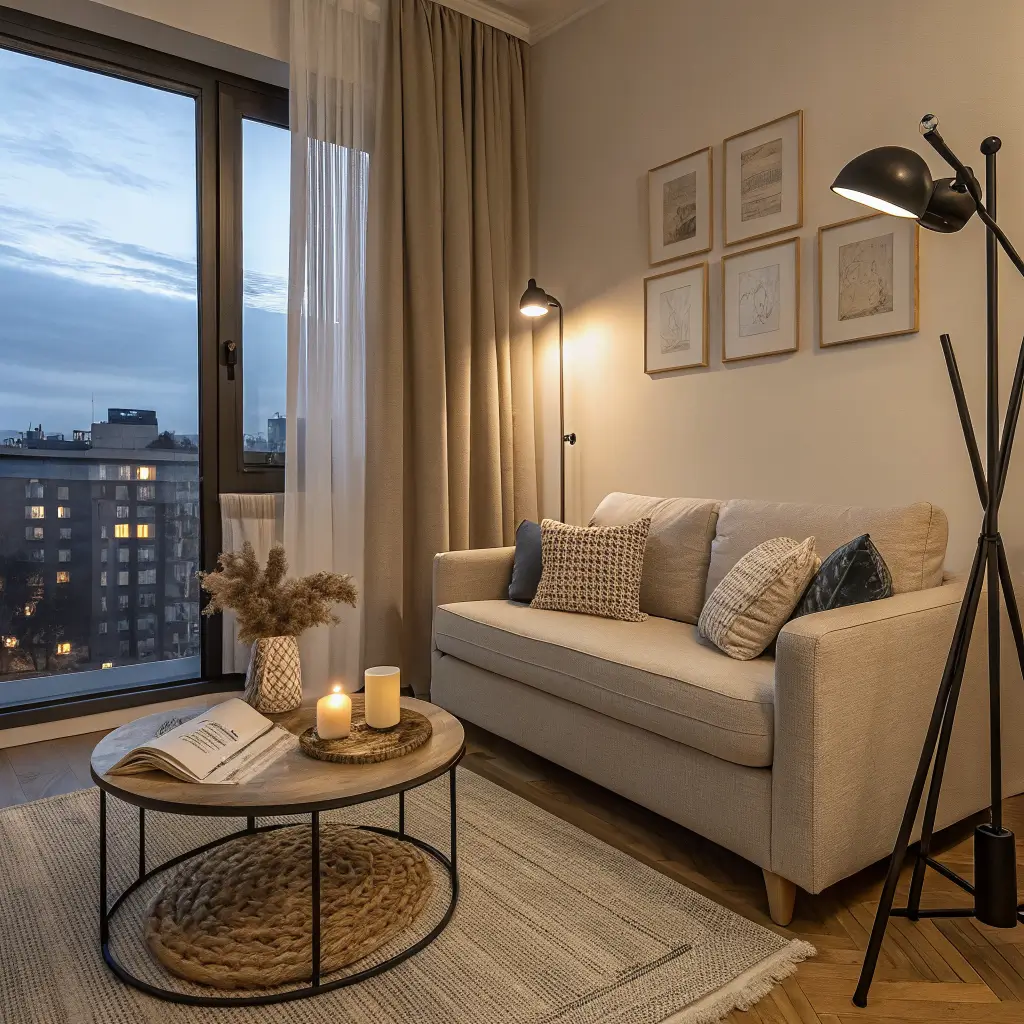
If your apartment feels “off” and you can’t figure out why, it’s probably the color temperature. Cool greys and stark whites read clinical under apartment lighting. Switch to warm neutrals and everything softens.
Walls (if you can paint): Swiss Coffee, Alabaster, or Cloud White in a matte finish. Eggshell if your walls are beat up — it hides texture.
Main fabrics and rug: greige, oatmeal, latte, mushroom.
Accents — pick two, max:
– Soft terracotta or clay (ceramics, one pillow cover)
– Smoky blue or muted sage (textiles, art)
– Charcoal or matte black in tiny doses — frames, a lamp base, hardware
The rough ratio I aim for: 70% light neutrals, 20% mid-tones, 10% dark accents. When a room feels flat, it’s usually missing the 10%. When it feels heavy, the 10% has crept up to 25.
The Hero Pieces
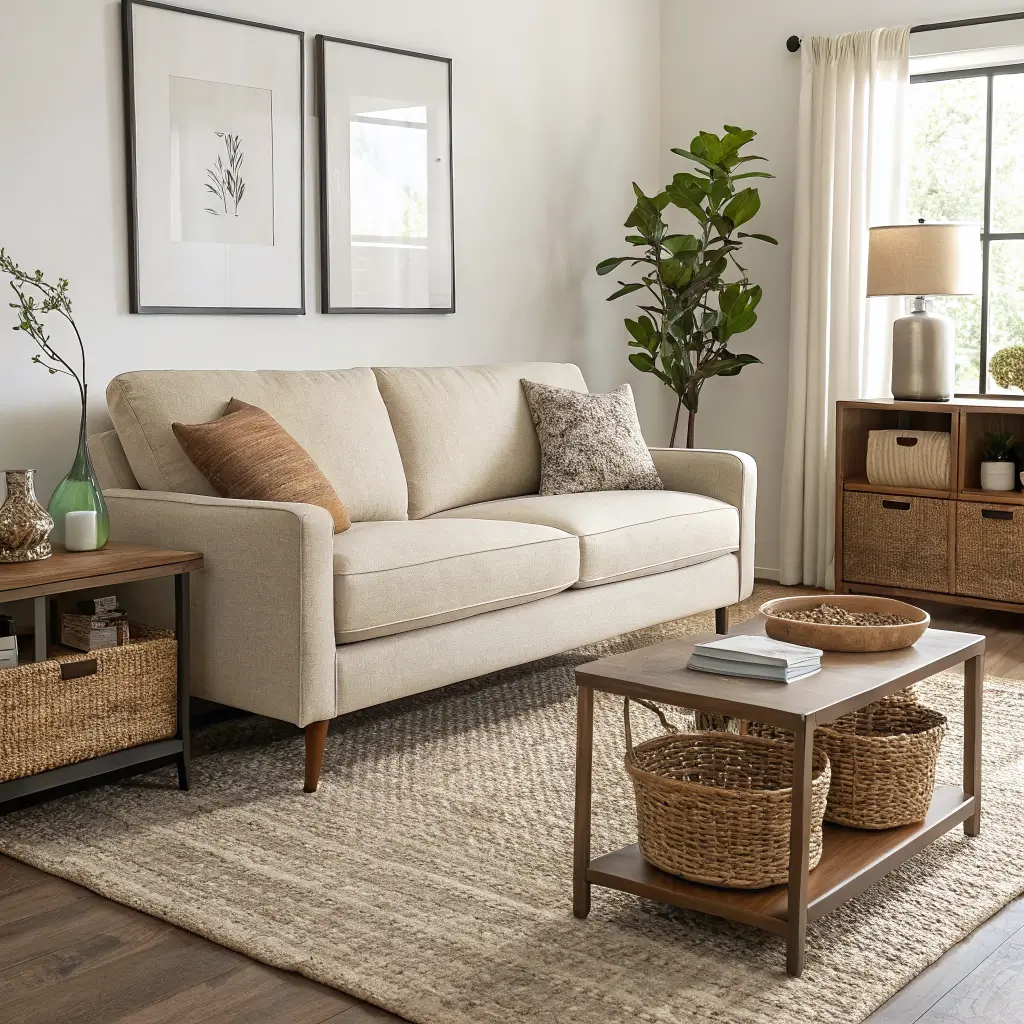
These are the four things to get right before you worry about anything else.
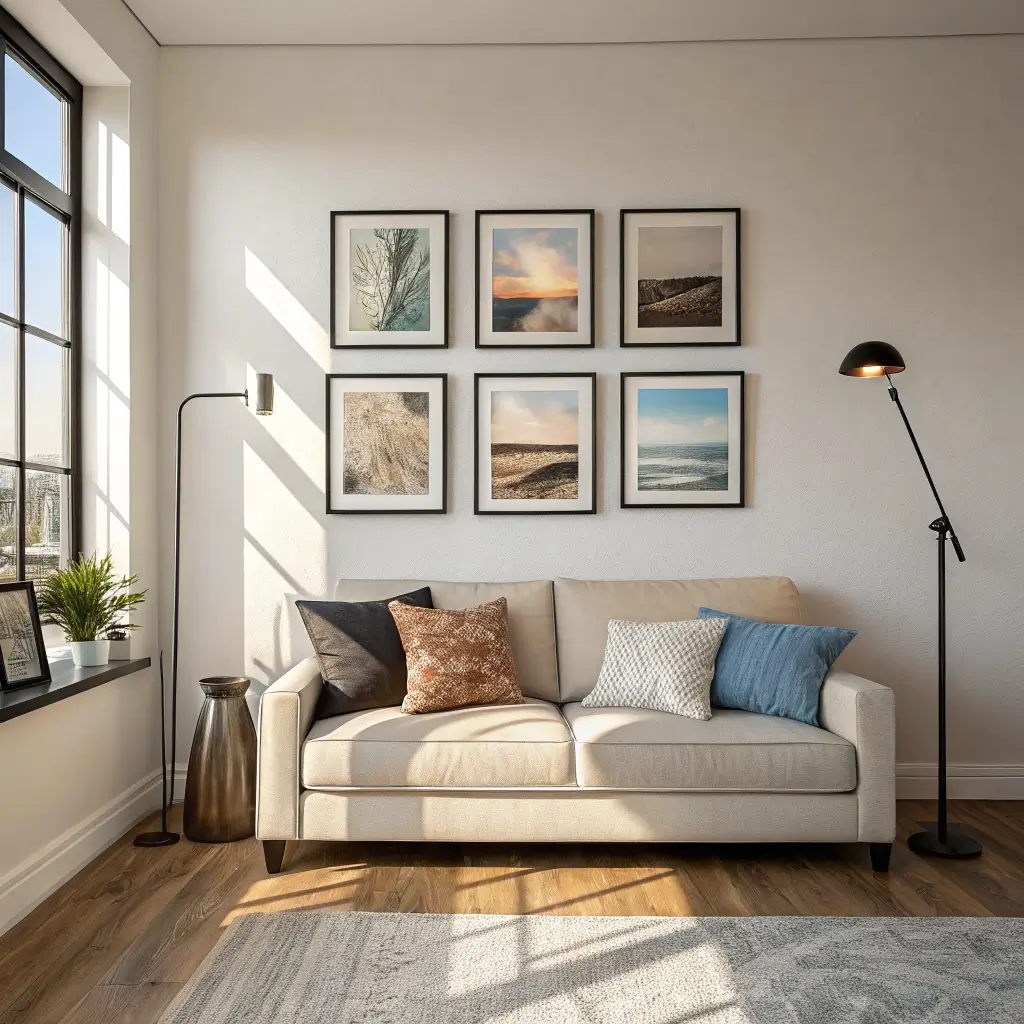
1. A compact sofa or loveseat, 60"–72" wide. Slim arms, raised legs you can see the floor under. A skirted sofa in a small room reads like a parked van. Greige or oatmeal performance fabric if you have any kind of life happening on it.
2. A multi-functional coffee table. Round or oval — corners eat walking space and shins. Look for a lower shelf or hidden storage. I went through three coffee tables before landing on a round one with a rattan shelf underneath, which holds two baskets I actually use.
3. A rug that’s big enough. This is the single biggest mistake I see. A 3’×5′ rug floating under the coffee table makes the room look like a doll’s house. Get a 5’×7′ minimum, ideally 6’×9′, and slide the front legs of the sofa onto it. The room will instantly feel anchored.
4. A slim media console or wall-mounted TV unit. 40"–60" wide, 12"–16" deep. Anything deeper is stealing your walkway.
Lighting Is the Whole Game
If you take one thing from this: stop using your overhead light. That single bulb in the ceiling makes every small apartment look like a leasing office.
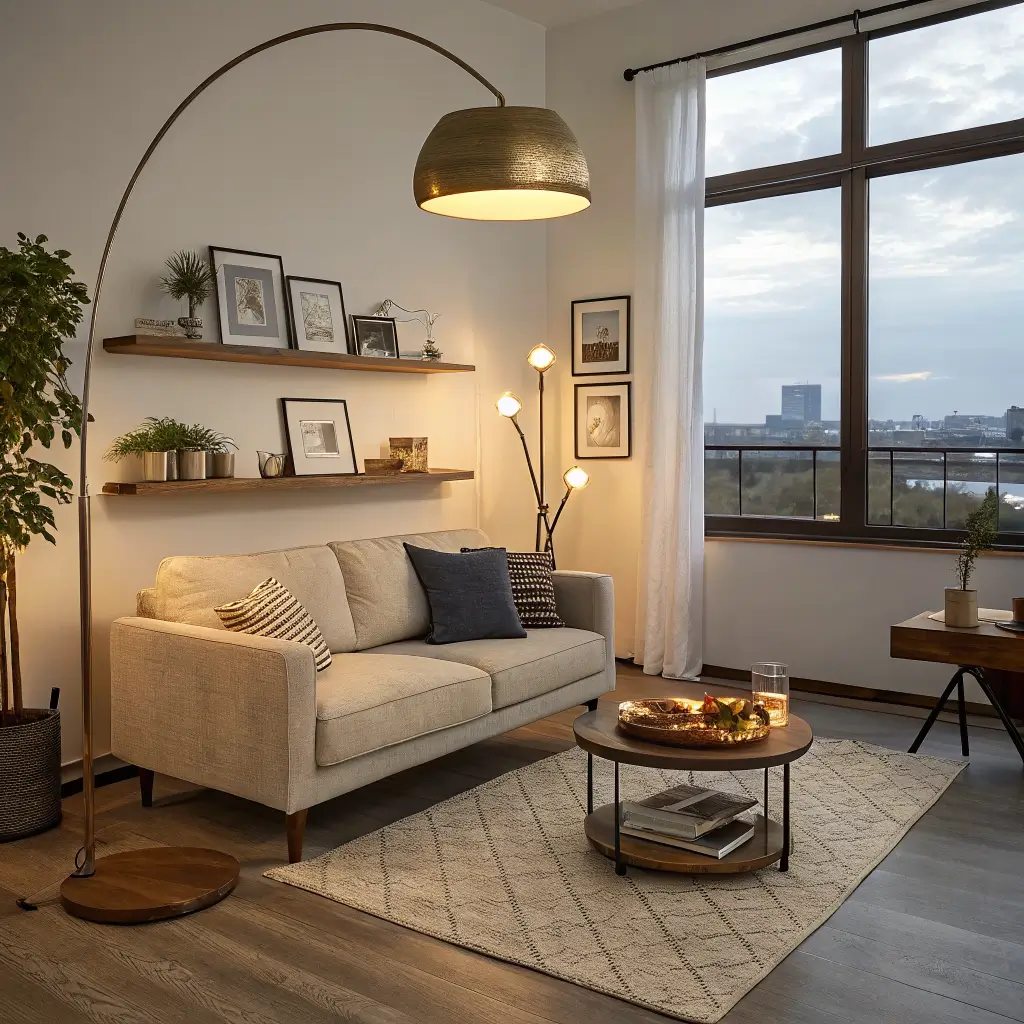
Layer three light sources at three heights:
– Floor lamp in the sofa corner, arched or slim-base
– Table lamp on the console or a side table
– Ambient layer — fairy lights along a shelf, an LED strip behind the headboard, or a plug-in wall sconce
Bulb color matters. Use 2700K warm white everywhere. Not 3000K, not “daylight.” 2700K. This one swap does more for the aesthetic than any piece of furniture.
How to Actually Put It Together
Step 1: Clear the room completely. Everything that can move, moves. You can’t plan around clutter you’ve stopped seeing.
Step 2: Place the sofa first. Against the longest uninterrupted wall, or — in a studio — floating with its back to the bed to carve out a “living room” zone. Leave 14–18 inches between sofa and coffee table for legs.
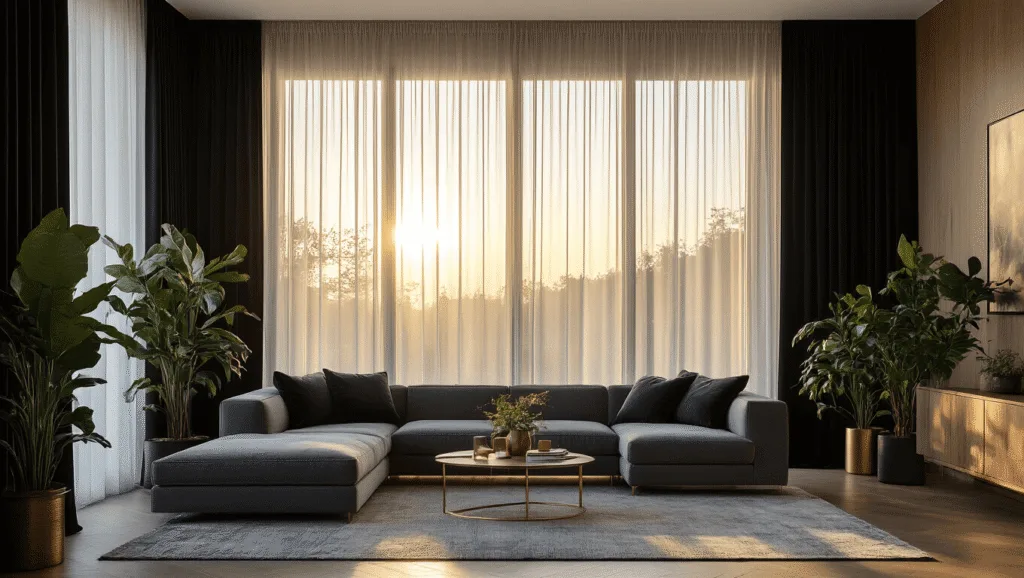
Step 3: Hang curtains high and wide. Rod 4–6 inches above the window frame, extending 6–8 inches past each side. Panels should kiss or puddle on the floor. Sheer white or off-white. This single move makes ceilings look taller than almost anything else.
Step 4: Build the focal wall. Above the sofa, either one larger piece (24"×36") or a 3–5 piece gallery wall with matching frames. Center the art at roughly 57 inches from the floor. People hang art way too high — that’s almost always why a wall feels awkward.
Step 5: Style the soft layer. Two to four pillows in mixed textures (one bouclé, one linen, one knit), varied sizes — a 20" square plus a lumbar reads more intentional than four matching squares. One throw, draped diagonally on the arm. Not folded in a neat triangle. Looser.
Step 6: The coffee table tray. A tray with a candle, a small stack of books, and one organic element (a low ceramic vase with dried grasses, or a small trailing plant). Three items. Done.
Step 7: Plants at three heights. One floor plant (a 4-foot snake plant in the empty corner past the sofa is foolproof — mine has survived three moves and one bout of total neglect), one on the console, one trailing from a high shelf. Faux is fine if your apartment has no light. Just spend the extra $15 on the realistic kind; the $8 ones look like cake decorations.
Mistakes I Made So You Don’t Have To
Too many small pieces. I once had a tiny side table, a tiny stool, a tiny pouf, and a tiny plant stand all in one corner. It looked like a yard sale. I swapped all of it for one round bouclé pouf and the corner finally breathed.
Rug too small. My first apartment rug was 3’×5′. I told myself it “defined the seating area.” It defined nothing. Size up.
Decorating every surface. Shelves crammed with trinkets shrink a room visually. Group decor in odd-numbered clusters of 3 or 5 and leave actual empty space between them. Negative space — the empty area around objects — is what makes a styled shelf look styled instead of busy.
Ignoring the walls. In a small apartment, vertical real estate is everything. Floating shelves 9–12" deep, hooks behind doors, a tall leaning mirror (60"–70") in a corner to bounce light.
That one harsh ceiling light again. Turn it off. Forever.
Renter-Friendly Moves When You Can’t Drill or Paint
– Peel-and-stick wallpaper on one wall behind the bed or in a kitchen nook
– Plug-in sconces with cord covers painted to match the wall
– Command hooks rated for the actual weight — the picture-hanging strips hold more than you think
– Tension rods for curtains if you can’t drill above the window
– Contact paper over ugly laminate counters or a builder-grade bathroom vanity
– A tall leaning mirror instead of a hung one
Easy Seasonal Swaps
Don’t redecorate. Swap three things:
– Fall/winter: chunky knit throw, pillow covers in rust or forest green, amber glass candle, faux pampas in a tall vase
– Spring/summer: cotton waffle throw, muted pastel or cream pillow covers, fresh eucalyptus or olive branches, a lighter scent
Pillow covers (not whole pillows) are the cheat code. A set of four covers runs $40–60 and changes the whole room.
Cross-Style Blends If Strict Minimalism Isn’t You
– Boho-leaning: add a vintage Moroccan-style rug, a macramé piece, more plants — keep the furniture lines clean
– Coastal-leaning: light wood, seagrass baskets, soft blue and cream stripes, no nautical kitsch
– Modern/industrial: black metal legs, a concrete-look planter, graphic black-and-white prints — keep the lighting warm or it tips cold
A Few Real Questions Worth Answering
How do I make a tiny apartment look aesthetic without spending a lot?
Lighting and textiles. A $25 lamp with a warm bulb, a $30 set of pillow covers, and $20 of string lights will do more than a $400 accent chair.
How do I divide a studio into bedroom and living zones?
Use the back of the sofa as the divider. A 6’×9′ rug under the living side reinforces the boundary. Skip room dividers — they block light and make both halves feel smaller.
Where does the TV go when there’s only one wall?
Wall-mount it. A slim console underneath holds the rest. Don’t fight a small room with a giant media center.
How do I add personality if I can’t drill?
Leaning art on a console or floating shelf, peel-and-stick wallpaper on one wall, a bold rug, and a single statement lamp. Personality lives in your specific objects — the weird ceramic mug from a trip, the secondhand book stack — not in built-ins.
The little apartment aesthetic isn’t really about smallness. It’s about deciding what each piece is doing in the room, and getting rid of anything that’s just taking up space because you haven’t gotten around to dealing with it yet. Start with the rug, the lamp, and the curtains. The rest follows.
Conclusion
The little apartment aesthetic that felt like home to me was a three-hundred-fifty square foot studio with a Murphy bed, a small table for two, and a single window that looked at a tree. The owner had painted the walls white, added a rug that defined the living area, and hung a single piece of art that she had drawn herself. The room felt like her, not like a magazine, because every object had a story.
More Decor Ideas to Explore
- Little Bathroom Ideas That Actually Work: Smart, Stylish Updates for Tight Spaces
- Tiny Laundry Room Ideas: A Real Plan for Closets, Alcoves, and Awkward Corners
- Coastal Farmhouse Decor: How to Mix Beach and Rustic Without It Looking Like a Souvenir Shop
- 16 Lake House Bathroom Ideas That Feel Like a Morning Swim