Modern Coastal Decor: A Real-World Guide to Getting the Look Right (Without the Beach-Theme Cringe)
Modern coastal decor is what most people actually want when they say “beachy” — calm, light-filled, layered with natural textures — but without the rope-wrapped lamp shaped like a lighthouse. I learned that the hard way. My first attempt at a coastal living room, about six years ago, involved a navy-and-white striped rug, three different starfish wall hangings, and a sign over the doorway that said “The Beach Is Calling.” It looked like a rental in Destin. I’ve since redone that same room three times, and the version that finally stuck is the one I’m walking you through here.
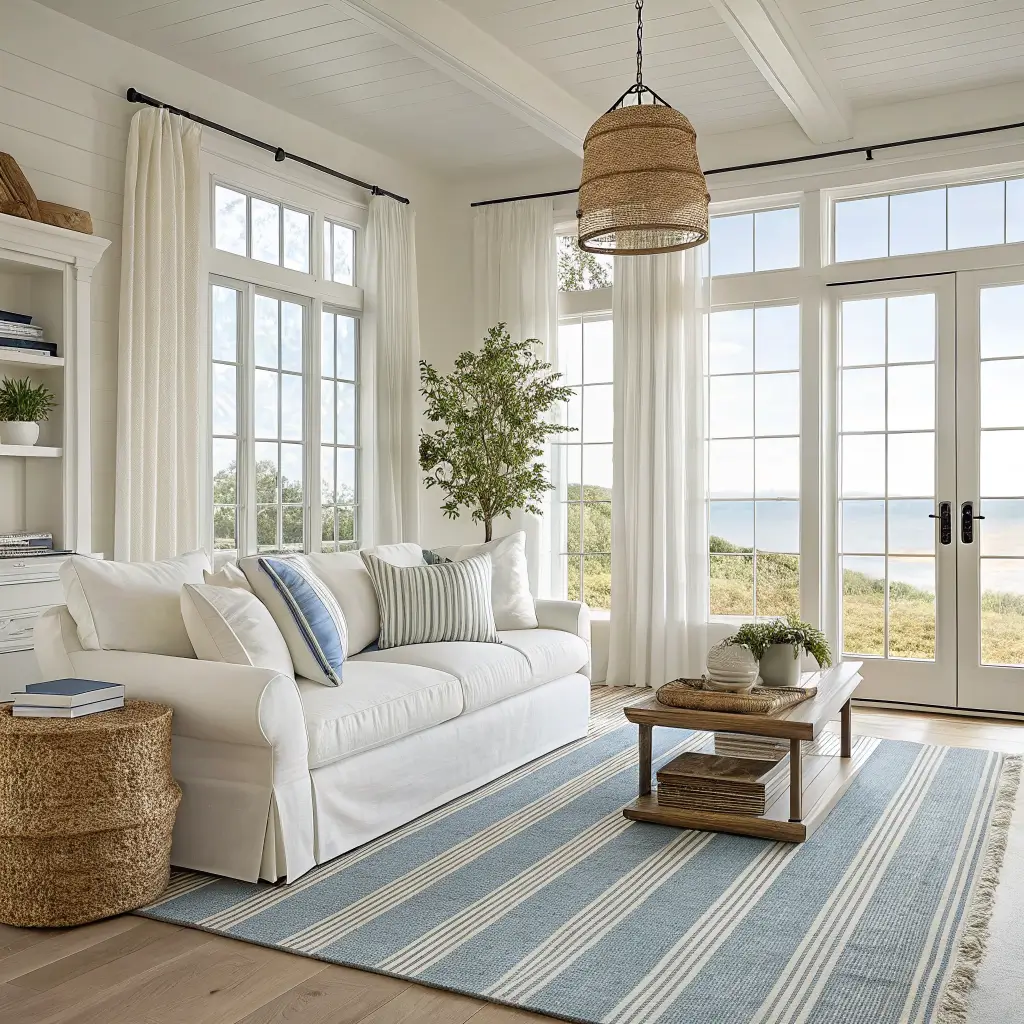
This is the airy, grown-up version of coastal: light wood, slipcovered seating, woven everything, muted blues used like a whisper instead of a shout.
Who This Style Is For
If you want a room that feels like a deep exhale — uncluttered, breezy, and not tied to a specific season — this is the look. It works for:
– Renters who can only change paint, textiles, and accessories
– Families that need washable upholstery and durable rugs
– Anyone who likes the feeling of the coast but hates literal beach motifs
– People in apartments and inland homes, not just beach houses
I’ve done this in a 10×12 condo living room and in a 22-foot open-plan space. Both worked. The style scales.
Year-round, not seasonal. That’s the whole point. You shouldn’t have to box anything up in October.
What It Actually Costs
I’m going to be honest about prices because most articles aren’t.
Budget refresh: $400–$1,000
Mostly textiles and accessories on an existing room.
– 8’×10′ jute rug: $200–$350 at Target, Wayfair, or IKEA
– Framed coastal print: $40–$120
– Seagrass baskets: $30–$80 each
Mid-range full room: $2,000–$6,000
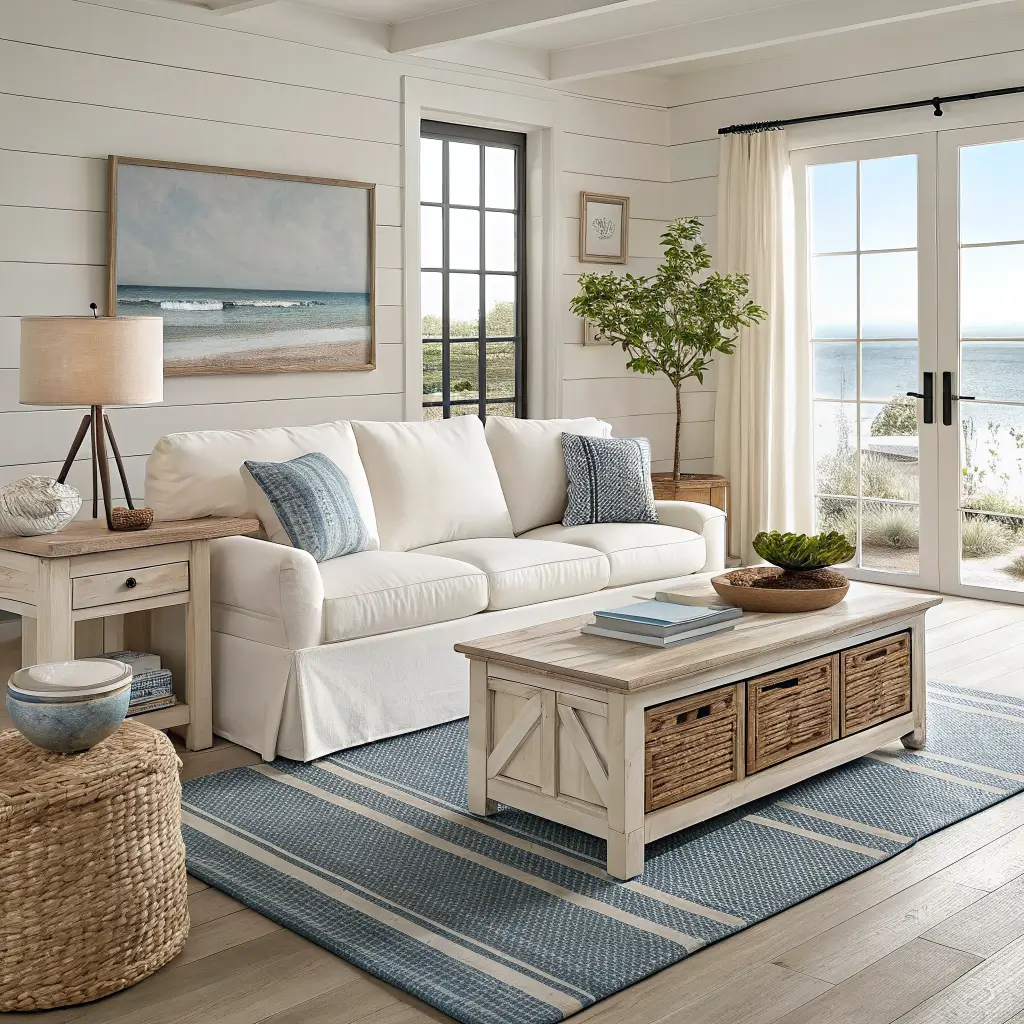
– Slipcovered sofa in performance fabric: $1,200–$2,500
– Light-wood coffee table (white oak or ash): $400–$900
– Rope or ceramic table lamps: $70–$180 each
– 9’×12′ jute or seagrass rug: $400–$800
High-end: $8,000 and up
– Coastal-specialty sectional: $3,000–$6,000
– Custom linen drapery: $800–$2,000+ per room
For a light refresh, plan 1–2 days of sourcing and styling. A full room with paint, furniture delivery, and shiplap install is realistically 2–4 weekends once shipping times are factored in.
Skill Level
Beginner to intermediate. Painting walls, swapping pillows, hanging curtain rods, and rearranging furniture are all beginner-friendly. Installing a vertical shiplap accent wall, mounting heavy art, or assembling a sectional pushes into intermediate.
The Color Palette I Actually Use
Most “coastal palette” lists give you fifteen paint colors and no guidance. Here’s what I’ve used and re-used.
Walls (white or off-white):
– Benjamin Moore Chantilly Lace — cleanest white, best in north-facing rooms
– Benjamin Moore White Heron — slightly warmer, my favorite for living rooms
– Sherwin-Williams Snowbound — soft, very forgiving
Walls (soft greige, when pure white feels too sharp):
– Benjamin Moore Pale Oak
– Benjamin Moore Moonshine
Accent blues (cabinetry, an accent wall, textiles):
– Pale: BM Beach Glass, BM Palladian Blue, SW Sea Salt
– Deep: BM Van Courtland Blue, SW Krypton for a navy moment
Supporting tones: sandy beige, warm caramel woods, earthy greens (think dune grass), and the occasional muted rose for a hit of modernity.
The mix I follow: 70–80% neutrals, 10–20% blue/sea tones, 5–10% darker anchor (navy, charcoal, matte black metal). That last 5–10% is what most people skip, and it’s why their rooms look washed out.
Materials That Do the Heavy Lifting
The look is built on natural textures more than any single color.
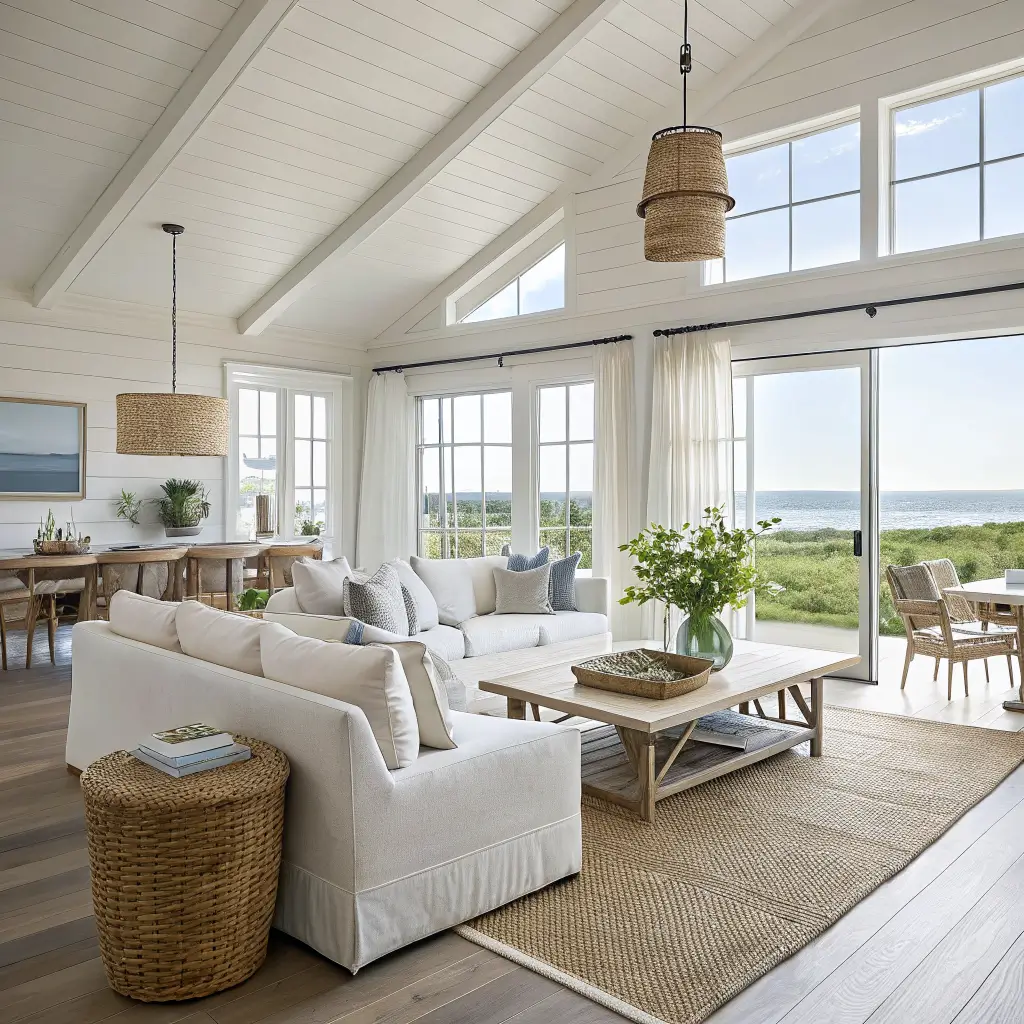
– Fibers: seagrass, jute, sisal, water hyacinth
– Woods: light oak, ash, whitewashed pine, driftwood tones, rattan, cane
– Fabrics: linen, cotton, performance-fabric slipcovers, gauzy sheers
– Hard surfaces: white or sand-toned ceramic, matte brass or nickel, a little marble for contrast
The trick is repetition. If you use rattan, use it in three places — a chair, a pendant, a tray — not one. Same with linen. Same with light oak. Repeating materials is what makes a room feel intentional instead of accidentally beige.
The Hero Pieces
Slipcovered sofa
Performance fabric, white or ivory, tailored — not the baggy collapsed-marshmallow look. Length 84–100 inches for a sofa, 100+ for a sectional. I went with a slipcover after a toddler and a golden retriever destroyed a non-slipcovered linen one. Wash, dry, re-stretch. Done.
Light-wood coffee table
White oak or ash, clean modern lines. Skip anything painted distressed-white with rope handles. A simple rectangular oak table in the $400–$900 range punches well above its weight.
Media console
Light wood or white with cane or rattan door fronts. The cane breaks up a flat surface and reads coastal without trying.
Dining table (open-plan rooms)
Slim-profile light oak with rattan or upholstered chairs. Round tables work better in small spaces and soften all the rectangles.
Anchor rug
A jute or seagrass rug, 9’×12′ if your seating area allows it. The front legs of every major piece should sit on the rug — that’s the rule that fixes 90% of “my room feels off” problems. I had an 8’×10′ under a 96″ sofa for two years and the room felt cramped until I sized up.
For more softness, layer a low-pile cotton or wool rug (subtle stripes, a muted geometric) on top of the jute.
Lighting
You need three layers. Overhead is not enough.
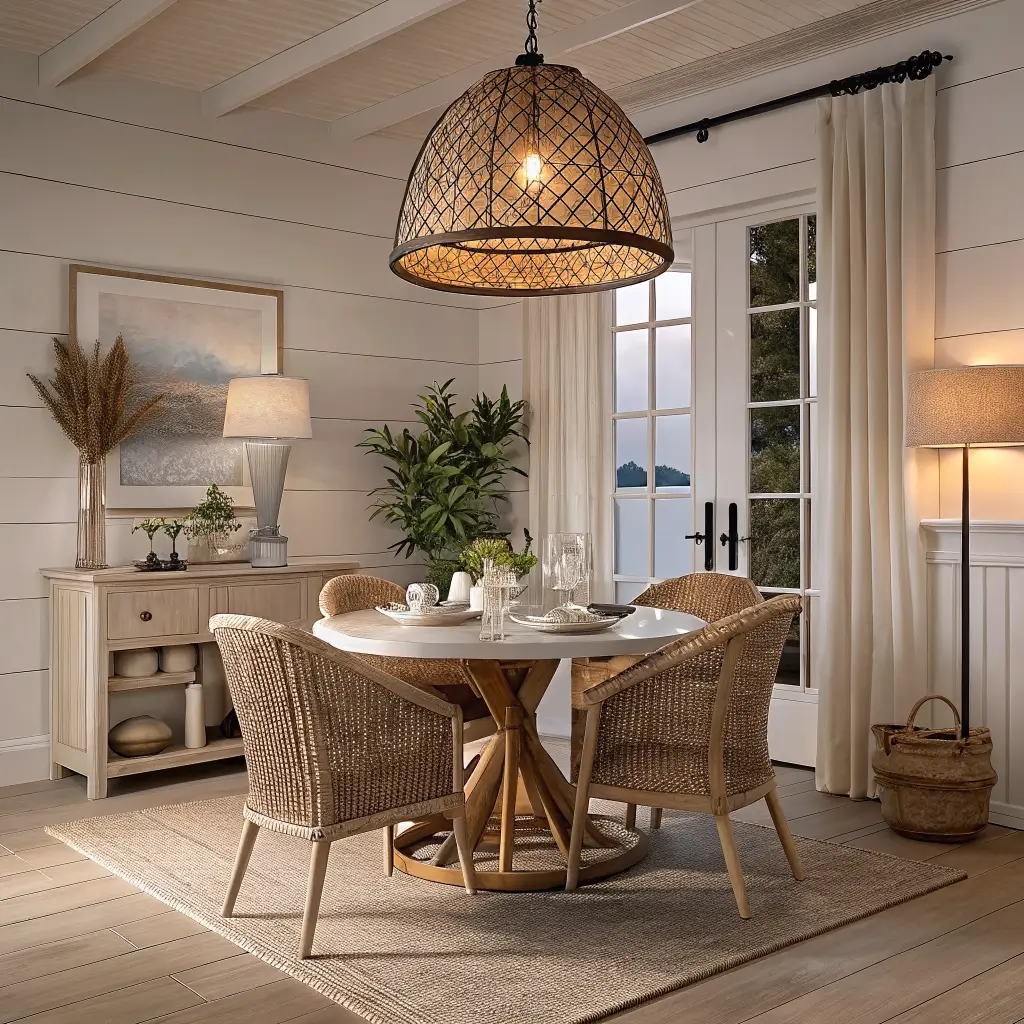
– Ambient: a woven seagrass or rattan pendant for dining or entry ($150–$350)
– Task: a rope or ceramic table lamp on each side table ($70–$180)
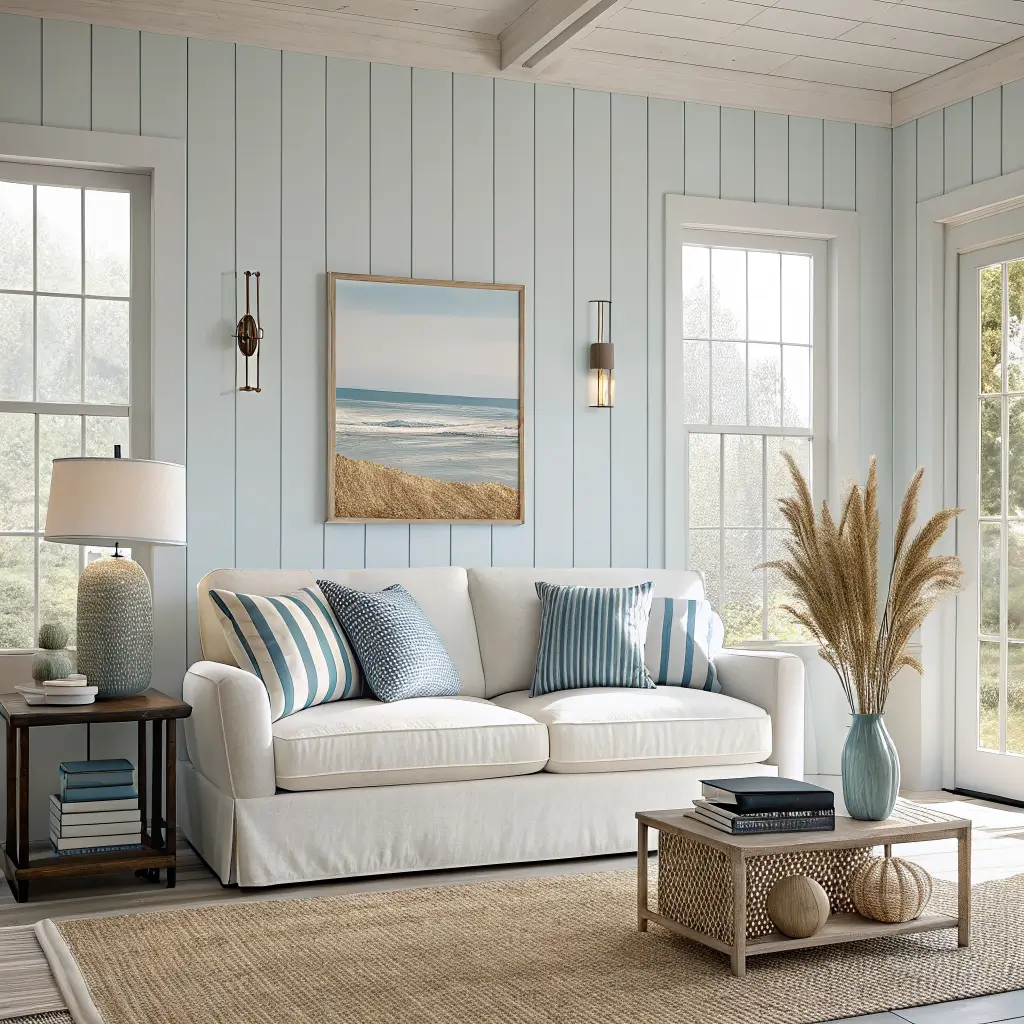
– Accent: sconces in muted brass or matte black, or a floor lamp by a reading chair
Matte black sounds wrong for coastal — it’s not. A few black-metal elements (sconces, picture frames, a thin floor lamp) are what keep the room from floating away.
Walls and Shiplap (Use Sparingly)
Shiplap is the move people overdo. I’ve done it right once and wrong twice.
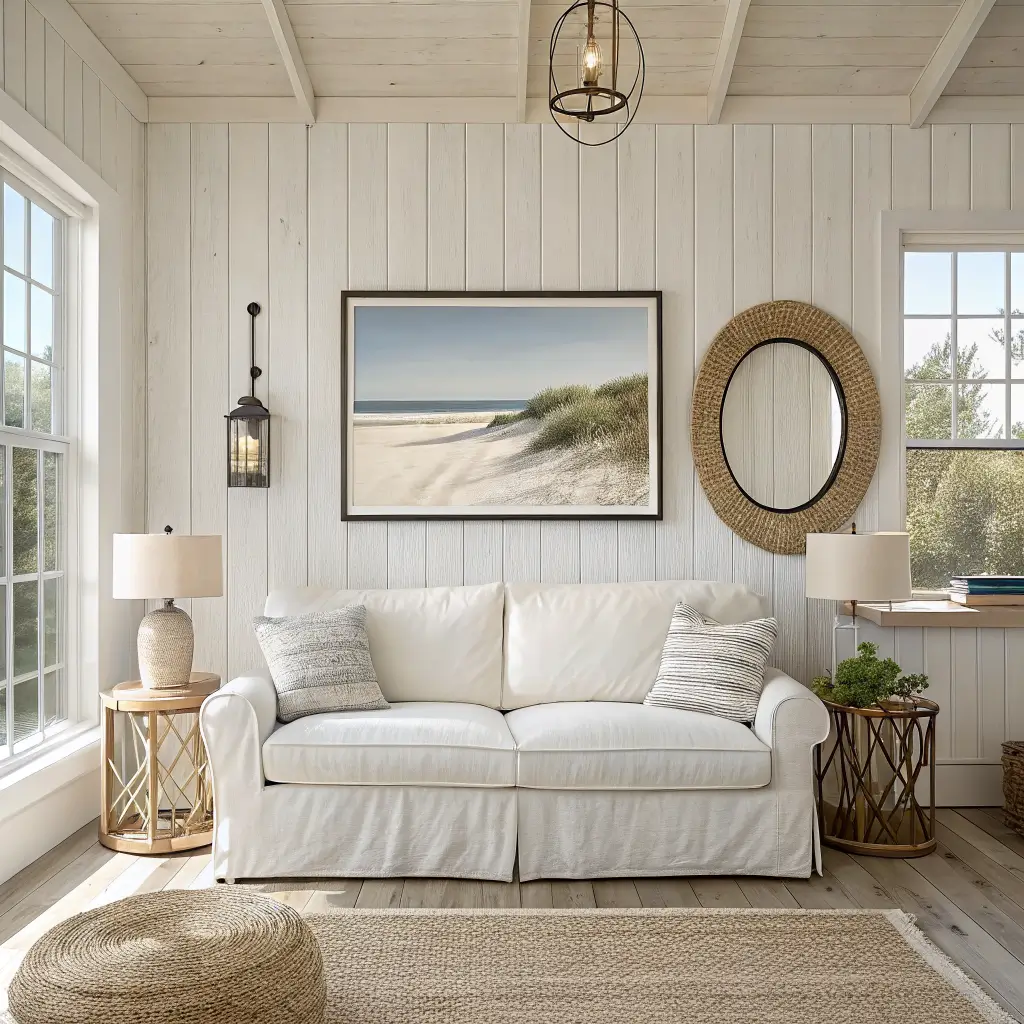
The fix: one accent wall, OR lower-half wainscoting style, OR ceiling only. Not everywhere. Vertical shiplap reads more modern than horizontal — I’d choose vertical every time now.
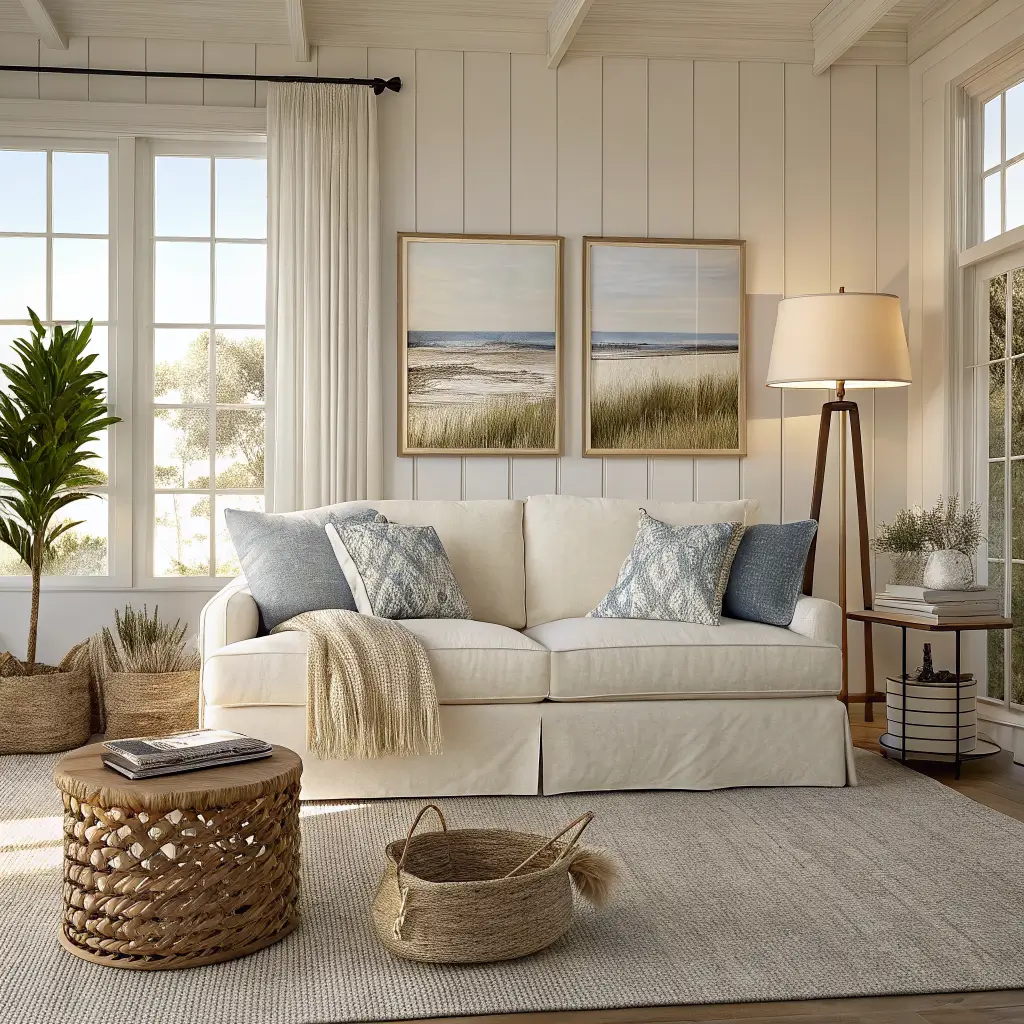
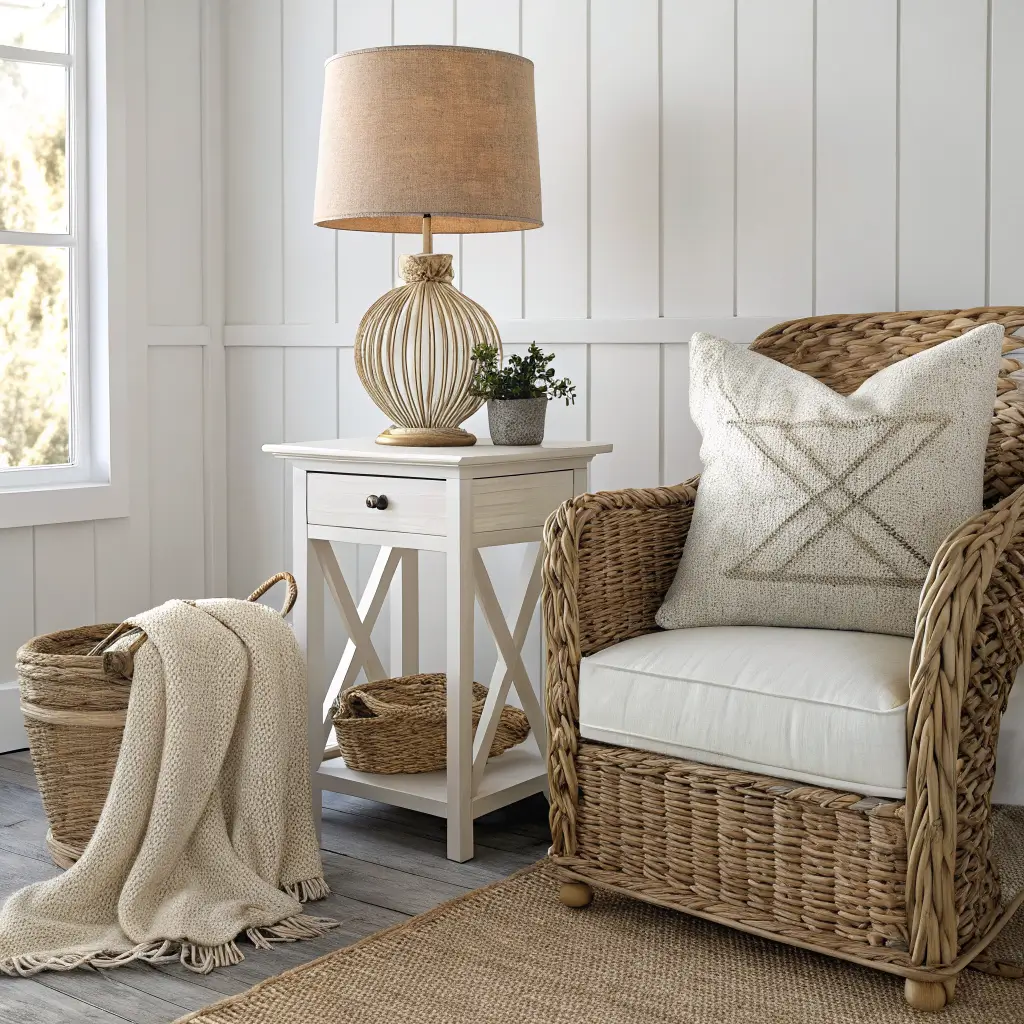
For art, go big and quiet. One oversized framed photograph of a horizon or dune beats six small “Beach Vibes” prints. Soft abstracts in blues, sand, and white also work. A round mirror with a rattan or driftwood frame, hung where it can bounce window light, does double duty as decor and brightening tool.
Signature Accessories
Keep this short. The whole style breaks if you over-accessorize.
– Woven baskets for blankets and storage ($30–$80)
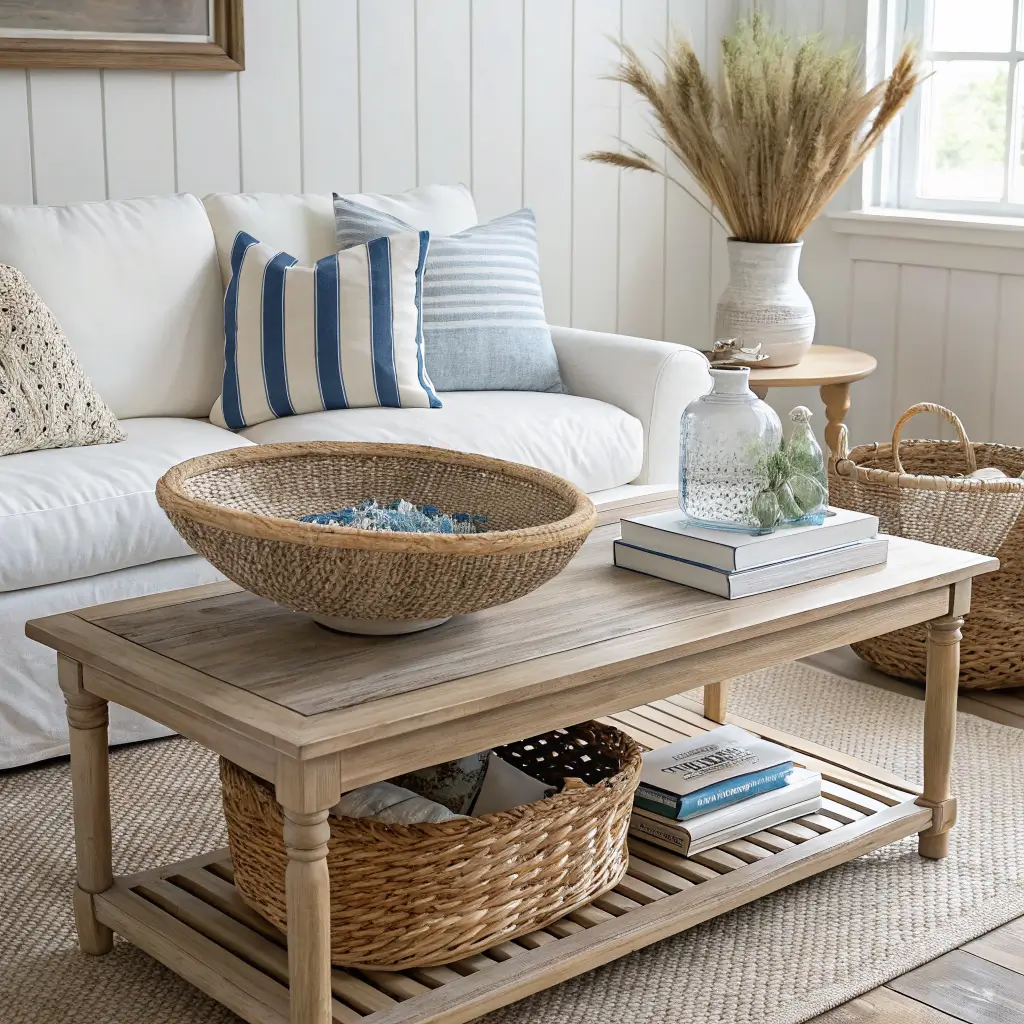
– One large clamshell or stone bowl with sea glass beads — the adult nod to shells
– Striped linen pillows in blue/white or beige/white
– Cream or pale-blue throws, cotton or chunky knit depending on season
– White or sand ceramic vases with branches, pampas, or grasses
How to Actually Style the Room
Order matters. I’ve redone enough rooms to know that doing this out of sequence costs you money.
1. Paint first. Before any furniture lands.
2. Lay the rug. Front legs of sofa and chairs on it.
3. Place the sofa. Facing the best thing in the room — a window, a fireplace, or your main art wall. Not the TV by default.
4. Add side tables, coffee table, console. Keep walkways at 30–36 inches.
5. Hang curtains high and wide. Rods 4–6 inches above the window frame and 10–12 inches past it on each side. Light-filtering linen panels. This single move makes ceilings look taller and windows look bigger.
6. Layer pillows and throws. Solids in ivory and sand with 1–2 striped or subtly patterned accents.
7. Hang art. One large piece centered 6–8 inches above the sofa back, or a balanced grid of 2–3.
8. Style surfaces last. Groups of 3 or 5. One vertical (vase, lamp), one textural (woven tray, stone bowl), one small (book stack, ceramic object).
Where to Spend, Where to Save
Spend on: the sofa, the rug, the main light fixture. These are the bones. A cheap rug and a cheap sofa will undo every other smart choice you make.
Save on: art (HomeGoods, Etsy printables, framed yourself), baskets (Target and IKEA are fine), pillow covers ($15–$30 on Amazon or Etsy in real linen), ceramics, faux greenery.
I spent $89 on a “driftwood” mirror from HomeGoods three years ago that everyone assumes is from a designer brand. I also spent $1,800 on a sofa that I’d buy again tomorrow. Both calls were right.
The Mistakes I Made So You Don’t Have To
Going too literal. Anchors, “Beach this way” signs, bright turquoise, starfish clusters. Replace all of it with abstract art, muted blues, and maybe one understated shell-shaped object.
Shiplapping every wall. Pick one. Move on.
Forgetting texture. All-smooth surfaces — painted furniture, basic rug, flat cotton — read flat and cheap on camera and in person. Mix seagrass, jute, rattan, linen, slubbed cotton, nubby wool.
Going too cold. All white with no wood is a showroom, not a home. Warm wood, tan leather, a wicker pendant, and dim lamps fix this fast.
Over-styling. Two to four items per surface. Negative space — meaning empty room around objects — is part of the design, not a gap to fill.
Keeping It Cohesive Long-Term
The fastest way to ruin this style is letting unrelated things drift in: a bright red throw your aunt gave you, a heavy mahogany chair from a move, a neon kid’s toy basket. Have a defined palette and stick to it: one white, one wood tone, one or two blues, one or two accent neutrals.
Repeat materials. Limit silhouettes to mostly clean and modern with a few soft curves (a round mirror, a rounded vase, an arched lamp). Hide the chaos — baskets inside the console for remotes, a closed cabinet for the kids’ stuff.
Seasonal Updates Without Buying New Furniture
Spring/summer:
– Swap to sheer linen panels
– Lighter pillow covers, more stripes
– Glass vases, white ceramics, fresh eucalyptus or grasses
Fall/winter:
– Camel, cocoa, or deep navy pillow covers
– Chunky cream knit throws
– Darker baskets, more candles, a second layered rug for warmth
Pillow covers at $15–$30 and one new piece of art are how I refresh the room twice a year for under $150.
If You Want to Bend the Style
Boho coastal: add muted block prints, a worn kilim in blues, sparing fringe or macramé.
Scandi coastal: strip back further. Pale woods, black accents, almost no accessories. Severe but beautiful.
Modern farmhouse coastal: keep the shiplap, add black metal lighting, use rustic wood pieces with the coastal blues. This is where most Pinterest “coastal” actually lives.
The version I keep coming back to in my own house is straight modern coastal with one boho lean — a vintage kilim runner in the hallway that I found at an estate sale for $40. It shouldn’t work next to all the linen and jute, but it does, because the colors stay in the palette. That’s the whole game. Stay in the palette, repeat your materials, leave room to breathe, and skip anything with a starfish on it.
Conclusion
The modern coastal decor I aspire to lives in a house where the walls are white, the floors are bleached oak, and the only blue in the room is the ocean through the window. The owner has a single rattan chair, a concrete coffee table, and a wool throw that looks like it has been there for twenty years. There are no shells, no starfish, no signs that say ‘Paradise.’ The view does the work, and the room knows enough to get out of the way.