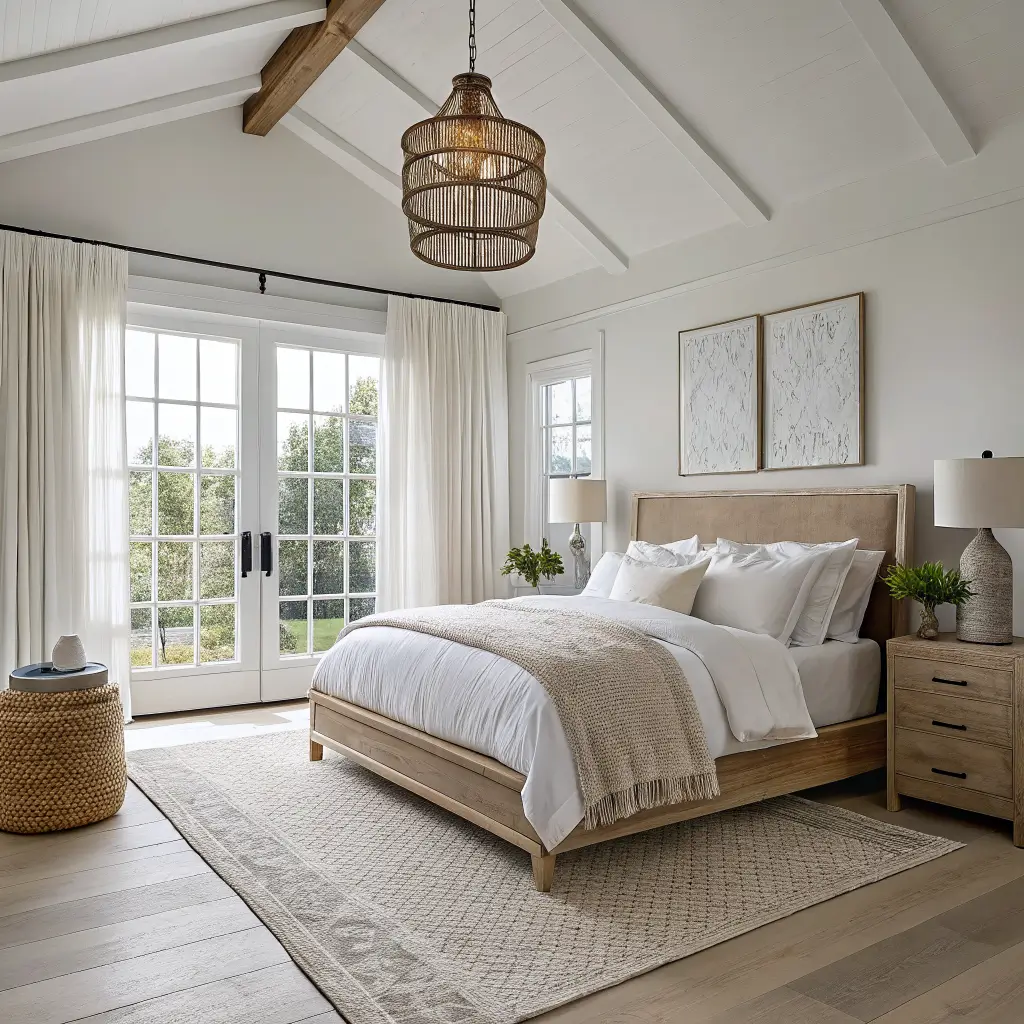
Modern coastal is restrained. It pulls from the ocean through color, texture, and light instead of literal motifs. Think bleached wood, soft blue, sand-toned linen, woven rattan. No anchors required.
It works for:
– Anyone wanting a calm, spa-feeling primary bedroom
– Renters who can’t paint or renovate but can swap textiles
– Beach houses and landlocked apartments (mine is firmly inland)
– Guest rooms where you want a clear, welcoming mood
If you like the idea of a serene room but find pure minimalism cold, this style is the middle ground. Texture does the warming.
I’ll be honest about pricing because the gap between budget and high-end here is huge, and most people don’t need the high end.
Budget refresh — $300 to $800. Keep your existing bed and dresser. Swap the duvet and pillows ($80–$200 for a set at Target or IKEA, $20–$60 each for pillows), add a 5×8 jute rug ($120–$250), buy a pair of lamps with ceramic or glass bases ($50–$120 a pair), and frame a few ocean prints ($30–$150 total — Etsy is great here).
Mid-range redo — $1,000 to $3,000. This is where you get a rattan or light-oak bed ($400–$1,200), two whitewashed nightstands ($150–$400 each), an 8×10 natural-fiber rug ($200–$600), and a proper linen bedding bundle ($150–$400). A woven pendant overhead runs $150–$400.
Higher-end — $3,000 to $8,000+. Solid wood or upholstered bed from Crate & Barrel or Pottery Barn ($1,000–$2,500), matching case goods ($1,000–$2,500), a wool-jute blend rug ($600–$1,500), designer linen sheets ($300–$800).
The mid-range is the sweet spot. I’ve spent more and gotten worse results.
Walls first. These are the whites and neutrals I’d use:
– Benjamin Moore White Dove — warm white, my default
– Benjamin Moore Simply White — cleaner, slightly cooler
– Sherwin-Williams Chantilly Lace — crisp, almost no undertone
– Sherwin-Williams Agreeable Gray — when you want a soft greige instead of white
I painted my current bedroom White Dove after spending two weekends with sample swatches taped above the headboard. Worth it. A bright cool white made the room feel like a dentist’s office at 7 a.m.
For accents, build from three families:
– Blues: seafoam, aqua, sky, denim, navy
– Sandy neutrals: oat, driftwood taupe, warm beige
– Grounding tones: charcoal or black in small doses — a lamp base, a picture frame, drawer pulls
A small touch of sea-glass green or a dusty blush works as a fourth note if you want it. I have one washed-blush lumbar pillow on my bed and that’s the only pink in the room.
The bed. This sets everything. A light oak platform bed, a whitewashed panel bed, or a rattan/cane headboard all work. If you can only buy one new piece of furniture, this is it. Queen is 60×80, king is 76×80 — measure your room before you fall in love with a king.
The rug. Jute, seagrass, or a wool-jute blend. Pure jute is the cheapest and the scratchiest; if you walk barefoot a lot, spend up for the wool blend. Pull the rug at least 18–24 inches past the sides and foot of the bed. A too-small rug shoved under the bottom third is the single most common styling mistake I see.
The bedding. White cotton or washed linen sheets. A white or sand duvet — quilted or waffle-textured beats flat and shiny every time. Then layer:
– Two Euro shams at the back (26×26)
– Your sleeping pillows in front
– Two 20×20 or 22×22 decorative pillows
– One 12×24 lumbar
That’s it. More than that and you’re moving a pile onto the floor every night, which means you’ll stop making the bed.
Nightstands and lamps. Matching nightstands give you the calm hotel symmetry. Lamps should be 24–28 inches tall so the bottom of the shade sits roughly at your shoulder when you’re sitting up reading. Ceramic bases with subtle texture, or clear glass with linen shades.
A bench or stool at the foot of the bed. Optional but it adds another texture — woven seat, weathered wood, or upholstered in light linen.
The trick is layering textures so the room reads rich instead of flat. Coastal style is mostly neutral, so without texture variation it goes lifeless fast.
In a single room I want:
– Smooth (cotton sheets, ceramic lamp)
– Rough (jute rug, woven basket)
– Nubby (a knit or bouclé throw)
– Woven (rattan headboard, cane detail, or a pendant)
Pattern-wise, cap yourself at two or three. A blue-and-white stripe, a subtle organic motif (waves, palm fronds, an abstract), and maybe one tiny geometric. Any more and the calm evaporates.
For color balance, I use a rough 70/20/10 split: 70% light neutrals (walls, bedding, rug), 20% your blues and greens, 10% grounding dark tones. If you have a dark wood bed you can’t replace, that is your 10% — so keep everything around it light. Pale walls, pale rug, white bedding. My sister kept her heavy walnut bed and got the airy feel anyway by painting her walls White Dove and putting a 9×12 wool-jute rug under the whole thing.
The bed wall is your focal point. Big horizontal artwork above the headboard, or two stacked pieces, plus those matching lamps. Keep the sightline from the doorway to the window as clear as you can — nothing tall blocking the light.
A single overhead fixture flattens the whole room. You need at least two more sources:
– Bedside lamps for warm pools of light
– An overhead — a woven pendant or simple rattan fixture if you want a focal piece, or just keep a clean flush mount
– Optional floor lamp in a reading corner, or sconces flanking the bed if you can hardwire
Stick to warm bulbs around 2700K. Cool daylight bulbs ruin the mood instantly. I learned this after installing 5000K bulbs in my bedside lamps and wondering why the room suddenly felt like a hospital.
Spend on: the rug, the bed frame, and the lamps. These are the structural pieces you see from the door, and cheap versions show it — especially rugs, which start to mat and shed within months.
Save on: pillow covers (HomeGoods, Target, Etsy all have good linen covers under $30), framed art prints (Etsy digital downloads printed at a local shop run $15–$40), woven baskets (IKEA), and faux greenery if you can’t keep real plants alive. A 4-foot faux palm in a woven basket past the dresser is the cheat code for filling an empty corner.
Going literal with the theme. The anchor duvet, the shell wall. Abstract beats obvious. A blue-and-cream watercolor reads “coast” without spelling it out.
Too much dark, heavy furniture. If you have a dark dresser you’re keeping, paint the smaller pieces (nightstands) white or a soft driftwood tone to lift the room. Don’t double down on dark wood.
Cluttering the nightstands. Lamp, one book, one small object. That’s it. A tiny ceramic dish for earrings counts as the one object. Three candles, a stack of magazines, a water glass, and a framed photo do not.
The too-small rug. I mentioned it above and I’ll mention it again. If your budget only covers a 5×8 and your room needs an 8×10, wait and save. A 5×8 under a queen bed always looks like a bath mat.
Forgetting the window treatments. Sheer white or light linen curtains, hung high and wide — rod about 4 inches below the ceiling, extending 8–10 inches past the window frame on each side. This makes the window look bigger and the ceiling higher. Add a bamboo or woven shade behind for texture and light control.
Seasonal swaps. In summer I switch to thinner cotton pillow covers and a gauzy linen throw. In winter I bring out a chunky cream knit blanket and swap in darker navy and charcoal pillow covers. Same bed, different mood.
Cheapest big-impact change. Paint. If you don’t want to do all four walls, paint just the headboard wall in a soft sandy taupe or a muted aqua-gray. It frames the bed without committing the whole room.
Boho-coastal crossover. A macrame wall hanging or a kilim pillow in muted blues and terracottas blends in well, as long as you keep your bedding and walls neutral. The trouble starts when you try to do boho-coastal-farmhouse-Scandinavian all at once.
Coastal in a city apartment. Skip anything that telegraphs “vacation rental.” Lean into the textures — linen, rattan, jute, ceramic — and one piece of abstract water-toned art. Nobody walking in should think “is this person obsessed with the beach.” They should just feel like the room is breathing.
The thing that finally made my own bedroom click wasn’t any single piece. It was taking three things off the dresser, swapping the rug for one a size up, and switching my sheets from gray to white. Total cost that weekend: about $180. The room looked completely different on Monday morning.
Start with the bed, the rug, and the light. Get those three right and the rest is just editing.
Conclusion
The coastal bedroom decor that helped me sleep better was not the thread count of the sheets. It was the sheer curtains that moved all night, the sound of the ceiling fan, and the pale blue walls that looked like the sky just after sunset. The room had one framed photograph of a dune, a ceramic bowl of sea glass on the dresser, and nothing else. I slept there for a week and did not check my phone once after nine.