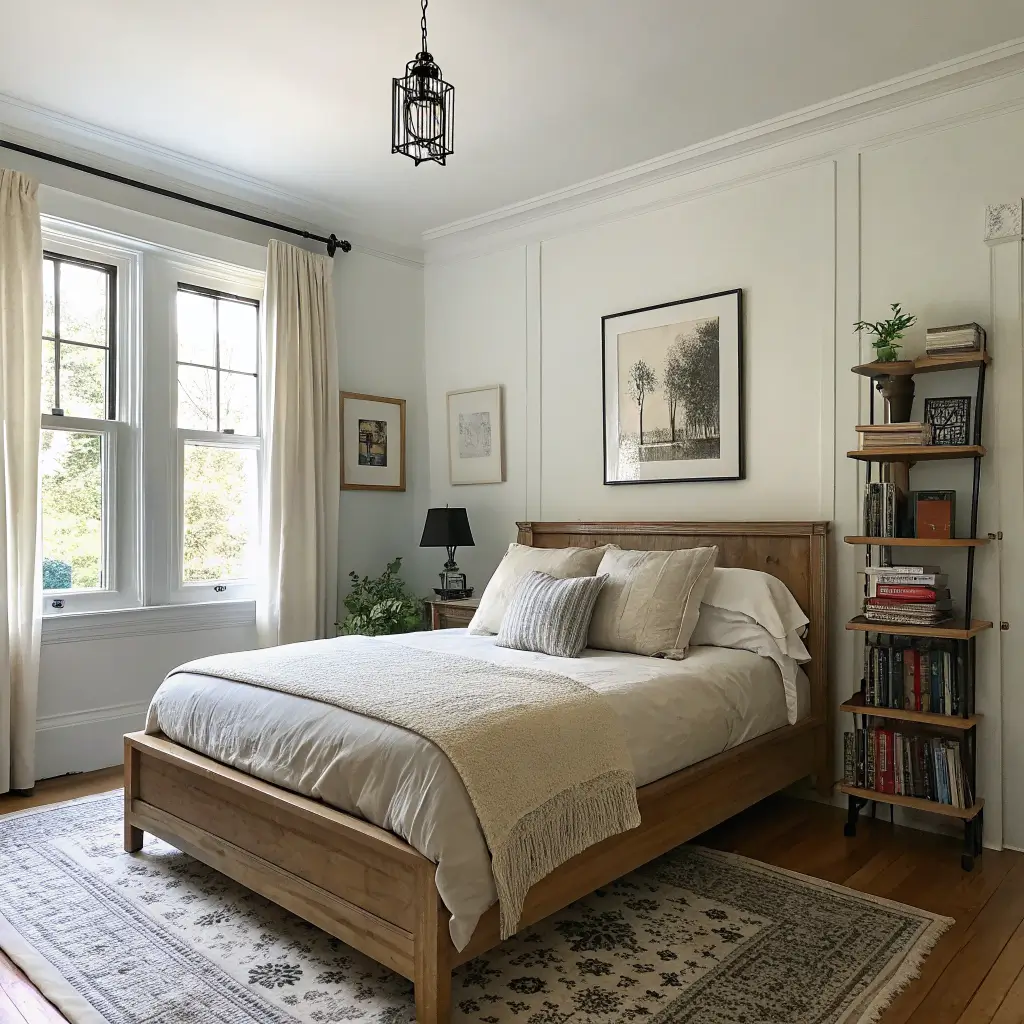
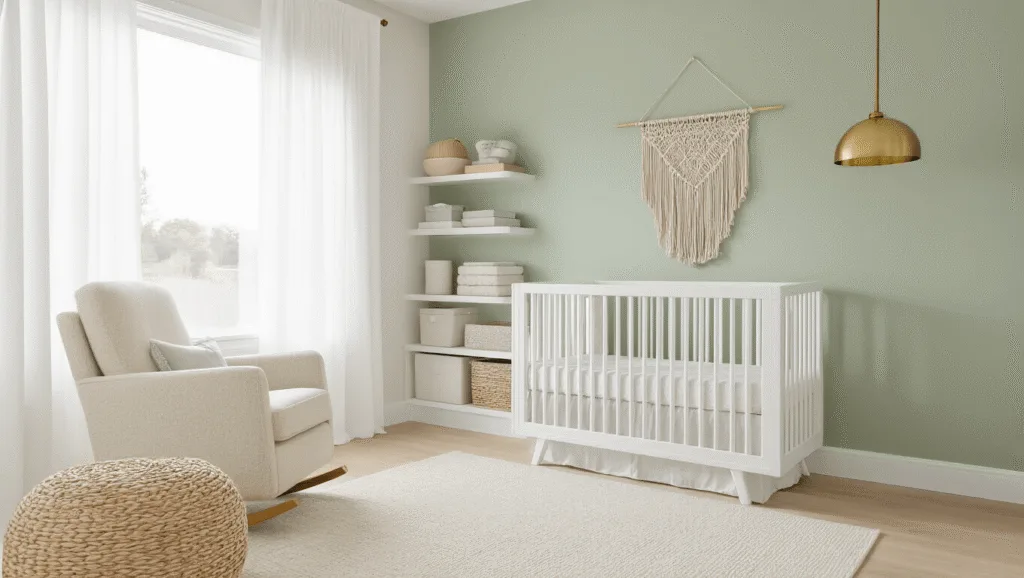
This is a guide for bedrooms in the 65–95 square foot range — think 7′ x 9′ city box rooms, attic eaves with knee walls, or that one bedroom in the apartment that everyone calls “the small one.” If your room is bigger than 100 ft², some of this still applies, but you have more breathing room than I’m assuming.
Time and money, realistically:
– Weekend refresh (paint, textiles, basic storage, swap the lighting): 10–15 hours, $250–$600. An IKEA MALM or NEIDEN frame runs $129–$199, SKUBB under-bed boxes are about $25 for a set, LACK shelves are $10–$20 each, and blackout curtains land around $40–$80.
– Mid-range redo (storage bed, small PAX wardrobe, real rug, layered lighting): two weekends, $700–$1,800. A BRIMNES storage bed is around $349–$499. A small PAX configuration runs $400–$900.
– High end (Murphy bed or custom built-ins): $2,000–$5,000+. Custom millwork around the bed usually starts at $2,000 and climbs fast.
Skill-wise, almost everything here is beginner to intermediate: flat-pack assembly, hanging shelves into studs, swapping out plug-in fixtures. Hardwiring sconces or building cabinetry into a sloped ceiling is where I’d call someone.
Three approaches consistently work in rooms this size, and they share more than they don’t:
– Scandi-minimalist — pale wood, white walls, low-slung furniture, very little on display.
– Soft modern — clean lines, warm neutrals, integrated storage, slim metal hardware.
– Japandi — low platform beds, natural materials, restricted palette, a near-religious commitment to not having too much stuff.
What they have in common is low visual weight. Heavy four-poster beds, dark mahogany dressers, and ornate headboards eat tiny rooms alive. The pieces I keep recommending sit low, have slim legs you can see under, and don’t compete for attention.
Colors I’d actually paint a small bedroom:
– Warm white: Benjamin Moore Simply White or Sherwin-Williams Alabaster. These are my defaults. Cool whites can go blue and depressing in a room without much natural light.
– Soft greige: SW Agreeable Gray or BM Classic Gray if you want a cocoon feel without going dark.
– Muted dusty hues: a chalky pale blue or sage if you want color but not impact. Skip anything saturated unless you’re committing to the moody look on purpose.
Finish matters more than people think. Go eggshell or matte on the walls — flat enough to hide the patched nail holes from the last tenant, with just enough sheen to bounce light around.
For furniture, I’d choose light oak, birch, or white-stained wood every time. Bedding in cotton percale or a linen blend. A jute or flat-weave rug because shag in a tiny room is a trip hazard and visually heavy. Black or brushed brass for lamp hardware and small metal accents — that’s the part that keeps the room from looking like a dorm.
This is the single biggest decision and the one people get wrong most often. I tried to fit a queen into my 7′ x 9′ room. I had about 14 inches of clearance on one side and zero on the other. It was miserable. I swapped it for a full and got my life back.
– Twin (38″ x 75″) or Twin XL for single sleepers, especially in rooms under 75 ft².
– Full (54″ x 75″) is the sweet spot for most very small bedrooms with one adult.
– Queen only if the room is at least 9′ wide and you can leave 24″ of walking room on one side.
If you can swing it, get a storage bed with drawers (BRIMNES, SONGESAND, or a MALM with the drawer add-on). The drawers replace a dresser entirely, which is the single best square-footage trade you can make.
For micro-rooms doing double duty as guest space, a daybed like the IKEA HEMNES gives you a sofa during the day and a real bed at night.
Solve the clothes problem
If there’s no closet, your options are:
– A slim wardrobe — anything 19–24″ deep with sliding doors so you don’t lose floor space to a swinging door.
– A small PAX configuration built to the wall.
– An open clothing rail along one wall plus matching storage boxes on top, which looks intentional if you keep the hangers uniform. Mismatched plastic hangers ruin it instantly.
The smaller pieces that earn their keep
– Floating nightstands or even a single wall-mounted shelf next to the bed. A regular nightstand can eat 20 inches of floor width you don’t have.
– Wall-mounted fold-down desk if the room doubles as an office. I’ve used a 30″-wide one in a guest room and it disappears completely when folded.
– A pouf or low stool that tucks under the desk and pulls out as extra seating.
Order matters. Doing this in the wrong sequence is how you end up with a rug that’s two inches too short or sconces in the wrong spot.
1. Measure and mock it up on paper first. Graph paper, or a free room planner app. Include the door swing, the radiator, and the window. I’ve skipped this step exactly once and ended up returning a wardrobe.
2. Place the bed on the longest uninterrupted wall. Centered if possible. If the room is too narrow, push it lengthwise against a wall and pile pillows along the back so it reads as an intentional daybed rather than a bed shoved in a corner.
3. Storage goes in next. Under-bed drawers, then the wardrobe or rail. Get this in before you start styling so you know what surfaces you actually have.
4. Address lighting before textiles. A flush or semi-flush ceiling fixture (skip the chandelier — low ceilings hate them). Then plug-in wall sconces beside the bed so your tiny nightstand surface stays clear. Swing-arm sconces are my favorite for this; you can angle the light for reading without a table lamp eating space.
5. Rug, then bedding. A 5′ x 7′ under the lower two-thirds of the bed is the standard move, or a runner along one side if the room is too narrow for that. Light, solid bedding. One throw at the foot. Two accent pillows. Stop there.
6. One big piece of art over the bed. Not a gallery wall of seven small frames. A single 24″–36″ piece reads as calm; the cluster reads as clutter in a room this size. I learned this after taking down a wall of mismatched thrift-store frames that I’d been very proud of for about six months.
7. The last 10%. A plant, a basket for laundry, a candle, one framed photo. Done.
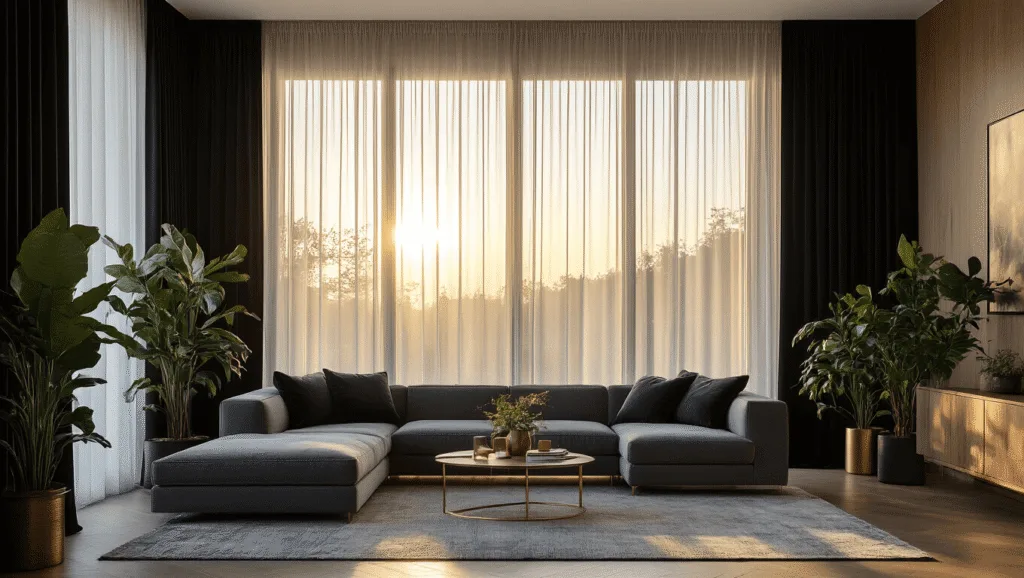
Hang the rod close to the ceiling and 4–6 inches past the window frame on each side. Curtains should brush the floor. This pulls the eye up, makes the ceiling read taller, and lets more actual light through because the fabric isn’t covering the glass when open. Sheers behind blackout panels is the combo I use — light during the day, dark when you want it.
Roughly 70% light neutrals (walls, bed, big furniture), 20% mid-tones (rug, curtains, wood), 10% dark contrast (a black lamp, brass hardware, a dark frame). That last 10% is what keeps the room from looking like an unfinished hotel.
If you want to do dark walls in a small room — and that look does work, despite what people say — you need to compensate hard with light bedding, a light rug, and more lighting than you think. I tried Hague Blue in a 70 ft² room and it looked great, but only after I added two extra lamps.
– A queen bed in a room that wanted a full. Downsize. You’ll sleep better in a smaller bed with room to walk than in a queen wedged between two walls.
– Two dressers plus a wardrobe plus a chair. Pick one storage strategy and commit. Usually that’s storage bed + wardrobe, or wardrobe + under-bed boxes.
– Stuff on every surface. The rule I use: one tray per surface, 3–5 objects on the tray, nothing else. Everything else goes in closed storage.
– One sad overhead bulb. A tiny room needs at least three light sources: overhead, bedside, and one more (a shelf puck light, a small floor lamp, anything).
– A massive tufted headboard. It looks enormous in photos and worse in person. Low-profile or wall-mounted only.
The hard part of a small bedroom isn’t setting it up. It’s keeping it set up. A few rules that have actually worked for me:
– Stick to 2–3 main colors plus one accent. Repeat them across bedding, art, and storage bins so the eye reads the room as one thing instead of five.
– Match your storage containers. All white SKUBB, all seagrass baskets, whatever — but the same. Mixed containers are the fastest way to make organized storage look messy.
– Hard capacity limits. If the drawer doesn’t close, something has to leave. If the hangers don’t slide easily, something has to leave. I do a clothing edit every season change and it’s the only reason my closet still works.
Easy Seasonal Updates Without Spending Much
Change three things only:
– The throw at the foot of the bed (chunky knit in winter, waffle cotton in summer).
– The accent pillow covers (deeper rusts and greens for cold months, washed linen in pale blues for warm).
– One piece of art or a framed photo.
That’s it. The furniture and the wall color stay. Peel-and-stick wallpaper on one wall ($80–$150 from the better brands) is the renter move that gives you the biggest visual shift for the least money. Swap cabinet knobs and lampshades for another $40–$100 and a tired small bedroom looks completely different.
Boho-Coastal in a tiny room: light walls, white bedding, jute rug, gauzy linen curtains, a small rattan pendant, two patterned pillows in muted indigo or terracotta. The trick is restraint — boho usually means more, and in a small room you have to cut it in half.
Japandi-industrial for a city box room: low wood platform bed, oatmeal linen bedding, one matte black swing-arm sconce, a single large abstract piece in charcoal and cream, a black metal clothing rail along one wall. Quiet, functional, and reads more expensive than it is.
The real shift, once you’ve done this once, is realizing a small bedroom isn’t about cramming a normal bedroom into less space. It’s a different category of room, and the sooner you stop fighting it, the better it’ll look.
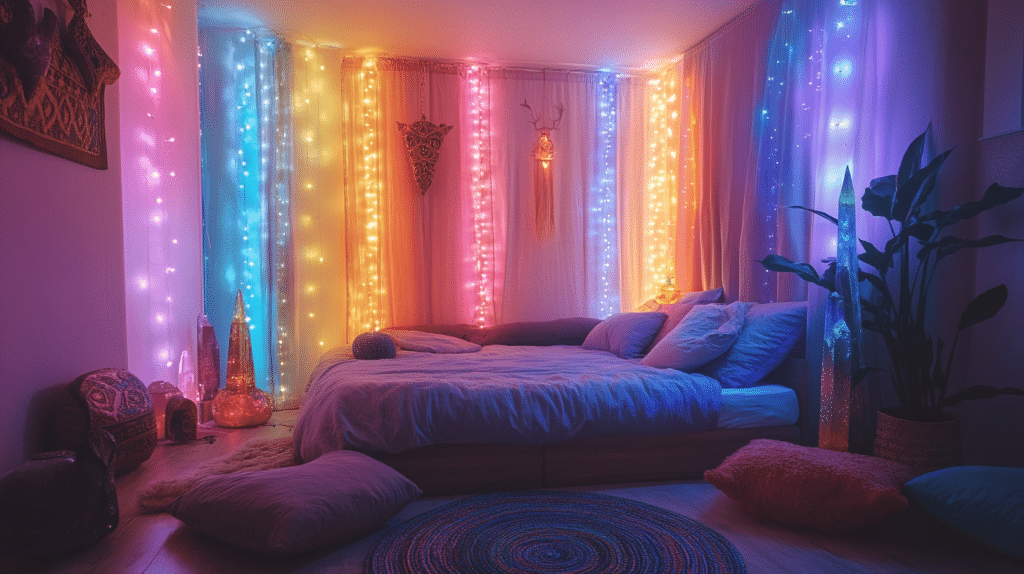
The very small bedroom that felt right to me was sixty-five square feet with a loft bed, a desk underneath, and a single window that looked at a tree. I painted the walls white, added a curtain to hide the closet, and hung a string of lights above the bed. The room felt like a nest, not a cage, because every inch had a purpose. That is the trick with small spaces — not to make them feel bigger, but to make them feel full.