The Look and Who It’s For
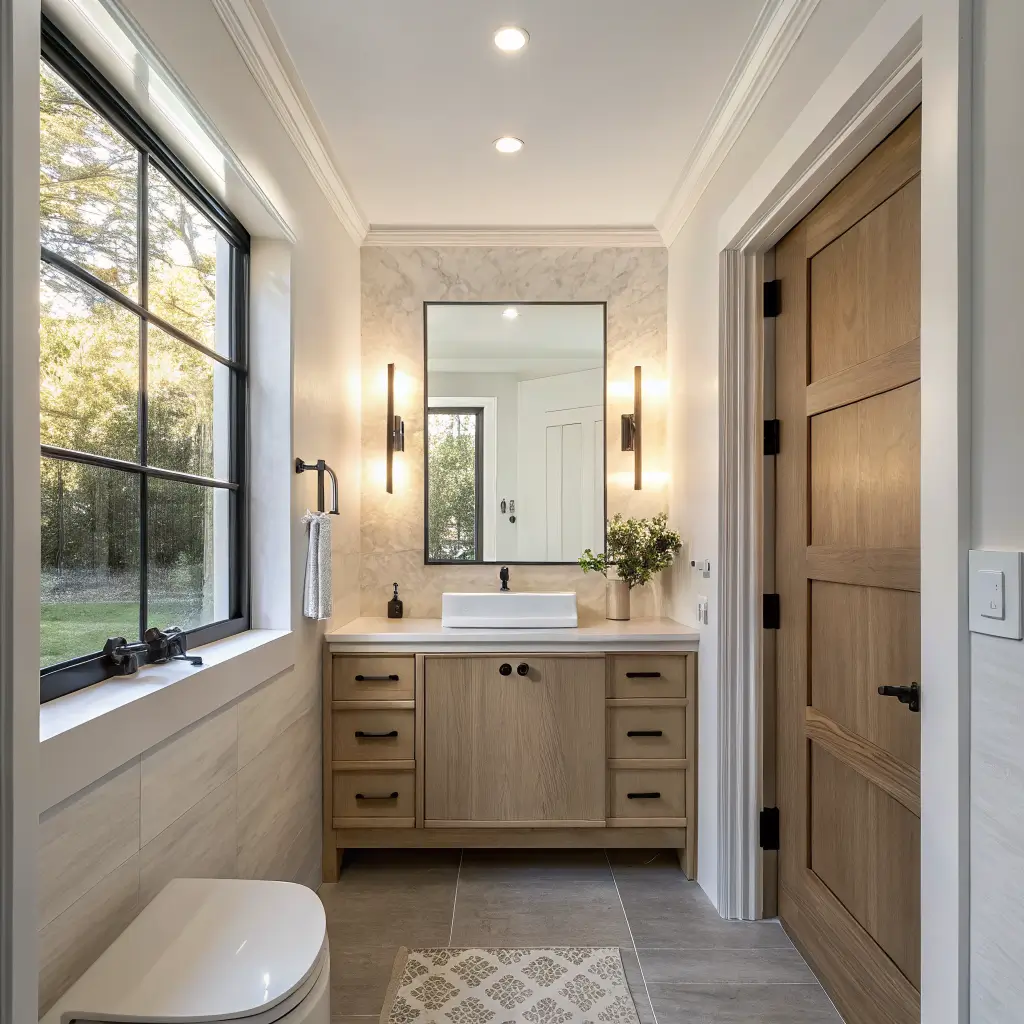
A modern small bath leans on clean lines, light surfaces, and the disappearance of clutter. Think floating vanity, frameless glass, wall-to-wall mirror, one strong accent — and that’s about it.
This works best in:
– Powder rooms between 15–25 sq ft (a 3’x5′ or 3’x6′ footprint with just a toilet and sink)
– Full baths up to about 40 sq ft with the toilet, vanity, and shower lined up on one wall
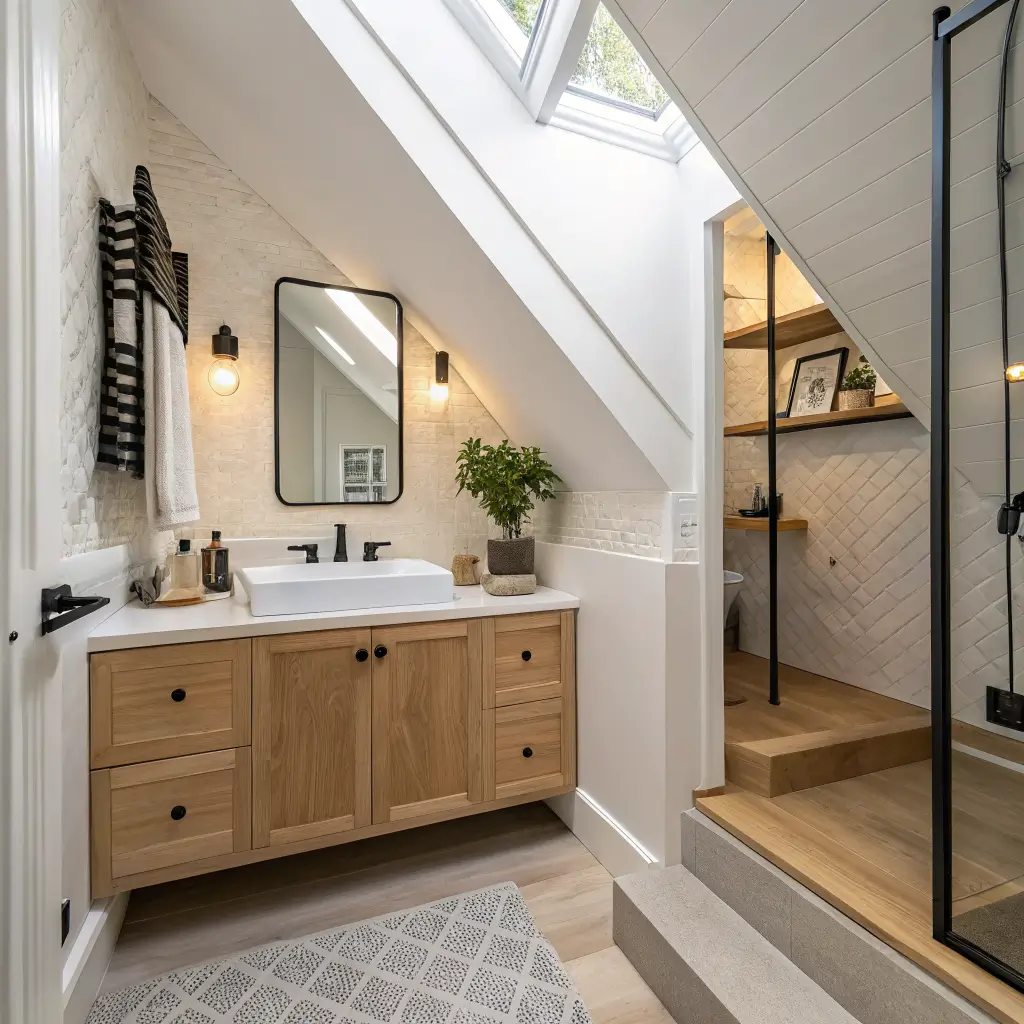
– Awkward attic or under-stairs baths where built-ins do the heavy lifting
If you live in a condo, rent an older apartment with a brutally small bathroom, or you’re staring down a 1970s half-bath that hasn’t been touched since, this is the lane.
What It Costs (With Actual Numbers)
I’ll break this into three honest tiers because “small bathroom remodel” can mean $400 or $40,000.
Cosmetic refresh — $300 to $1,000, one or two weekends:
– Mildew-resistant bathroom paint: $35–$70/gallon (one gallon covers a small bath easily)
– Modern matte black or brushed brass single-hole faucet: $60–$200
– Frameless mirror: $40–$150, or a mirrored medicine cabinet at $100–$350
– LED vanity bar or pair of sconces: $60–$250
– Floating shelves over the toilet: $40–$150
Mid-range mini-renovation — $4,000 to $10,000, one to two weeks with a contractor:
– Compact floating vanity, 18–30″ wide with integrated sink: $250–$900
– Wall-hung toilet with in-wall tank carrier: $600–$1,500 for the unit, plus heavier install labor
– Frameless glass shower screen: $600–$1,800 depending on thickness
– Large-format porcelain tile (24″x24″ or 24″x48″): $3–$10 per sq ft for material
– Heated floor mat under tile: $300–$800 in materials
High-end compact spa bath — $10,000 to $25,000+:
custom vanity with stone top, designer fixtures, built-in shower niche, premium tile. You’d be surprised how fast this adds up even in 35 square feet.
Skill Level: What You Can Actually Do Yourself
Beginner-friendly: paint, swapping hardware, hanging shelves, peel-and-stick backsplash, changing the mirror and accessories.
Intermediate: installing a new vanity and faucet, replacing a light fixture, mounting a pre-fab shower door.
Hire a pro: moving plumbing, wall-hung toilets (the in-wall carrier is unforgiving), custom tiled showers, in-wall niches, heated floors.
I tiled my own 4’x6′ powder room floor with 24″ porcelain and almost cried. Big tile is heavier and less forgiving than it looks on YouTube. If you’re new to tile, do a backsplash, not a floor.
The Color and Material Palette That Actually Works
Light walls open the room. That’s the first rule and the one people break most often by painting a tiny bath in deep navy “for drama” and then wondering why it feels like a coat closet.
Base palette — pick one:
– Warm white (Benjamin Moore Chantilly Lace or Sherwin-Williams Alabaster are the safe bets)
– Soft greige with a concrete feel
– Pale sand for a warmer modern read
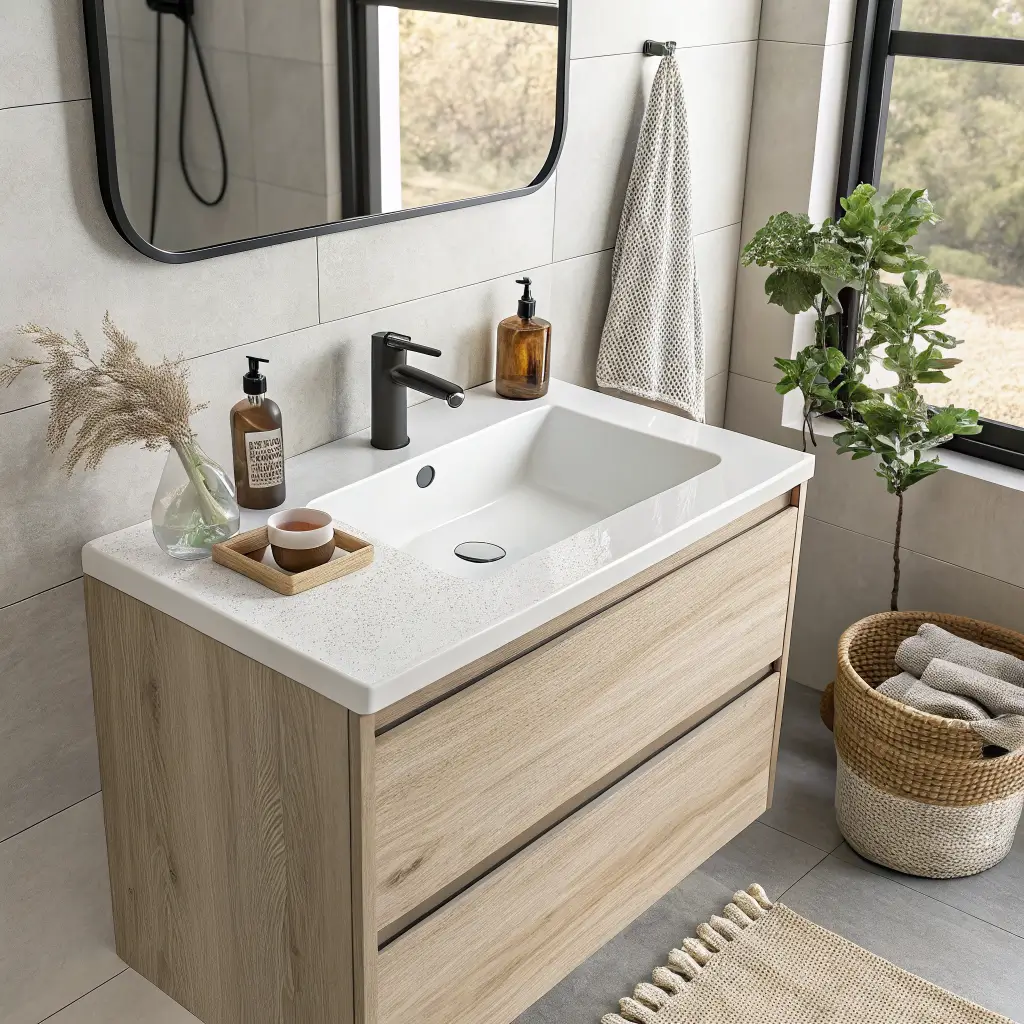
Use bold sparingly. A black faucet. A charcoal vanity. One forest green or merlot accent wall behind the toilet. Choose one — not all of them.
Materials that hold up and look current:
– Large-format porcelain tile in stone, terrazzo, or concrete looks (fewer grout lines = bigger feel)
– Frameless tempered glass for showers
– Quartz or solid-surface vanity tops
– Light oak or walnut veneer to keep the modern from feeling cold
– Brass, brushed gold, matte black, or champagne bronze hardware
The single biggest mistake I made early on: I bought a brushed nickel faucet because it was on sale, then a matte black towel bar because it was trendy, then a polished chrome shower head because that’s what the plumber had. Three finishes in 30 square feet. It looked like a hardware store threw up.
Pick one main metal. Optional second metal in tiny doses only.
The Hero Pieces That Make the Room Work
Four elements do the heavy lifting:
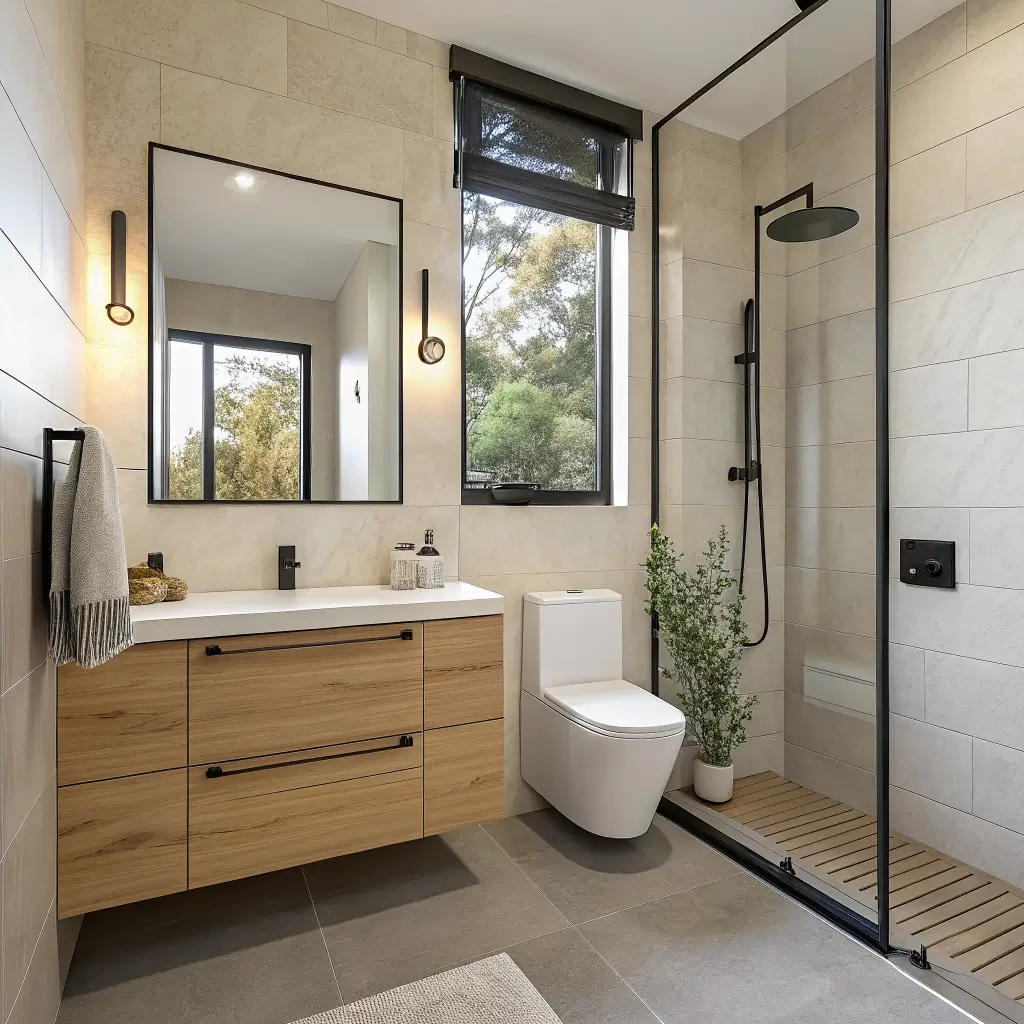
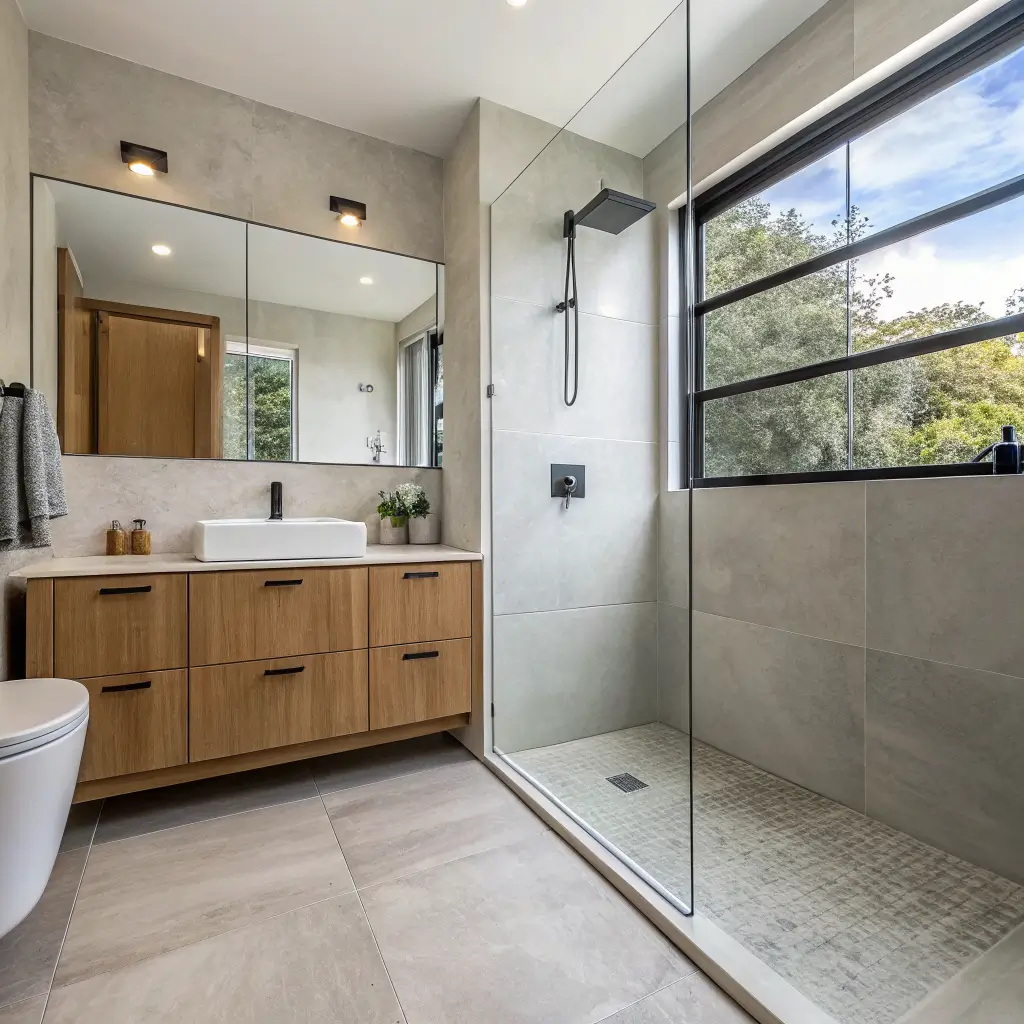
1. A floating vanity, 18–30 inches wide. Counter at 32–34″ height. The floor visible underneath is what makes the room feel bigger. A deep, boxy vanity on legs will eat the room alive.
2. Frameless glass shower enclosure, or even a single fixed glass panel for a walk-in wet-room feel. Framed sliders with thick metal rails are the enemy of small bathrooms.
3. A mirror that’s at least as wide as the vanity — ideally wall-to-wall over the sink. This is the single highest-impact change you can make. I replaced a 24″ oval mirror with a 48″ frameless rectangle in my powder room and three different houseguests asked if I’d “made the room bigger.”
4. A wall-hung toilet, if you can swing it. Frees up about a foot of visual floor space and is dramatically easier to clean around. It’s a real install — in-wall tank, beefed-up framing — but in a very small bath, it earns its cost.
Storage Without Visual Noise
– Recessed niche between studs in the shower instead of a hanging caddy
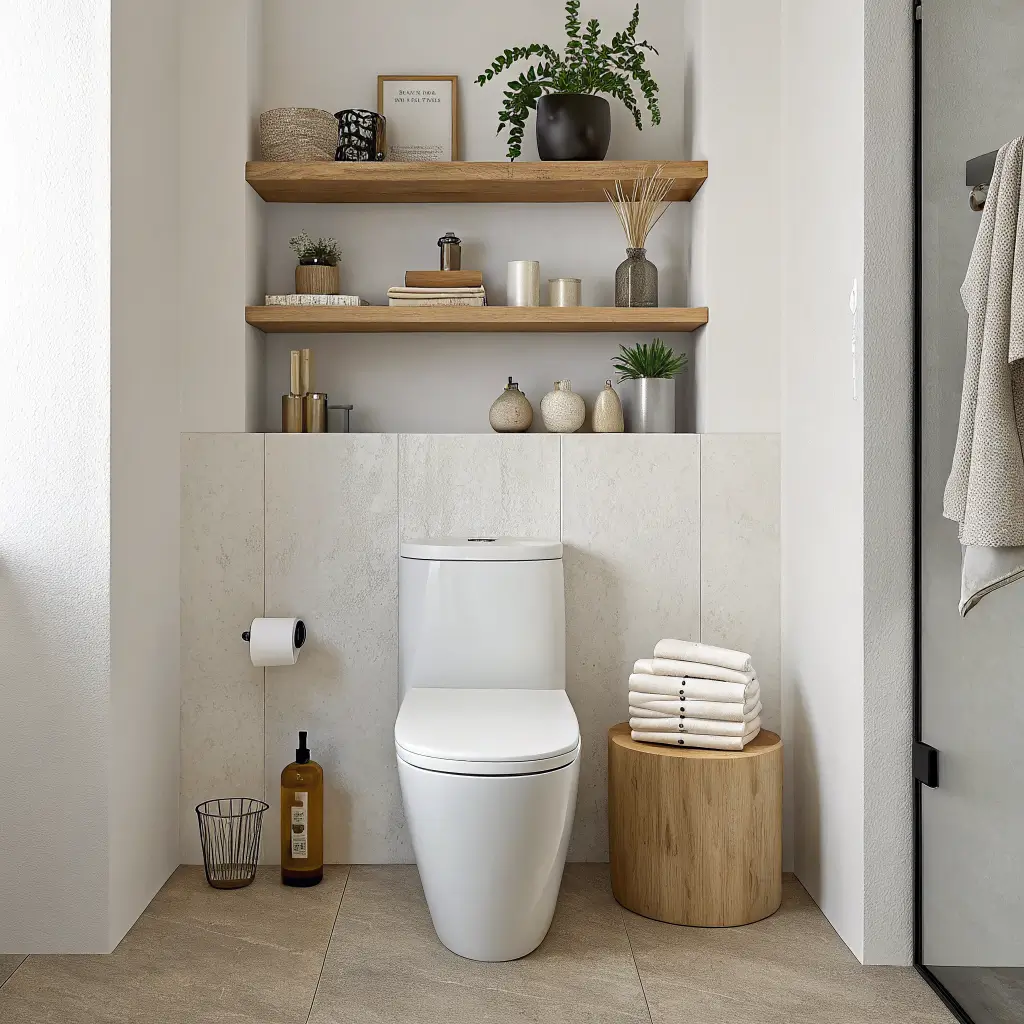
– Wall cabinet or two slim shelves over the toilet — the most underused real estate in any small bath
– Hooks instead of bars (a vertical column of three hooks holds more than a single 24″ bar and uses less wall)
– Matching lidded baskets under a floating vanity for the ugly stuff (extra TP, cleaning supplies)
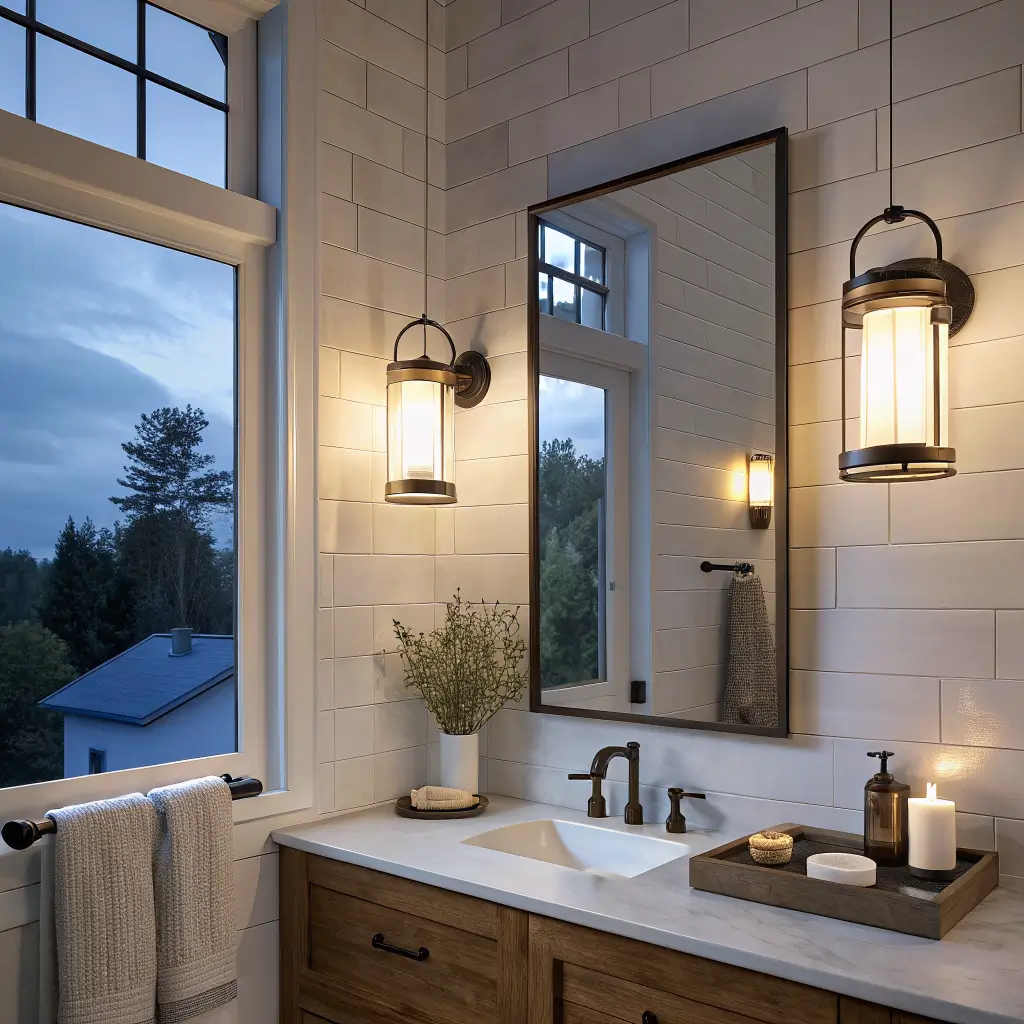
– A small tray on the counter to corral the daily three or four items. Everything else lives in a drawer.
Lighting: Where Most Small Baths Go Wrong
A single “boob light” on the ceiling with a cool blue 5000K bulb is what makes a small bath feel like a gas station restroom.
What to do instead:
– Vanity lighting first — a slim linear LED bar above the mirror, or two sconces flanking it (sconces beside the mirror give better face light, which matters if you do makeup)
– Color temperature: 3000–3500K, neutral-warm white. Not yellow, not blue.
– CRI 90 or higher so colors look right
– Dimmers if you can — task light in the morning, low light at night
Step-by-Step: How I’d Actually Do It
1. Paint the walls and ceiling the same light color. In a tiny room, painting the ceiling white and walls a different color creates a hard line that shrinks the space. Same color on both blurs the boundary.
2. Install the floor. Large tile, fewer grout lines. If you’re doing a curbless shower, run the same tile straight through — that continuous floor plane is the single biggest perceived-space trick in modern bath design.
3. Mount the floating vanity at 32–34″ and the wall-mounted faucet if you went that route (frees up sink depth and looks intentional).
4. Hang the mirror as wide as you can. Wall-to-wall if your studs allow it.
5. Install vanity lighting at the right height — bottom of sconces around 60–65″ off the floor, centered roughly at eye level.
6. Add storage: niche, over-toilet shelves or cabinet, hooks behind the door.
7. Textiles and accessories last. Two towel colors max. Low-profile bath mat in a solid color. One small piece of art on the least functional wall. A single plant — pothos or a few eucalyptus stems in a slim vase on the tank.
8. Stand at the doorway and look. Anything that visually sticks out or breaks the flow — remove it.
Common Mistakes I See (and Made)
Over-decorating. Tiny baths can’t absorb a lot of stuff. Limit yourself to 2–3 colors total, one pattern, a handful of accessories.
Bulky fixtures. Deep vanities, pedestal sinks that waste under-storage, heavy framed shower doors. All of these eat inches you can’t spare.
Ignoring vertical space. The wall above the toilet and the wall above the door are basically free storage. Use them.
Mixing four metal finishes. Pick one. Maybe a second in small doses (a brass mirror frame with otherwise black hardware works; black + chrome + brass + nickel does not).
Cool, harsh overhead lighting only. Add a vanity light. Warm the temperature. Put it on a dimmer.
Easy Updates and Variations
Seasonal swaps that don’t fight the modern base:
– Rotate hand towels and bath mat — muted terracotta in fall, soft sage in spring
– Change one small piece of art
– Swap candle scents: citrus in summer, cedar or fig in winter
Budget upgrades over time if you can’t do everything at once:
1. Faucet and hardware (biggest visual change for the money)
2. Mirror
3. Lighting
4. Paint
5. Vanity
Each one alone modernizes the room. You don’t need to do it all in one weekend.
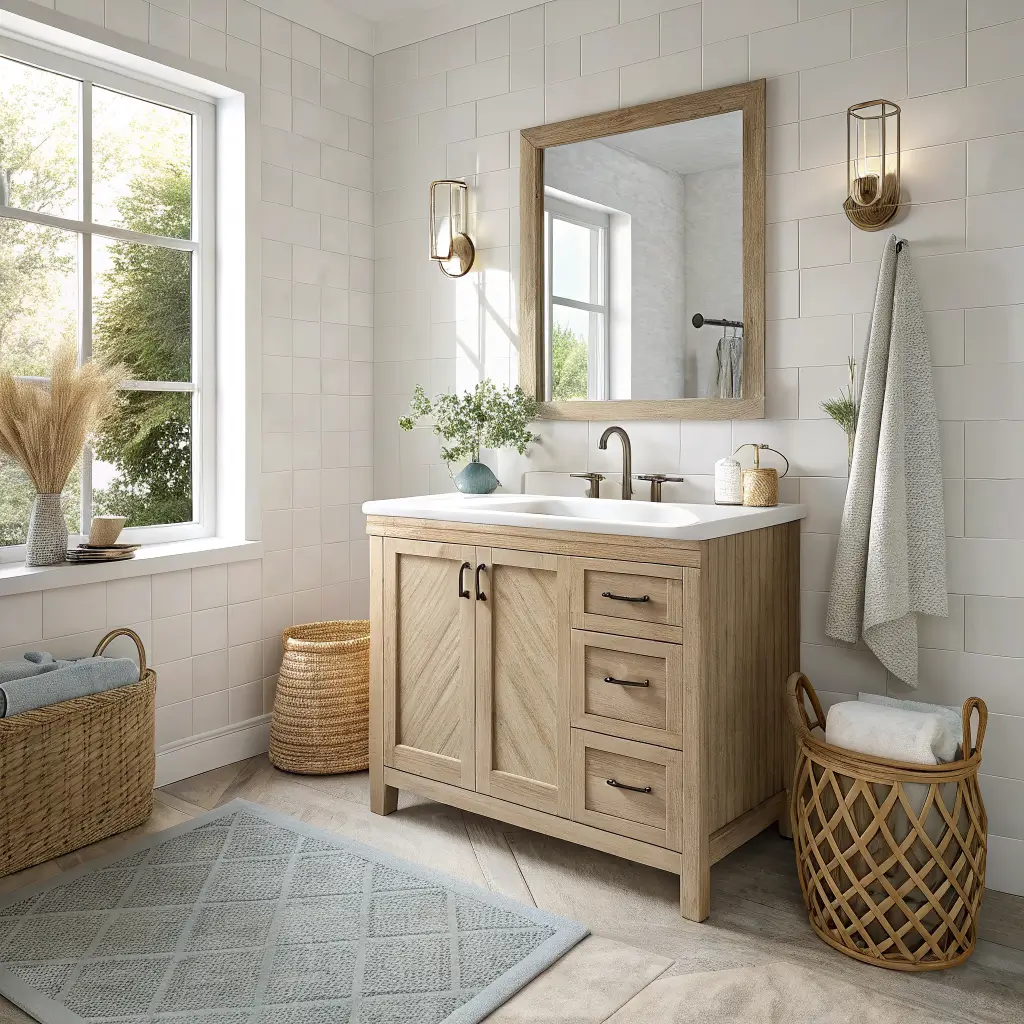
Modern + Coastal: white + sand + one muted blue, light wood, woven basket under the vanity, textured linen towels. Lines stay clean.
Modern + Japandi: stone or off-white walls, pale oak floating vanity, matte black fixtures, a single branch of dried foliage. This is the easiest direction to go in a very small space because the whole aesthetic is built around restraint.
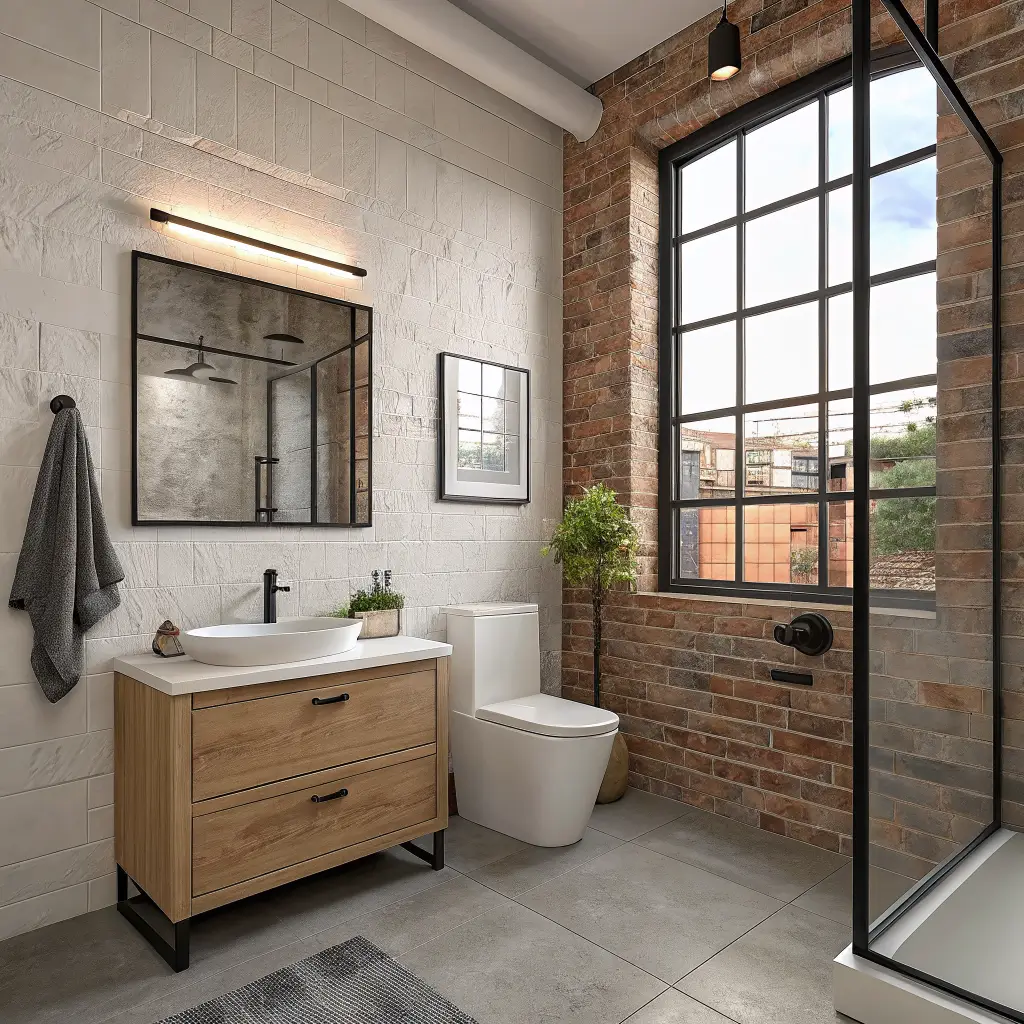
Modern + Industrial: concrete-look porcelain, black metal fixtures, a single Edison-style sconce, exposed wood shelf. Works best if you’ve got at least one architectural detail to play with — exposed brick, a beam, a real window.
The smallest bathroom I’ve ever decorated was 32 square feet. After two rounds of getting it wrong, what finally worked was almost embarrassingly simple: white walls, white ceiling, big mirror, black faucet, black hooks, one floating oak shelf, two white towels, one plant. That was it. The room reads as twice its size now, and nothing in it is expensive or hard to replace.
Restraint is the whole game in a space this small. Decide what your one statement is, then protect it from everything else.
Conclusion
The very small bathroom ideas modern that worked for my friend came from a thirty-five square foot space with a floating vanity, a large mirror, and a shower with a glass door. She had painted the walls white, added a heated floor, and hung a single shelf for towels. The room felt like a spa, not a closet, because she had chosen every piece to fit the space instead of fighting it.
More Decor Ideas to Explore
- The Very Small Bedroom Guide: How to Make 65–95 Square Feet Actually Work
- Little Bedroom Ideas: How to Maximize a Small Bedroom Without Making It Feel Like a Closet
- The Little Apartment Aesthetic: How to Style a Small Space That Feels Cozy, Cohesive, and Actually Yours
- Rustic Coastal Decor: How to Get the Look Without It Feeling Like a Beach Gift Shop