If you’ve ever stood in the doorway of your tiny bathroom wondering why it feels cramped, cluttered, and somehow both boring and chaotic, you’re not alone.
My first apartment had a 4×6 bathroom with a pedestal sink, no window, and a medicine cabinet from roughly 1987. I’ve since redone that one, helped redo two others, and learned what’s worth spending on, what’s a waste, and what fixes a room overnight.
Most tiny bathrooms fall between 18 and 40 square feet — think 3×6, 4×6, or 5×7. Powder rooms can dip under 20. Anything up to about 50 sq ft still counts as small enough that the same rules apply: scale matters, storage matters more, and lighting matters most.
– Mid-level makeover (new vanity, lighting, peel-and-stick tile, new shower setup): 2–4 weekends, $800–$3,000
– Full remodel (new tub/shower, tile, maybe layout shifts): 1–3 weeks with a contractor, $5,000–$15,000+
If you’ve never replaced a faucet, start with paint, hardware swaps, and peel-and-stick tile. Hanging a recessed medicine cabinet or installing a floating vanity is intermediate — doable, but you’re cutting drywall and hitting studs. Moving plumbing, tiling a shower pan, or adding a vent fan? Pay someone.
For a tiny bathroom, less is genuinely more. Every extra material, finish, or trinket eats square footage visually. The styles that work in small footprints:
– Japandi / modern minimalist: light oak, soft white, wall-hung everything, almost no visible hardware. Best for windowless baths.
– Scandi spa: white walls, light wood vanity, big mirror, plush textiles, one plant. The forgiving choice.
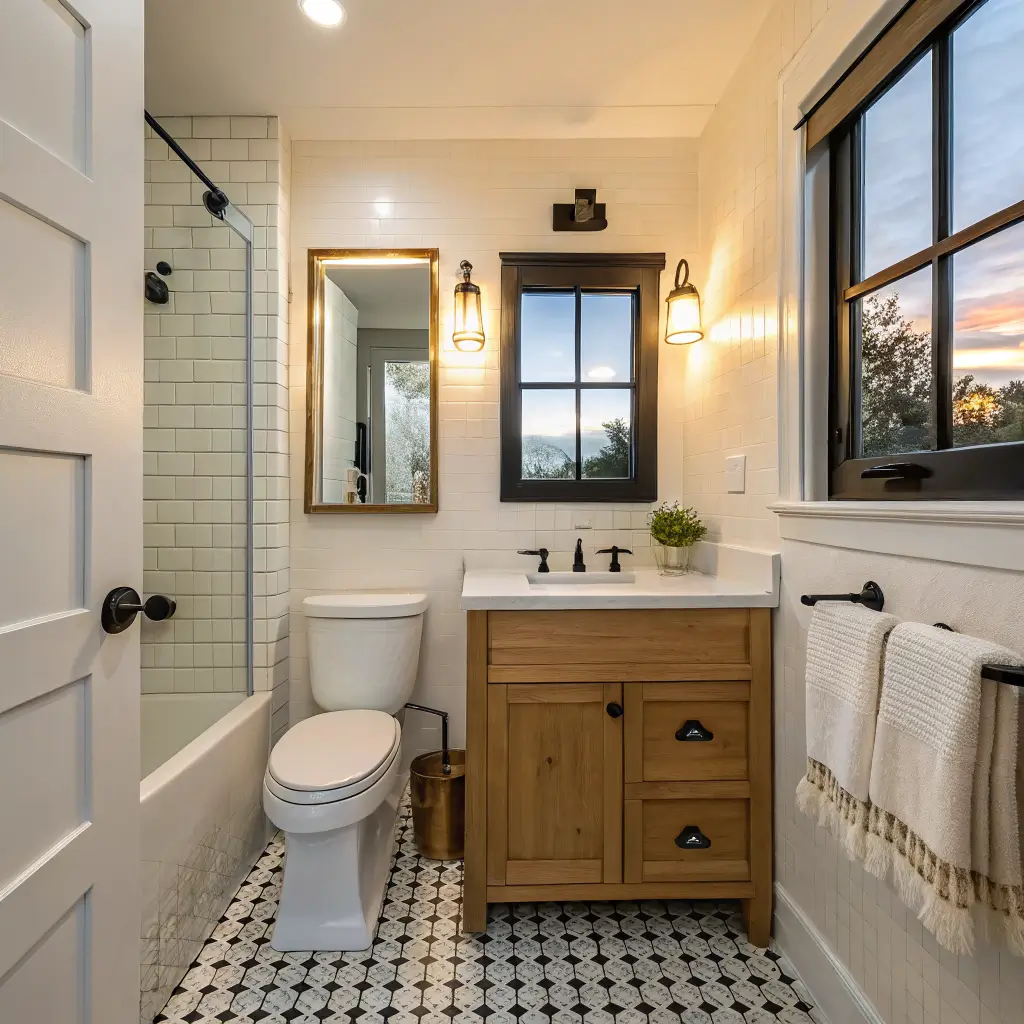
– Transitional with vintage bones: white subway tile, black or brass hardware, a slim console sink, maybe a tub under 54 inches.
– Jewel-box powder room: this is where you go loud. Deep navy, emerald, oxblood, or a wild wallpaper. Half baths get no real use, so they can absorb risk.
In my current house, the powder room is painted Farrow & Ball Hague Blue from ceiling to baseboards with unlacquered brass fixtures, and it’s the thing every guest comments on. The main bath two feet away is warm white with a white oak floating vanity. Different jobs, different moves.
Stick to 24–30 inches wide for a single sink. A 36-inch vanity can work if the room allows, but I’d rather have floor showing than another six inches of cabinet.
A floating vanity is the single biggest visual upgrade for a tiny bath. Seeing floor under the cabinet tricks the eye into reading the room as larger. Big-box single-sink vanities with tops run $250–$900; floating versions tend to start around $400.
In a powder room, skip storage entirely and use a console or pedestal sink. You don’t need to stash shampoo where guests wash their hands.
Mirror
Go bigger than feels reasonable. A mirror that runs nearly wall-to-wall above the vanity will visually double the room. If you need storage, get a recessed medicine cabinet with integrated LED lighting — the kind with an interior outlet for electric toothbrushes is worth the upgrade ($300–$600 range).
Toilet
A round-front bowl saves about two inches versus elongated. Wall-hung toilets are gorgeous and free up floor, but the in-wall tank install is a real project and you’ll pay for it.
– Over-toilet cabinet or shelves — this is dead space otherwise
– Tall linen tower running to the ceiling (a 12-inch-deep tower in a corner can hold a month of towels)
– In-wall niches in the shower and on any spare wall — cheap when the wall is already open
– Hooks beat towel bars in family baths. Six hooks on the back of the door changed our morning routine.
Shower or tub
If you’re remodeling, a curbless shower with a single glass panel opens the room more than any other single move. Continuing the floor tile straight into the shower extends the visual floor.
Keeping a shower curtain? Get a curved rod. It’s a $25 fix that adds real elbow room and makes the tub read larger.
A single ceiling light over the room means your face is shadowed at the mirror and everything else feels like a cave. The fix is layers:
– Ambient: recessed cans on a dimmer (or a flush mount)
– Task: sconces flanking the mirror, or a vanity bar light above. Sconces look more custom; bar lights are fine if you don’t have the wall space.
– Mirror lighting: in a windowless bath, an integrated LED mirror or backlit medicine cabinet pulls double duty
Sconces flanking the mirror should sit about 60–66 inches from the floor, roughly eye level. I’ve installed them too high twice and had to patch and redo it. Learn from me.
Where to Spend, Where to Save
Spend:
– Mirror or mirrored cabinet (the room’s focal point)
– Faucet (you touch it every day; cheap ones look cheap fast)
– Lighting
– Tile in the wet area
Save:
– Towel bars, hooks, toilet-paper holder — Amazon and big-box are fine if the finish matches
– Shower curtain and liner
– Vanity, honestly — a $400 box-store vanity with a swapped faucet and new pulls looks expensive
Trying to cram in too much. Double vanities in a 5×7 bath. A 60-inch tub when a 54 would’ve left room to actually stand. Pick a layout that lets you move.
Open shelving full of stuff. I tried floating shelves in my first bath and within a week they held seven half-empty bottles and a tube of toothpaste. Closed storage for 90% of things. Open shelves get three styled items max: stacked towels, a small plant, a candle.
Forgetting vertical space. The wall above the toilet, above the door, between studs — all storage you’re ignoring.
Too many materials. One main tile, one accent. One or two metal finishes. If you’re picking a third metal you’re making a mistake.
Stark white everything. It looks clinical and shows every smudge. Warm it up with wood, brass, or a textured textile.
The reason I love bathroom decor is that small swaps actually change the room. Quick levers:
– New towels and bath mat in a tighter color palette — I do navy and white in summer, rust and cream in fall
– Swap the shower curtain (waffle weave in white is my default; a printed one for color)
– Replace the cabinet pulls with something brass or matte black ($3–$15 each)
– Decant soap and shampoo into matching pump bottles — sounds fussy, looks expensive
– One framed print swapped seasonally
– Eucalyptus stems hung from the showerhead — they release scent when it gets steamy and last about a month
Plants That Survive in a Windowless Bath
Pothos, snake plant, and ZZ plant will all tolerate low light and humidity. If you have zero natural light, a small grow bulb in the overhead fixture keeps them alive. A pothos trailing off the top of a tall cabinet softens every harsh edge in the room.
My main bathroom started as a 5×7 with a beige tile floor, oak vanity from the early 2000s, a plastic builder-grade light bar, and one of those frameless mirrors glued to the wall. Total spend to fix it: about $1,400.
What I did:
– Painted the walls and ceiling Benjamin Moore White Dove
– Replaced the vanity with a 30-inch floating white oak unit ($580)
– Hung a 32-inch round black-framed mirror ($120)
– Two black sconces flanking the mirror ($180 for the pair)
– Black matte faucet, towel bar, hooks, and TP holder ($160 total)
– Peel-and-stick black-and-white checkered floor over the existing tile ($90)
– New white waffle shower curtain on a curved rod ($55)
– Tall white linen cabinet in the corner ($210)
It reads as a completely different room and people assume it cost five times what it did. The floating vanity and the oversized mirror did the heaviest lifting. If you only do two things, do those.
The tiny bathroom ideas that worked for my friend came from accepting that the room was four feet wide and there was nothing she could do about it. She painted the walls white, added a mirror that covered one entire wall, and hung a shelf above the door for towels. The sink was a pedestal, the toilet was a compact, and the shower was a corner unit with a curved door. It was not luxurious. It was functional. And that was enough.