How to Design a Luxurious Walk-In Closet That Actually Feels Like a Boutique

The Look and Who It’s For

Think boutique-inspired contemporary with a little glamour — not Vegas glam, more like the back room of a small designer shop in a hotel lobby. The bones are clean and built-in. The lighting is layered. There’s usually an island, always a mirror, and somewhere to sit while you put on shoes.

It works for:

– Anyone with a primary suite walk-in they want to actually enjoy
– Couples splitting one closet who need defined zones
– People with real handbag, shoe, or jewelry collections that deserve display
– Spare rooms being converted into dressing rooms

You don’t need a huge footprint. My closet is 9 by 11 feet, which is medium at best, and the island fits because I went narrow (more on that later). Smaller closets can pull this off too, but you’ll lean harder on mirrors, vertical storage, and reflective surfaces instead of a center island.
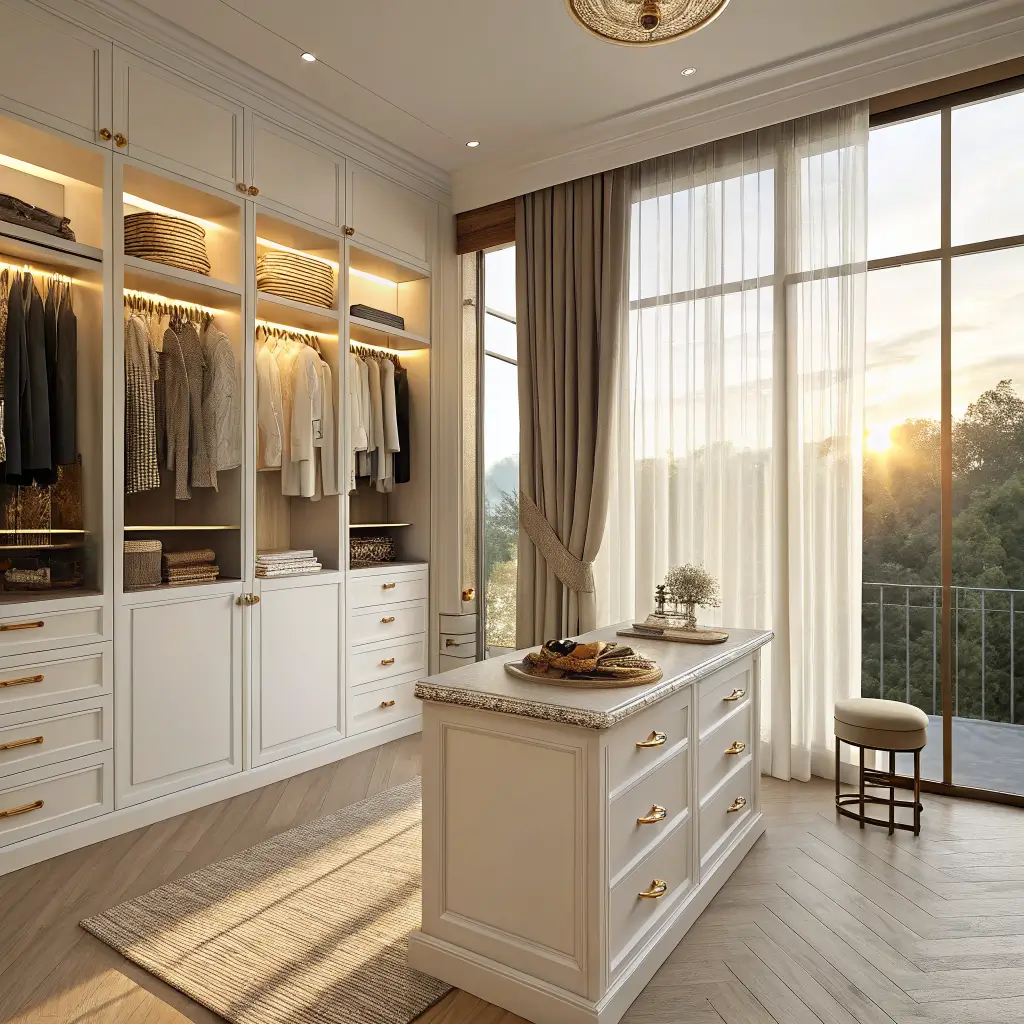
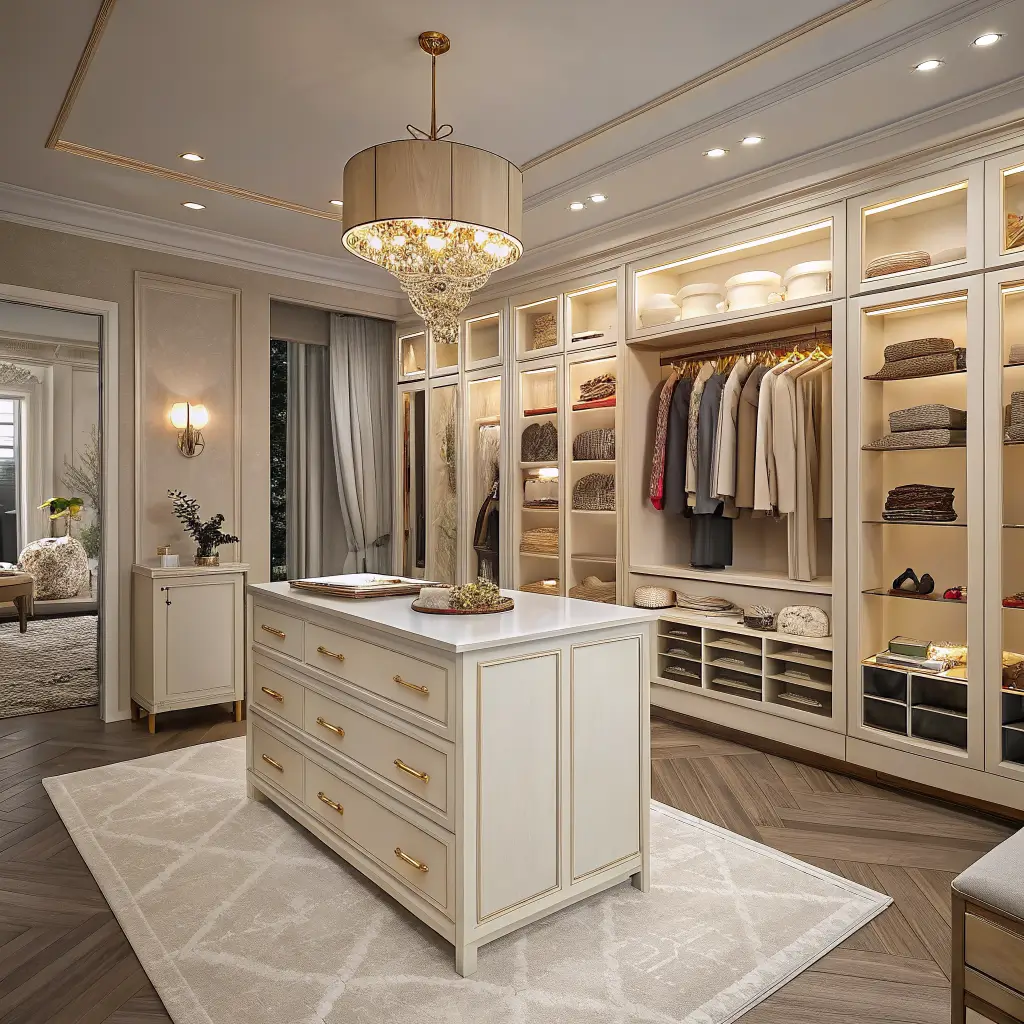
Photorealistic golden-hour view of a luxurious boutique walk-in closet with warm white cabinetry, light oak interiors, glass-front handbag displays, a quartz-topped island, cream runner, and ivory bouclé stool.

What This Actually Costs and How Long It Takes

A styling-only refresh — new hardware, LED strips, velvet drawer liners, a stool, better trays — is a weekend project and runs $400 to $1,500 depending on how far you go.

A full custom buildout with cabinetry, an island, glass-front doors, and integrated lighting is a different animal. Expect 6 to 14 weeks from measurement to install if you go custom, and budgets that start around $8,000 for a modest walk-in and climb past $30,000 quickly once you add marble tops, glass, and a designer chandelier. IKEA PAX with upgrades sits in between — maybe $2,500 to $5,000 if you DIY the install and add custom fronts from Semihandmade or similar.

Skill level: intermediate to expert for a real buildout. If you’re doing PAX with upgraded doors and adding LED strips, an organized intermediate DIYer can pull it off in a long weekend.

Close-up of a luxury walk-in closet: backlit handbags in a glass cabinet, heels on angled shelves, and a half-open velvet drawer with watches in warm oak and champagne bronze accents.

The Pieces That Actually Make It Look Luxurious

Most of the “luxury closet” Pinterest images you’ve saved share the same handful of elements. Skip any one of these and the room reads as just storage.

The non-negotiables:

Floor-to-ceiling built-ins. No gap between cabinetry and ceiling. That single detail separates expensive-looking from rental-grade.
A center island, even a narrow one. Mine is 24 inches deep by 5 feet long with three drawers and a quartz top. Tight, but it works.
Glass-front cabinets for handbags and folded knits. This is the boutique cue.
Dedicated, angled shoe shelves — flat shelves waste space and look sloppy.
Velvet-lined drawers for jewelry and watches. I bought drop-in inserts from Amazon for about $30 each instead of paying for custom millwork.
A full-length mirror. Not optional. Get one that’s at least 65 inches tall.
Layered lighting (more below — this is the thing people skip).
Somewhere to sit. An ottoman, a small bench, a vanity stool.

Hardware matters more than you think. Soft-close everything. Cheap drawer slides are the fastest way to make a beautiful closet feel like a flip.

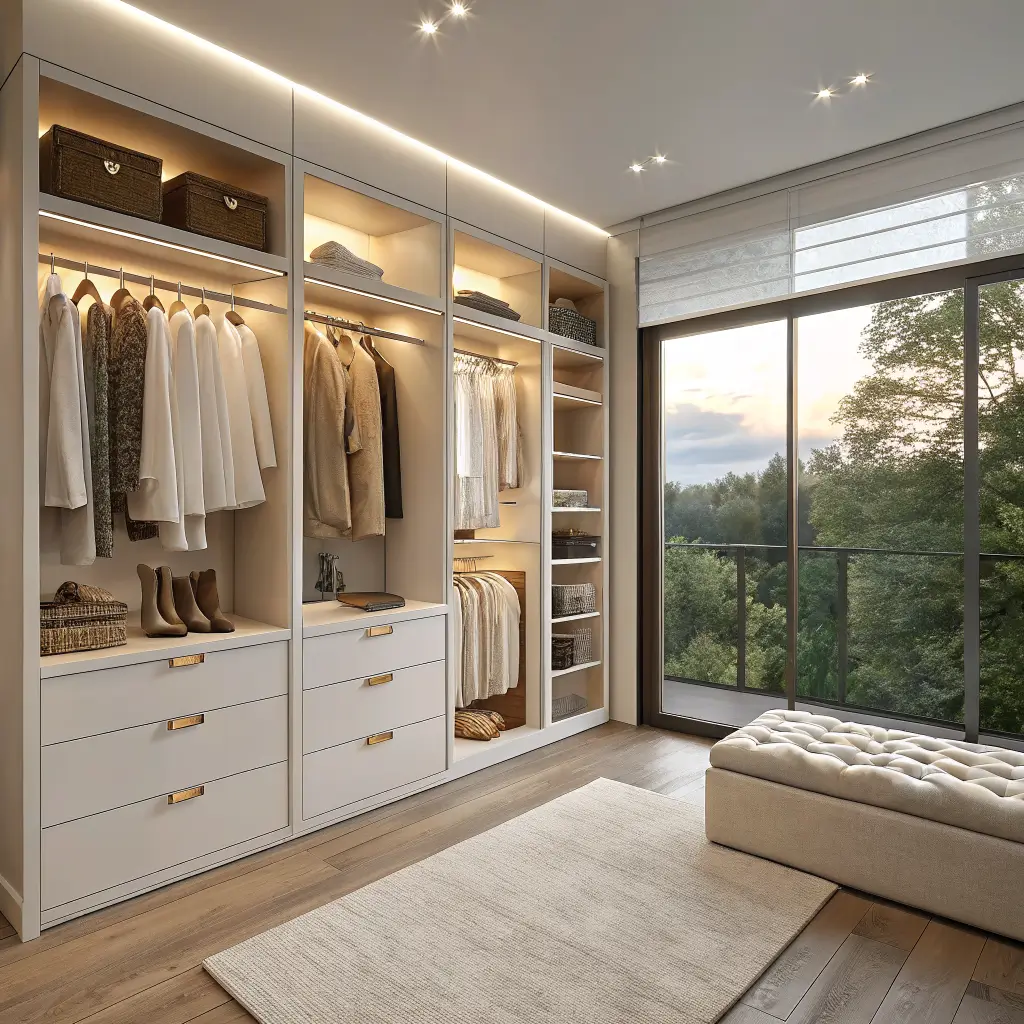
Photorealistic small walk-in closet with warm white IKEA PAX-style cabinetry, glass-lit upper shelves, champagne bronze pulls, leaning full-length mirror, ivory bench, and cream runner in soft daylight.

Colors and Materials That Read as Expensive

I tried a charcoal-and-brass scheme first. It looked moody in photos and like a cave in person, especially in the morning. Switched to warm white cabinetry with light oak interiors and champagne bronze hardware, and the room got bigger and calmer immediately.

Palettes that consistently work:

– Warm white + light oak + champagne bronze
– Ivory + walnut + matte black hardware
– Soft taupe + cream + polished nickel
– Matte black + white marble + brass (high-contrast, harder to pull off)

Rule of thumb: pick 2 to 4 colors total, and stop. That includes wall paint, cabinet finish, countertop, and metal. Any more and it starts to look busy.

Materials worth the spend:

– Quartz or marble island top (quartz is more forgiving, marble photographs better)
– Real wood or high-quality wood-look thermofoil cabinetry
– Glass cabinet fronts, ideally with a slim metal frame
– Velvet drawer liners
– A wool or wool-blend rug — synthetic rugs cheapen everything around them
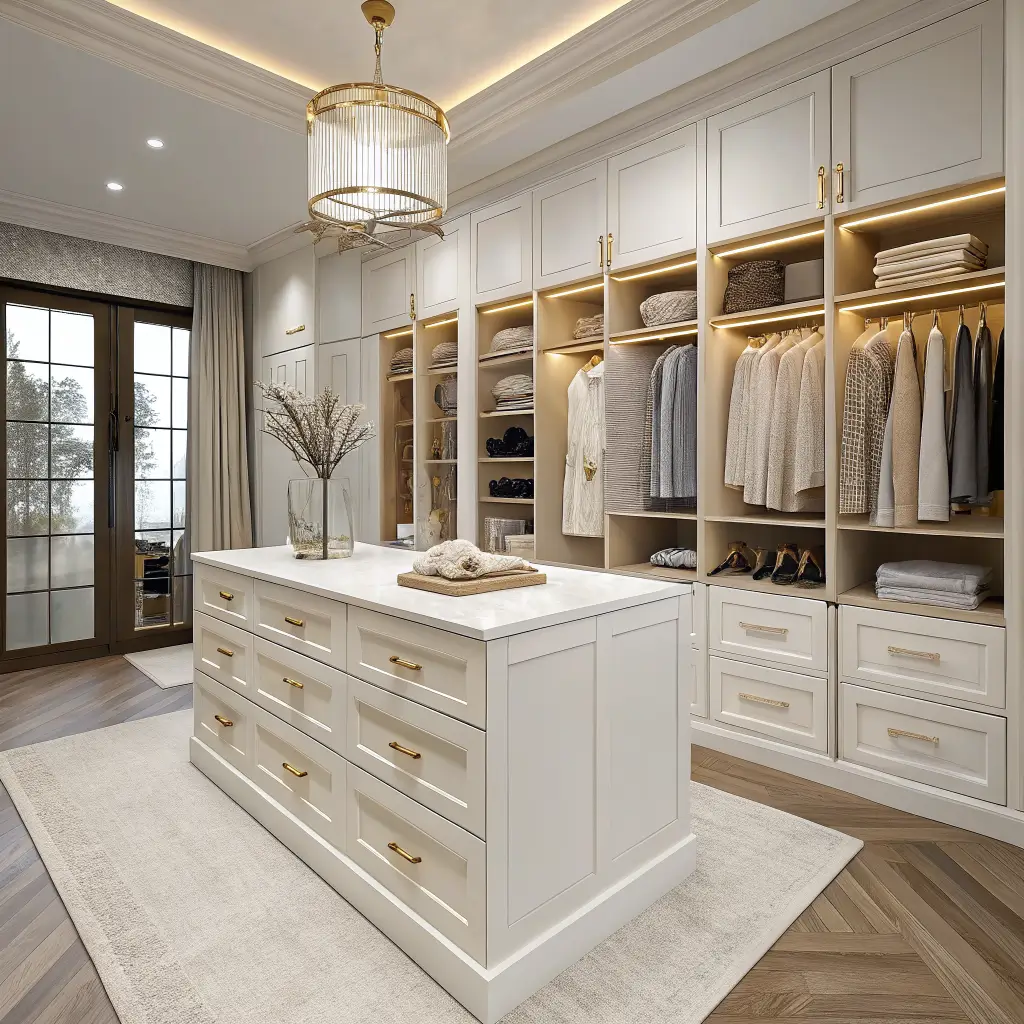
Overhead three-quarter view of a luxe walk-in closet with a narrow white quartz waterfall island, minimal styling on top, and warm white built-ins with oak interiors under soft morning light.

Lighting Is What People Get Wrong

If I could only fix one thing in an average walk-in to make it feel luxurious, it’d be the lighting. A single ceiling fixture flattens the room and creates shadows exactly where you don’t want them — on faces, in drawers, under shelves.

You need three layers:

1. Ambient. Recessed cans or a flush mount for overall light. A chandelier or pendant counts here and adds the focal-point moment.
2. Task. LED strips under every shelf and inside every drawer. The strips I use are 24V hardwired, dimmable, in a 2700K warm white. Battery-operated motion strips work for renters but look thinner.
3. Accent. Backlit niches or illuminated rods behind glass-front cabinets. This is the boutique trick — it makes a row of bags look merchandised instead of stored.

Color temperature: stay between 2700K and 3000K. Cooler than that and the room looks like a dental office, and your clothes will read different colors than they do in daylight.

Photorealistic luxury walk-in closet in warm white and light oak with champagne bronze hardware, quartz island, cream runner, color-sorted clothing behind glass, and layered evening lighting in symmetrical one-point perspective.

Laying It Out

Before any of the pretty stuff, you have to plan storage around how you actually dress.

Pull everything out. Sort into four piles: daily, seasonal, special occasion, accessories. Daily gets the prime real estate at eye and arm level. Seasonal goes up high. Special occasion can go in a less convenient spot. Accessories get their own zoned area.

Then measure: wall lengths, ceiling height, door swings, and how much floor clearance you actually need. You want at least 36 inches of clear aisle around an island, 42 inches is better. If you can’t hit 36, skip the island and do a built-in dresser on one wall instead.

Layout options based on size:

Under 6 feet wide: single-wall storage, mirrored back wall, slim bench
6 to 8 feet wide: double-sided perimeter, no island
8+ feet wide: perimeter plus island, if aisle clearance works

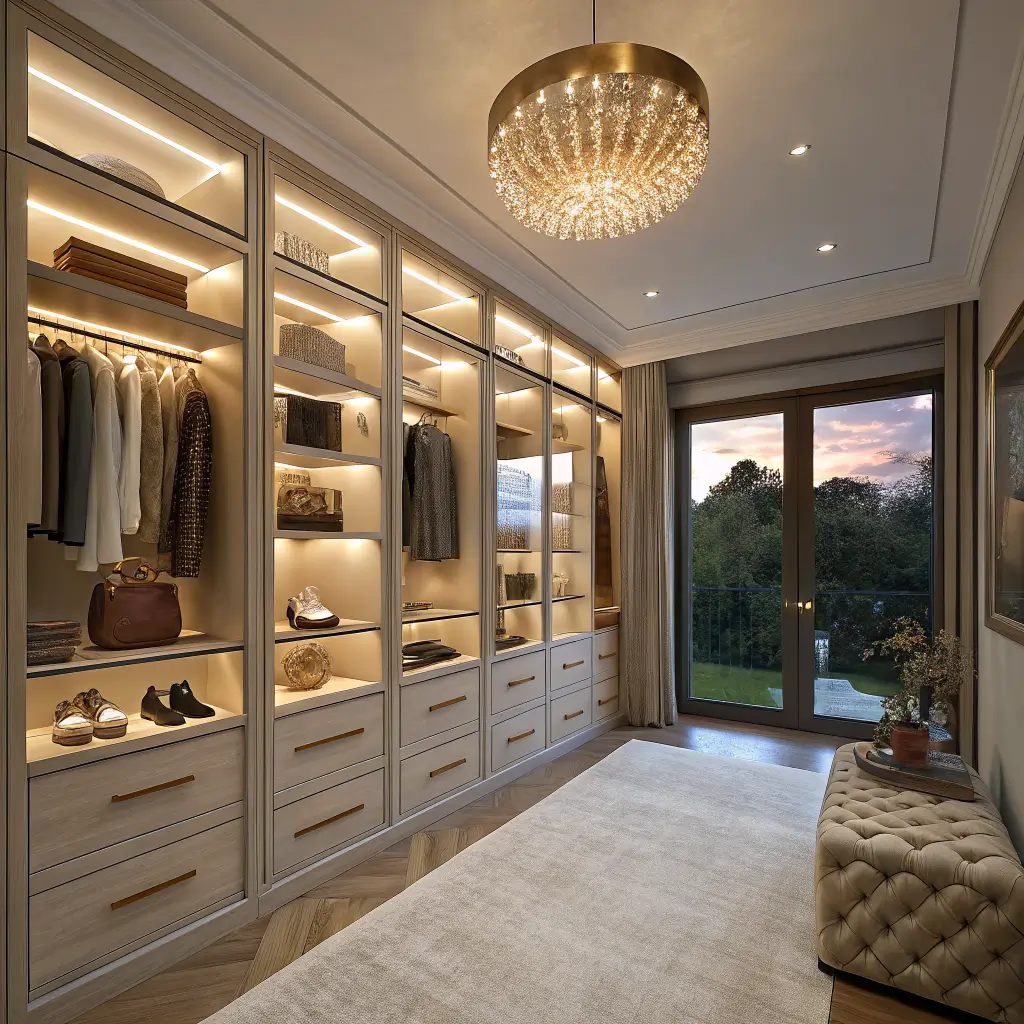
Photorealistic luxury walk-in closet at dusk with warm LED shelf lighting, glowing glass-front cabinets, and a champagne bronze pendant over organized shoes and cashmere.

Putting It All Together

Once cabinetry is in, the styling sequence I’d follow:

1. Hang clothes by category and color. This sounds obsessive but it’s what creates the “calm” look.
2. Load shoes onto angled shelves, toes facing out, most-worn at eye level.
3. Put bags behind glass with the strip lights on — space them out, don’t line them up touching.
4. Set up the island top with one tray, one small vase or object, one stack of folded items. That’s it. Resist the urge to decorate further.
5. Add jewelry inserts to drawers.
6. Hang the mirror where you have at least 4 feet of space to step back.
7. Bring in the rug or runner last.

The island staging is where people lose the plot. Mine has a low brass tray for whatever I’m wearing tomorrow, a small ceramic dish for earrings, and a candle. That’s the whole surface. Anything else and it becomes a junk drawer with a marble top.
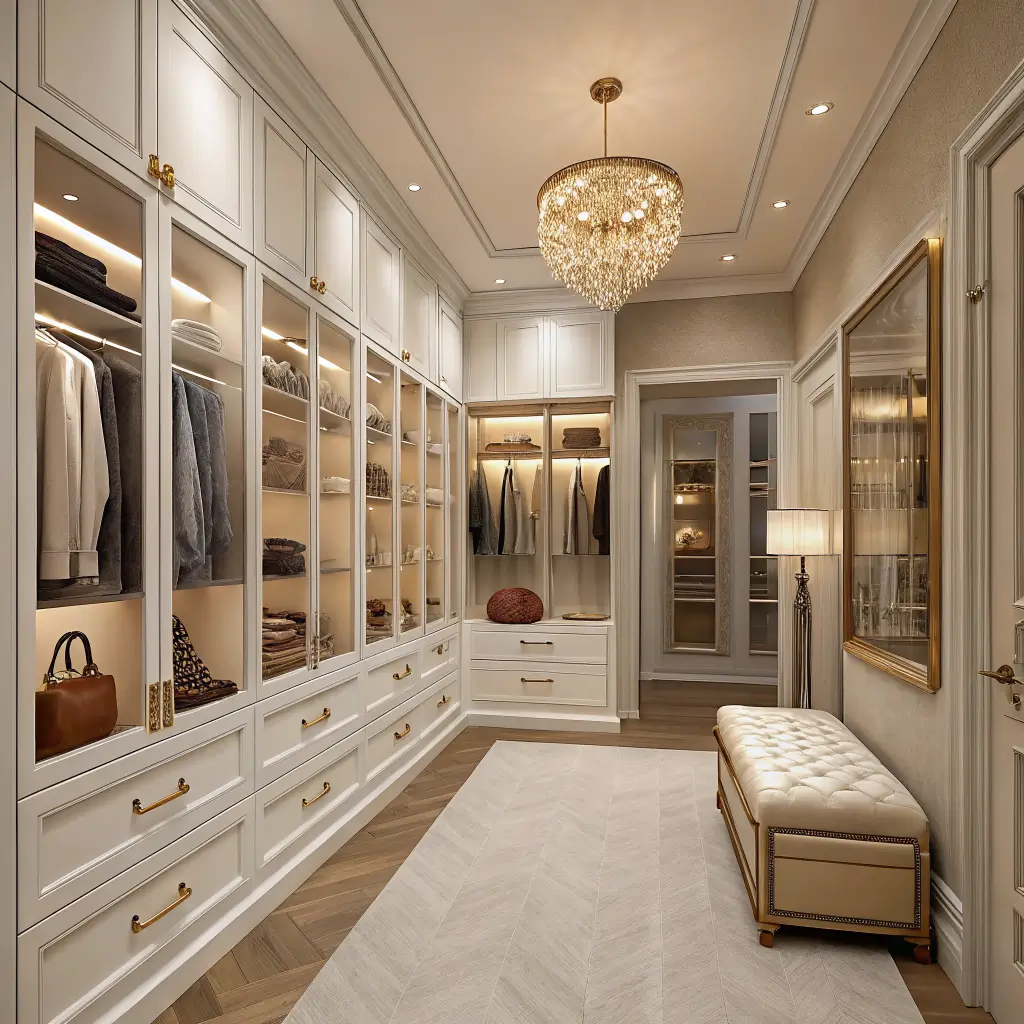
Photorealistic his-and-hers walk-in closet with warm white cabinetry, light oak interiors, bronze pulls, menswear hanging left, handbags and shoe shelves right, ivory bench under mirror, cream runner, viewed symmetrically from doorway.

Mistakes I’ve Made (and Watched Others Make)

Overstuffing open shelves. A luxury closet needs empty space around objects. If a shelf is 80% full, it looks crowded. Aim for 50 to 60%.
One overhead light and calling it done. Already covered, but worth repeating.
Mixing four wood tones because they “all kind of go.” They don’t. Pick one wood and one metal and commit.
Buying the chandelier first. Pick the fixture last, once you know cabinet color and ceiling height. I bought a gorgeous beaded chandelier before measuring and had to return it because it hung into the door swing.
Forgetting the bench or stool. A closet you can sit down in feels finished. One you have to lean against a wall in feels unfinished, no matter how nice the cabinets are.
Cheap drawer pulls on otherwise nice cabinets. Hardware is jewelry for the room. Spend the $8-15 per pull, not $2.

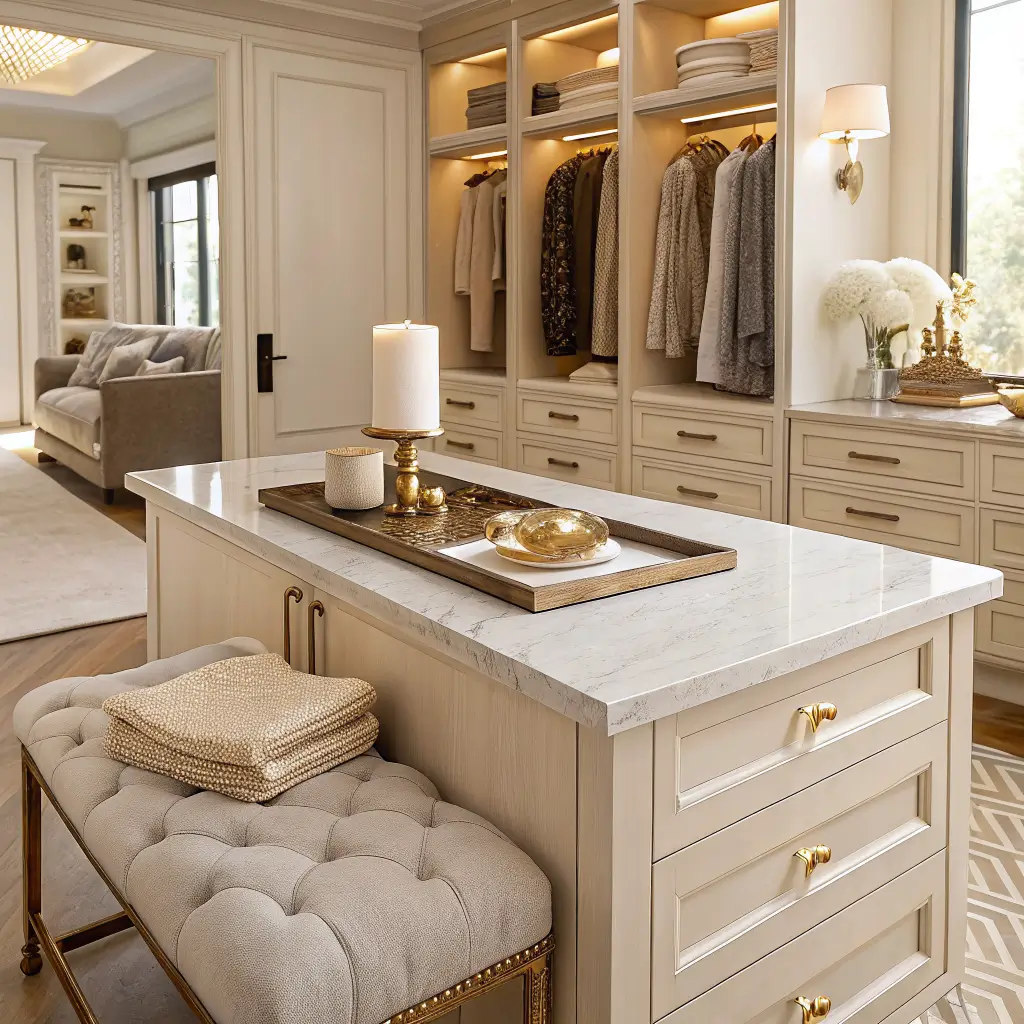
Photorealistic walk-in closet vignette with a quartz-topped island and brass tray holding a silk scarf, gold bracelet, pearl earrings, and ivory candle beside an ivory bouclé ottoman, warm white cabinetry, and backlit handbags in soft afternoon light.

Budget-Friendly Versions of the Same Look

If a full custom buildout isn’t happening, here’s where to put money:

Spend on:

– LED strip lighting (the single best dollar-for-dollar upgrade)
– Hardware to replace whatever came with your closet system
– A real full-length mirror, framed
– One quality piece of seating

Save on:

– Drawer organizers (Amazon velvet inserts are nearly identical to custom)
– Storage boxes (matching set from Target or Container Store)
– Rug (a good wool runner under 5 feet is cheap)
– Hangers — but matching them all is critical. Wood or velvet, pick one, throw the rest away.

A realistic budget-luxury PAX setup with custom-look doors, LED strips, new hardware, velvet drawer liners, matching hangers, a framed mirror, and a small upholstered stool comes in around $2,200 to $3,500 and looks shockingly close to a $15,000 custom job in photos.

Easy Updates Without Redoing Everything

Once the bones are in, the room shouldn’t need much. What I rotate:

– Trays on the island (swap brass for matte black for a different mood)
– A throw pillow on the bench
– Off-season clothes moved to upper cabinets so display shelves stay clean
– A small framed print swapped out once or twice a year

That’s the whole appeal of this style — it’s built around permanence and edited storage, not seasonal decor. Once you get it right, you mostly leave it alone.

Quick Answers to the Questions That Always Come Up

What’s the ideal size? Anything 7 by 8 feet and up can comfortably handle the look. 10 by 12 and up gives you island room.

Is an island worth it? If you have 36+ inches of clearance around it, yes. If not, a built-in dresser does the job and you keep the floor open.

What colors make a closet look more expensive? Warm neutrals — ivory, soft taupe, warm white — with one wood tone and one metal. High-contrast schemes (black and white) work but are harder to execute.

How do you organize shoes and bags? Shoes on angled shelves, sorted by heel height or category. Bags behind glass with lights, spaced out, stuffed so they hold shape. Both should look like a store display, not a pile.

How much does custom cost? A small custom walk-in starts around $8,000. A primary suite buildout with island, glass, marble, and integrated lighting runs $20,000 to $50,000+ depending on materials and region.

Now go pull everything out of your closet. That’s always step one, and it’s the part nobody wants to do.
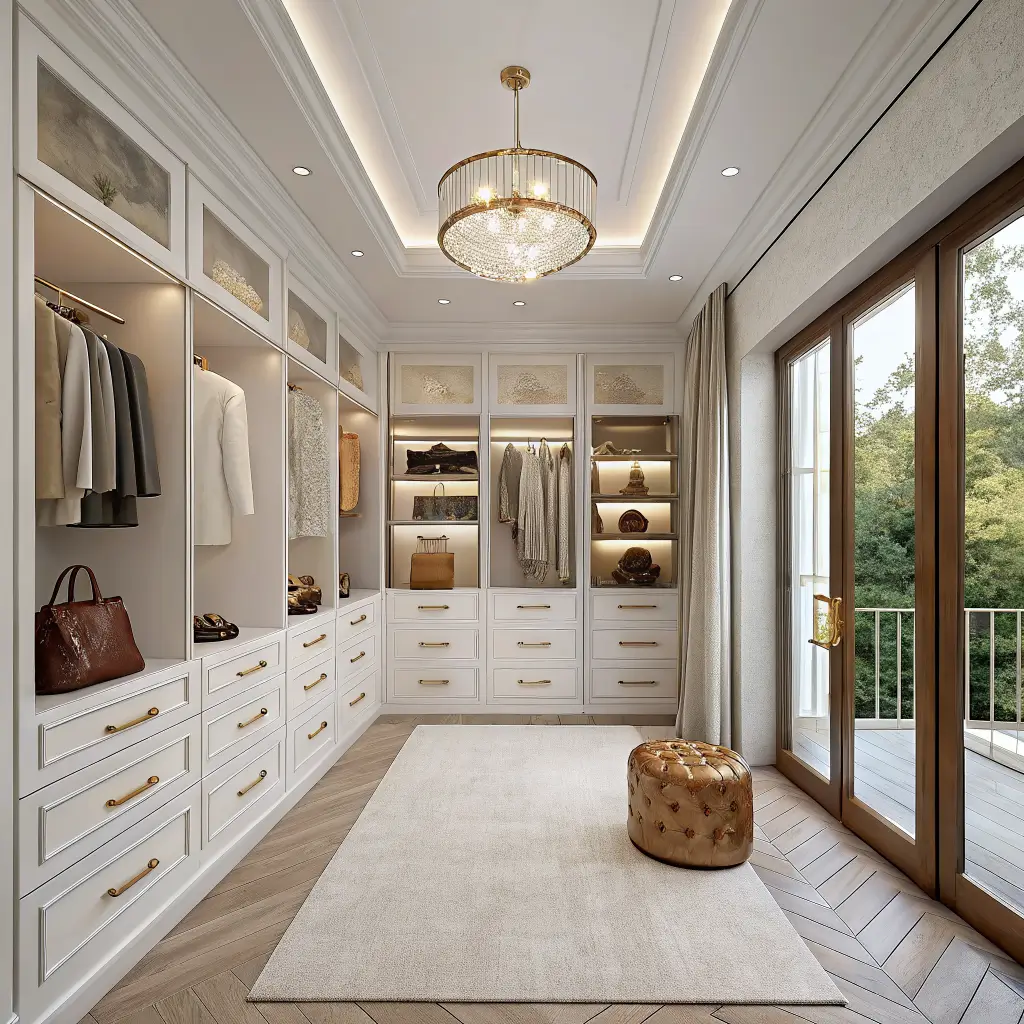
Photorealistic luxurious walk-in closet with warm white floor-to-ceiling built-ins, light oak shelving, champagne bronze accents, styled open shelves with spaced handbags and folded knits, quartz island, cream runner, and small bronze pendant in midday light.

Conclusion

The luxurious walk in closet that felt like a boutique to me had a single chandelier, a velvet ottoman in the center, and shelves that displayed shoes like they were sculpture. The owner had organized everything by color, hung bags on hooks that looked like branches, and left a single vase of white flowers on the dresser. She said she spent more time in there than she did in her living room, and she had designed it accordingly.

Scroll to Top