The Look and Who It’s For
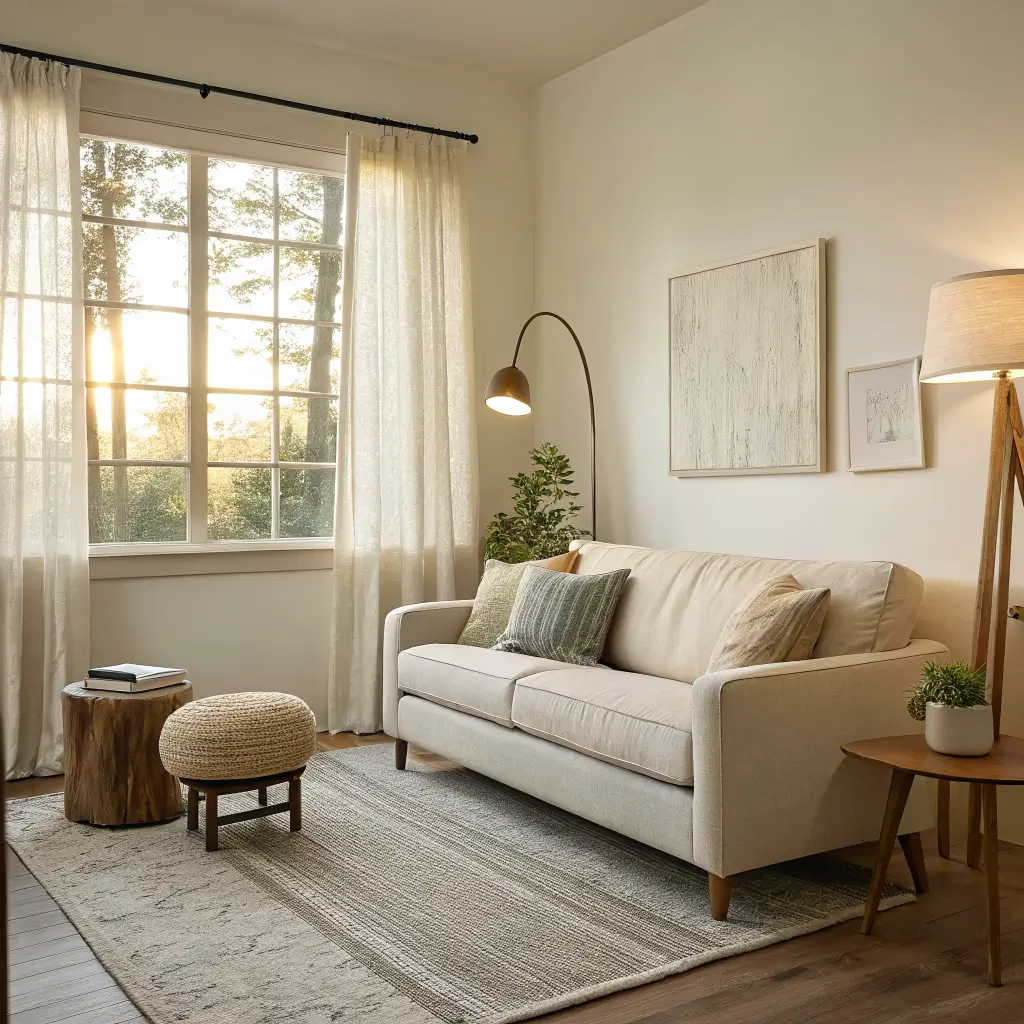
The base style I keep coming back to is modern small-space living: clean lines, legs visible under furniture, multi-functional pieces, and one strong focal point instead of five competing ones. From there it bends easily into soft Scandi, Japandi, or a slightly layered cozy-eclectic if you want more warmth.
This works for:
– Renters in studios or one-bedrooms who need flexible seating
– Condo owners with combined living/dining areas
– First-time buyers stuck with a tight front room
– Anyone who mainly uses the room for lounging, TV, and the occasional work-from-couch day
If you regularly host eight people for dinner parties, this isn’t your guide. If you host four people twice a year and otherwise want to read on the sofa, keep going.
Time, Cost, and Skill Reality Check
Fast refresh (3–5 hours): rearranging, decluttering, swapping pillows and throws, adding two or three new pieces.
Full rethink (1–2 weekends): paint, key furniture swap, lighting overhaul, including drying and delivery time.
Rough budget brackets I’ve actually hit:
– Budget makeover ($250–$800): flatweave 5×7 rug ($70–$200 from IKEA, Target, or Rugs USA), compact loveseat ($250–$700), two wall shelves ($20–$80 each), storage ottoman ($60–$200).
– Mid-range ($800–$2,500): small chaise sectional or quality loveseat ($800–$1,500), one leggy accent chair ($250–$800), layered lighting trio ($150–$600).
– Big-ticket optional: large-format porcelain feature tile at $5–$15 per square foot plus install, or a wall-mount electric fireplace at $200–$1,000+.
Skill-wise: rearranging, mounting a TV, putting up floating shelves, painting — beginner to intermediate. Slab tile or stone install — hire someone. I tried to DIY a peel-and-stick tile feature wall once. It bubbled within a week. Pay the pro or skip it.
Paint Colors That Actually Make a Small Room Feel Bigger
The instinct is bright white. The reality is bright white can read flat and cold, especially with one window.
What I reach for now:
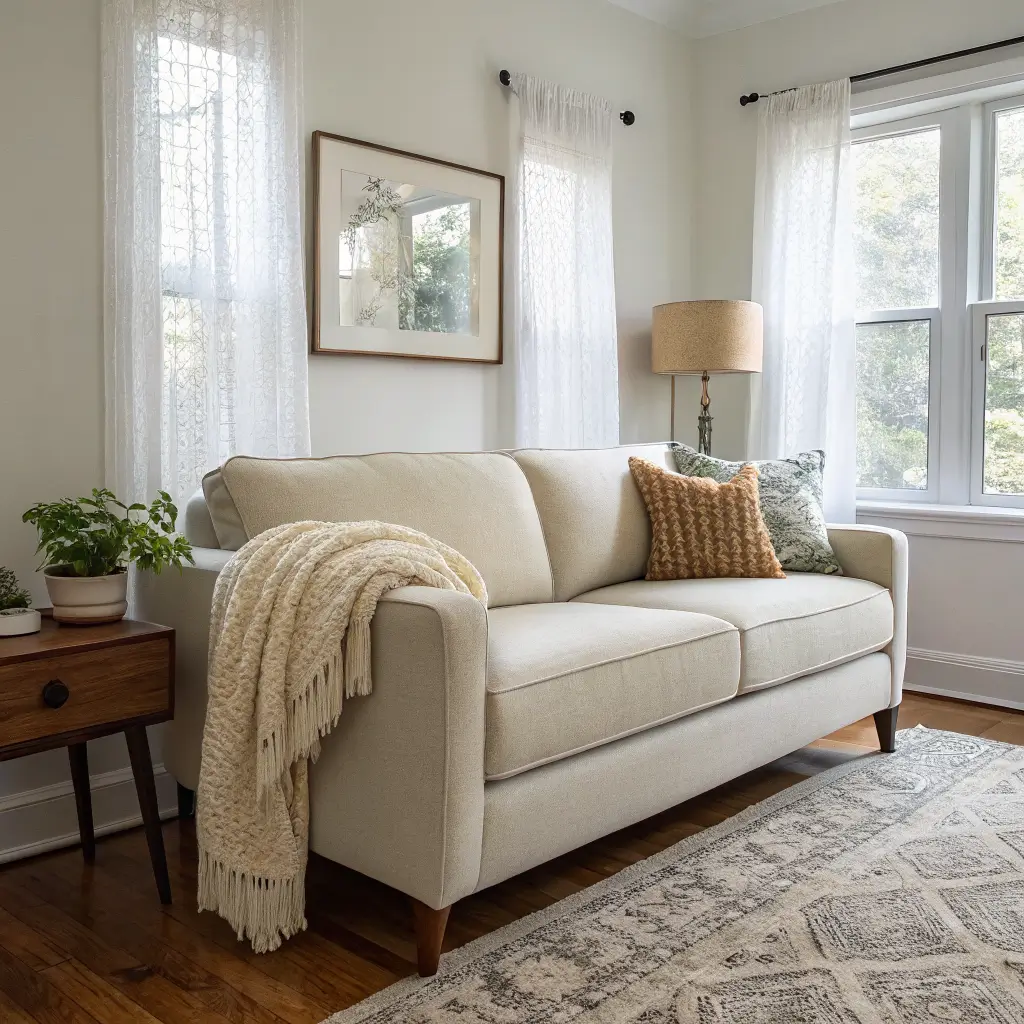
– Warm whites like Benjamin Moore Swiss Coffee or Chantilly Lace — they reflect light without going clinical
– Soft greiges in oatmeal or pale taupe ranges if your room gets warm afternoon light
– Muted pastels like dusty sage or faded blue, used as the whole-room color rather than an accent
The trick that changed my current living room: color drenching. Walls, trim, and ceiling all in the same soft shade (mine is a chalky off-white with a green undertone). The room reads bigger because your eye stops catching on edges and contrast lines. It sounds counterintuitive — paint the ceiling? — but in a tiny room with low ceilings, breaking it up with bright white trim actually shrinks the room.
For accent colors, use them in 10% doses max: deep navy, brick red, muted moss, or burnt terracotta in pillows, art, or a single chair.
The Hero Pieces
Get these right and the rest falls in line.
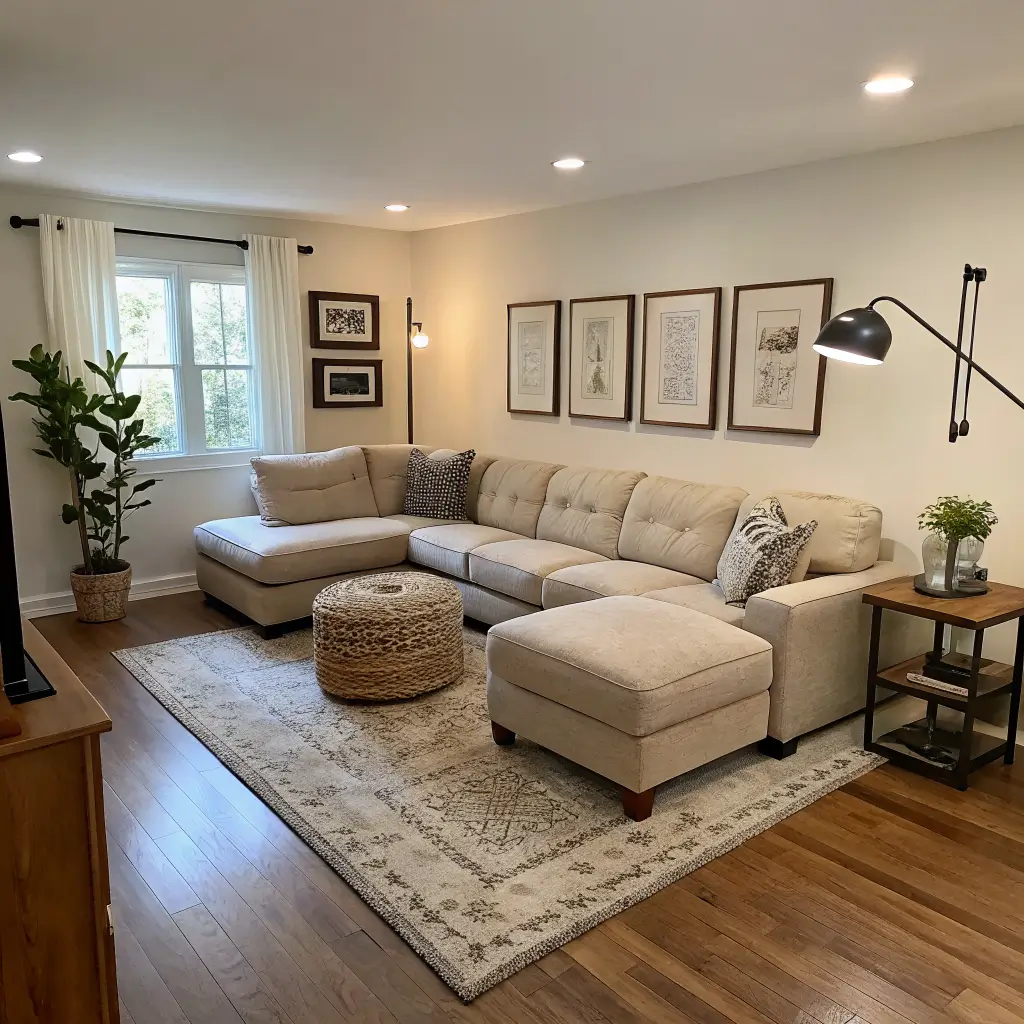
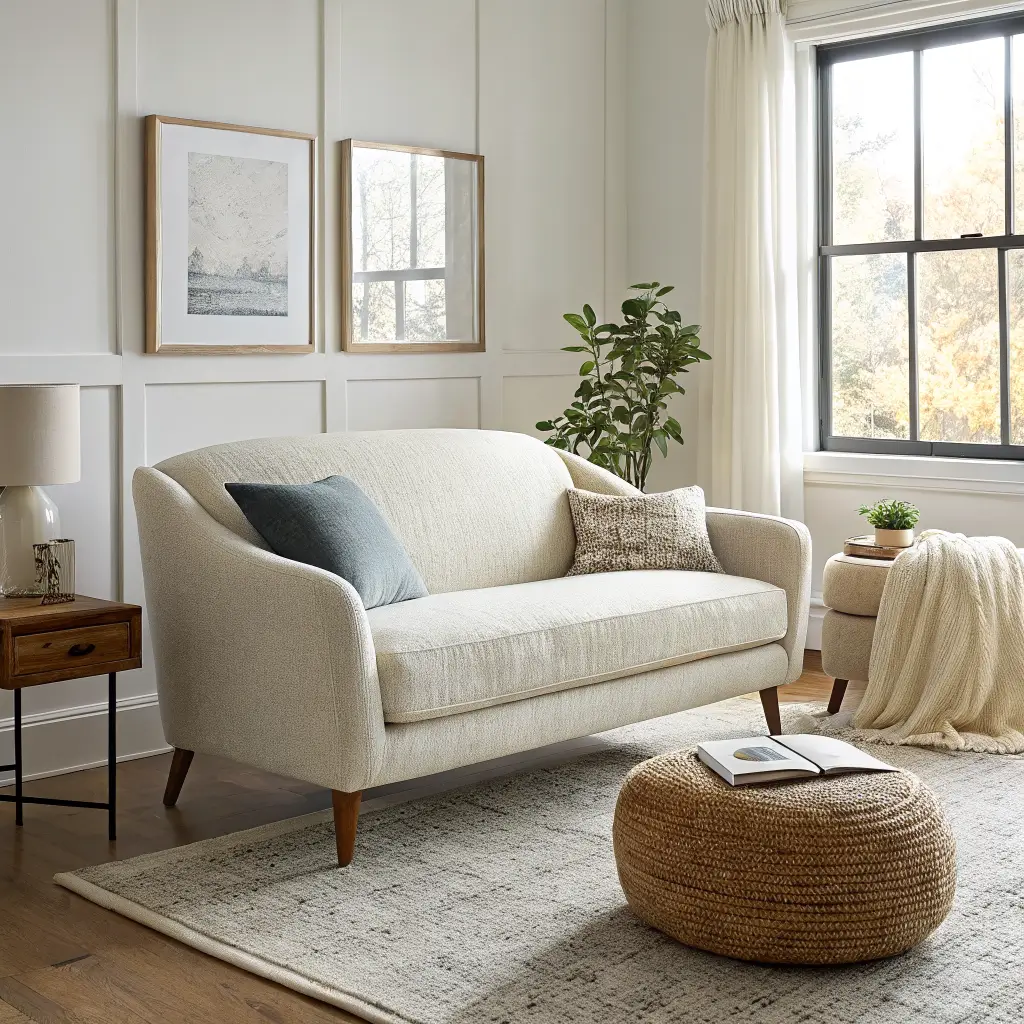
The sofa. A compact loveseat or apartment sofa, 60 to 72 inches wide, with low arms, a low back, and legs you can see under. The legs matter more than people think — anything that sits flat on the floor visually doubles in size. If your room is long and narrow (mine was 8 feet wide, 14 feet long), a small chaise sectional around 80 to 90 inches works better than a sofa-plus-chair combo.
One accent chair with visible legs. A slipper chair or anything with a delicate frame. Skip the overstuffed armchair, no matter how comfortable. It will eat the room.
A coffee table that does more than hold a coaster. I swapped my coffee table for a 24-inch round storage ottoman three years ago and I will never go back. Soft edges (no shins bruised on the corner when you walk past), blankets hidden inside, doubles as extra seating when people come over. Nesting tables are the other smart move — two or three tables that tuck together and pull apart when you need surface area.
Wall-mounted TV console. Floating the console off the floor changes the entire feel of the room. You see more floor, which reads as more space. I had a low credenza for years and didn’t realize how much it was visually weighing the room down until I switched.
Floating shelves instead of a bookcase. A 36-inch oak shelf above the sofa holds more books than you’d guess and takes zero floor space.
Lighting in Layers
One overhead light in a small room is the single fastest way to make it feel like a waiting area.
What I run:
– A central flush-mount with a diffused shade for general light
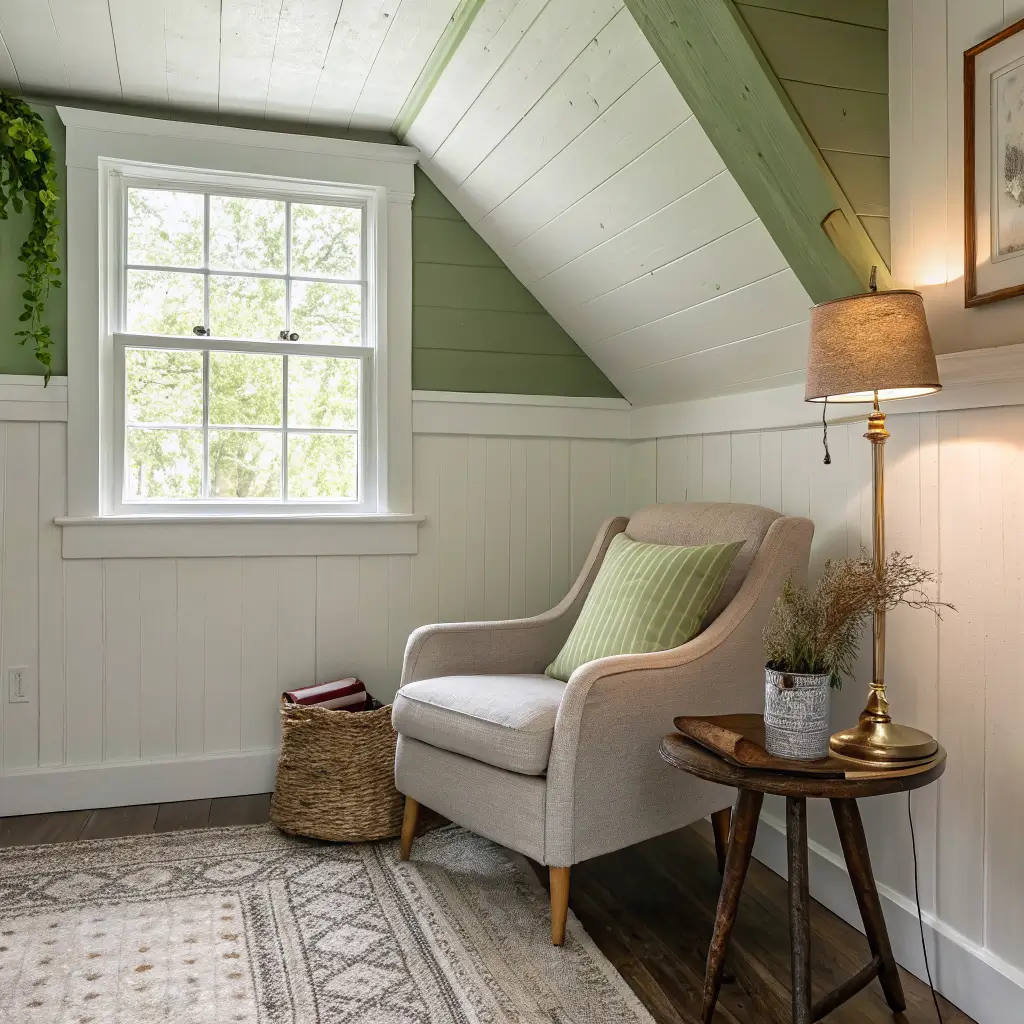
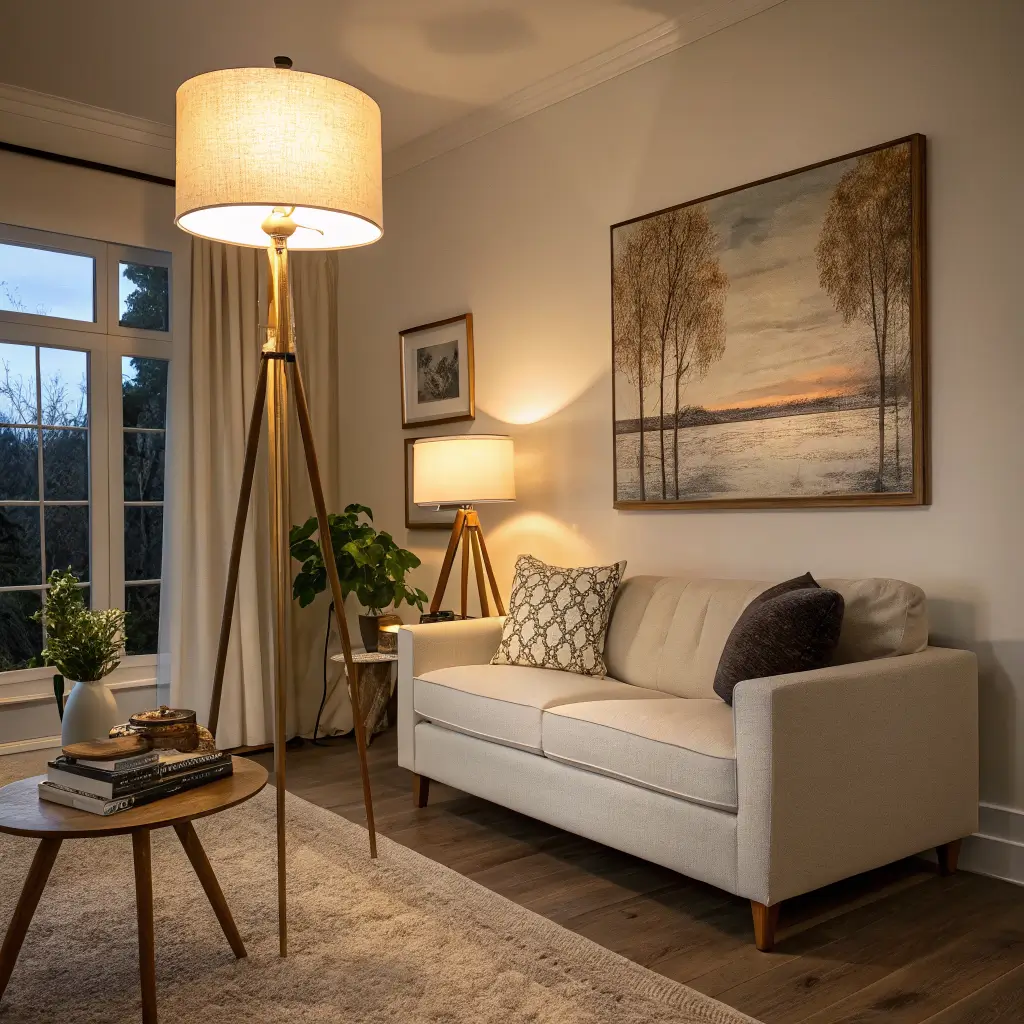
– One slim floor lamp (tripod or thin pole) in the corner farthest from the window
– A table lamp on the console or side table for reading
– Plug-in sconces flanking the sofa or above it — these were a game I didn’t expect to love until I tried them in my current place
Use warm-white bulbs at 2700K. Anything cooler in a small room reads like an office. I bought a pack of 3000K bulbs once and the whole room felt slightly off until I figured out what was wrong.
Layout: The Floating-Sofa Argument
The biggest mistake I see, and made myself for years: pushing every piece flat against a wall because you think it creates space. It doesn’t. It creates a perimeter of furniture around an empty middle, which makes the room feel like a dentist’s office.
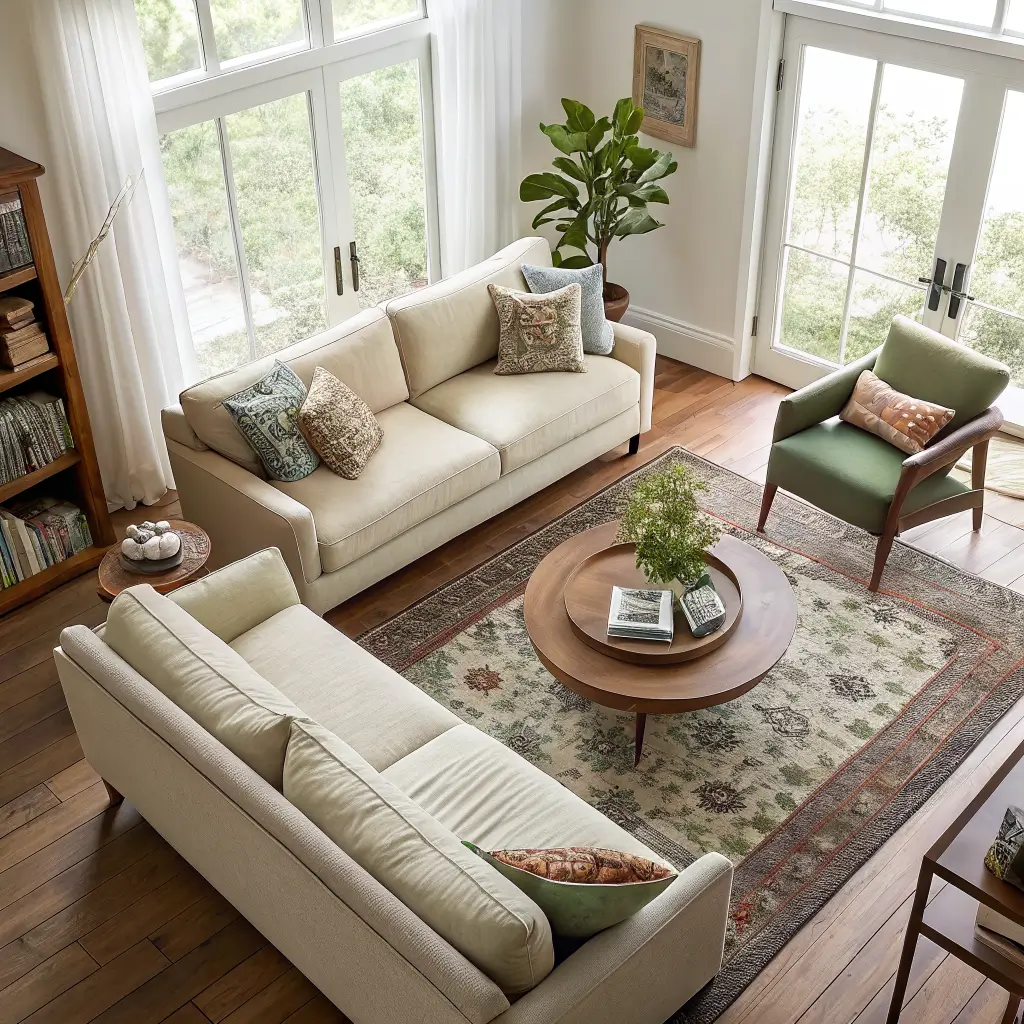
Float the sofa 4 to 6 inches off the wall. That’s it. Just enough that it doesn’t look glued there. Then angle a chair toward it, not next to it, so the seating actually faces itself.
A few layout rules that hold up:
– Leave 24 to 36 inches of walkway through main paths
– Align the rug’s long side with the sofa’s length — it visually widens the room
– Front legs of all seating on the rug at minimum (a 5×7 works in most tiny rooms, a 6×9 if you can stretch)
– Pick one focal point — TV, window, or fireplace — and orient the sofa toward it, not parallel to it
In a narrow room, arrange furniture lengthwise along the longest wall and let seating face seating across a coffee table. Don’t line everything up like an airport gate.
Textures, Patterns, and the 60–30–10 Split
A small room can’t carry six patterns. It just can’t.
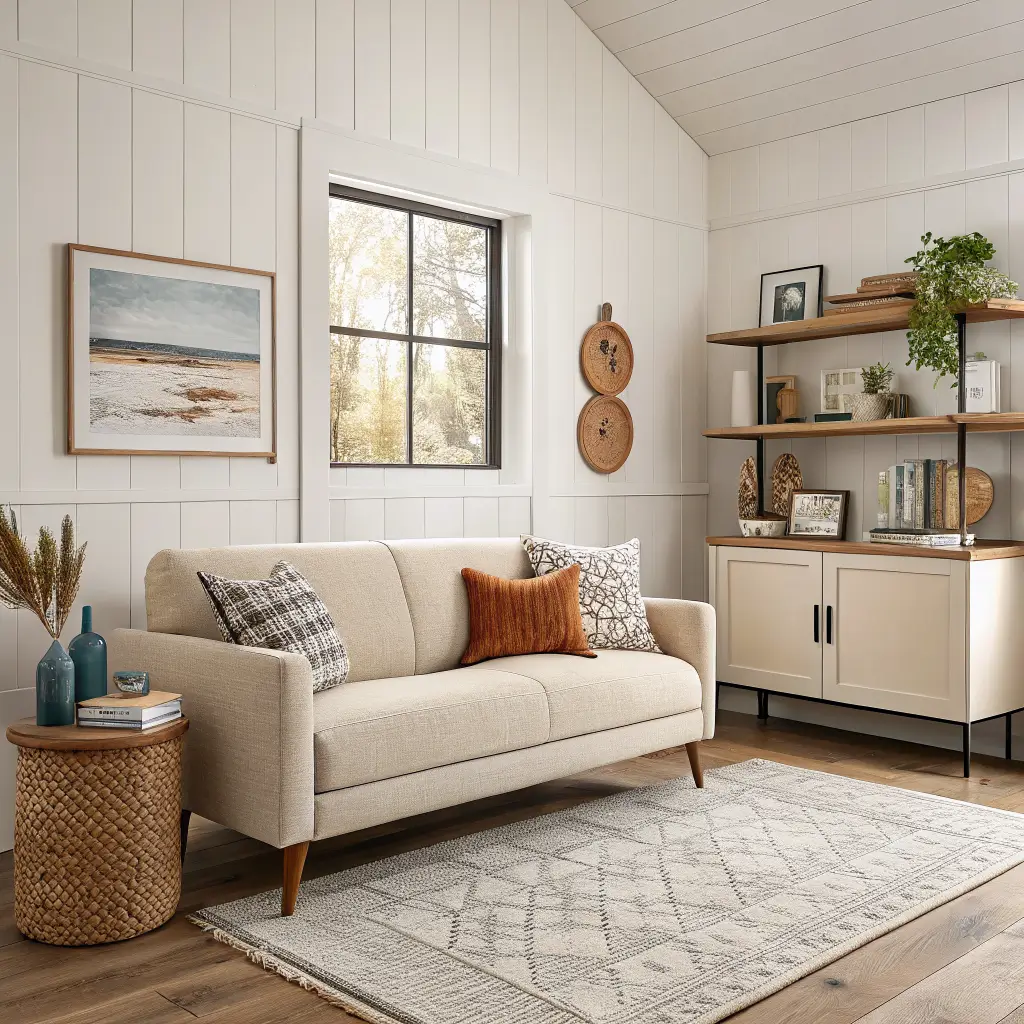
Keep the sofa and rug solid or quietly textured — a flatweave in a single tone, a boucle or linen upholstery. Then bring pattern in on one or two smaller surfaces: pillows, a single art piece, maybe a throw.
Texture is where you build depth without adding chaos. I aim for three to four in any room: a linen pillow, a chunky knit throw, light wood, matte black metal, and a plant. That’s the formula.
The color split I use:
– 60% light neutral (walls, sofa, large surfaces)
– 30% mid-tone (rug, wood furniture, secondary textiles)
– 10% accent (one bold pillow color, art, a small chair)
Cap pillows at 4 to 6 across the room. Pick two or three colors and stay in that lane. One throw, draped — not three throws competing.
Where to Spend and Where to Save
Spend on:
– The sofa. A bad small sofa is worse than a bad big sofa because you sit on it constantly and there’s nowhere to escape it.
– Lighting. Cheap lamps look cheap. A single well-made floor lamp at $200 outlasts three $60 ones.
– The rug if you have hardwood or tile — it’s the foundation of the whole zone.
Save on:
– Pillow covers. IKEA and H&M Home are fine. Buy covers, not whole pillows, and swap by season.
– Shelves. Plain pine or oak floating shelves under $40 each look the same as the $150 ones once they’re styled.
– Plants. Buy small, let them grow. A 6-inch pothos becomes a 4-foot trailing plant in a year for free.
– Art. Thrift stores, estate sales, and printables in cheap frames. The frame matters more than the art in a small room.
Mistakes I’ve Made (So You Don’t Have To)
The oversized sectional. Already mentioned, still my biggest regret. If you can’t walk around it comfortably, it’s too big.
Too many small accessories. I went through a phase of putting tiny objects on every surface — small candles, small frames, small bowls. It looked like a gift shop. Now I follow the rule: on every surface, three items max, varying in height.
A gallery wall in a tiny room. Twelve small frames above the sofa shrink the wall. One large piece — at least 60% the width of the sofa — does the opposite.
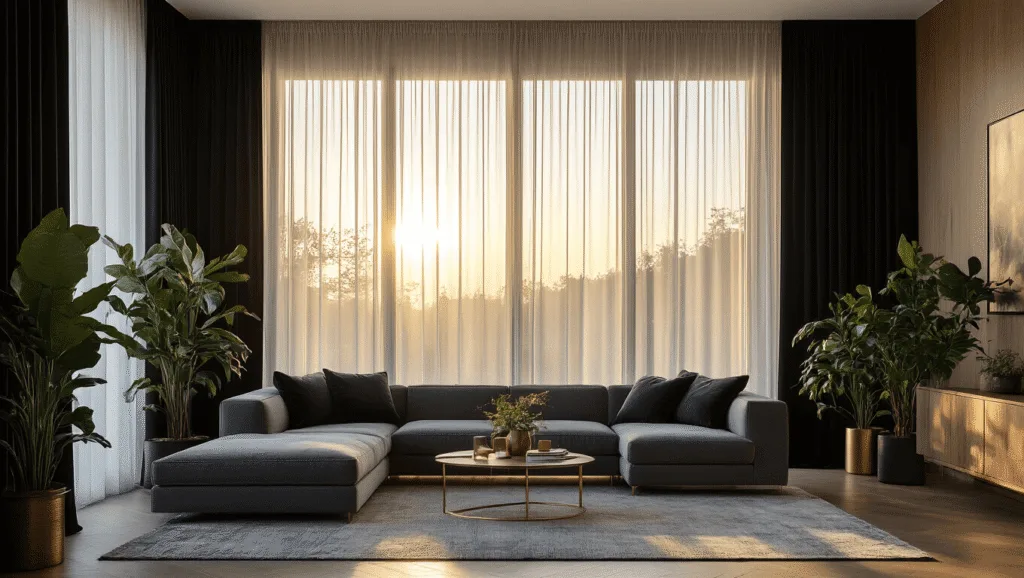
Heavy curtains. Blackout panels in a small room with one window? Disaster. Sheer linen or cotton in cream or pale grey, hung 6 to 8 inches above the window frame and extended past the sides so they don’t block any glass when open.
Too many metal finishes. Pick two. I run matte black and warm brass. Chrome stays out.
Seasonal Swaps Without Buying New Furniture
The shell stays the same; the soft layers shift.
Fall and winter: swap pillow covers to rust, deep green, burgundy. Heavier throw — wool or sherpa. Dried branches in a tall vase. If you have an electric fireplace, a couple of candles on the mantel and the room reads warm.
Spring and summer: linen covers in cream and pale blue, a lighter cotton throw, fresh foliage. I keep a tall fiddle leaf in the corner past the sofa year-round; in summer I add a small trailing plant on the floating shelf.
This is the cheap part. A set of four pillow covers and a throw runs $60 to $100 twice a year and the room genuinely feels different.
Cross-Style Variations
Tiny Boho-Coastal: soft white walls, jute rug, two patterned pillows in ikat or stripe, rattan tray on the ottoman, sandy beiges and faded blues. One large piece of art, not a wall full of macramé.
Tiny Scandi-Japandi: light oak everything, low-profile seating, walls in pale greige, textiles in clay and sage. One stone or stone-effect element — a small side table, a heavy ceramic vase — to anchor it.
A Few Specific Things I’d Buy Tomorrow If Starting Over
– IKEA ÄPPLARYD loveseat — 80 inches, leg gap, holds up
– A 24 inch round storage ottoman in a neutral boucle
– Two 36 inch oak floating shelves
– A slim tripod floor lamp with a linen shade
– A 4 foot tall plant — rubber plant if your light is low, fiddle leaf if you have a south window
– One oversized piece of art, at least 30×40 inches, in a thin black frame
That setup, in roughly that order, would carry a 100 square foot room from empty to actually livable for under $1,500.
The tiny living room isn’t a smaller version of a big living room. It’s its own thing. Once you stop trying to fit a “real” living room into the space and start designing for what the room actually is, it gets a lot easier — and honestly, a lot better than the bigger rooms I’ve had since.
Conclusion
The tiny living room ideas that worked for my friend came from a space under one hundred fifty square feet with a loveseat, a nesting table, and a single window. She had painted the walls white, added a large mirror that reflected the light, and hung a single piece of art above the sofa. The room felt like a conversation, not a performance, because she had chosen every piece to fit the space instead of fighting it.