Very Small Living Room Ideas: How to Make 100 Square Feet Actually Work
If your very small living room feels cramped no matter how you push the furniture around, the problem isn’t your taste — it’s scale, sightlines, and probably a sofa that’s four inches too deep. I’ve decorated a 9×10 living room in a walk-up apartment and a 10×12 in a condo since, and I’ve made every mistake worth making: the chunky rolled-arm loveseat that ate the room, the rug too small to anchor anything, the gallery wall that fought the TV for attention.
Here’s what actually works when you’ve got 70 to 140 square feet to play with.
The Look: Modern Scandinavian, Adjusted for Real Life
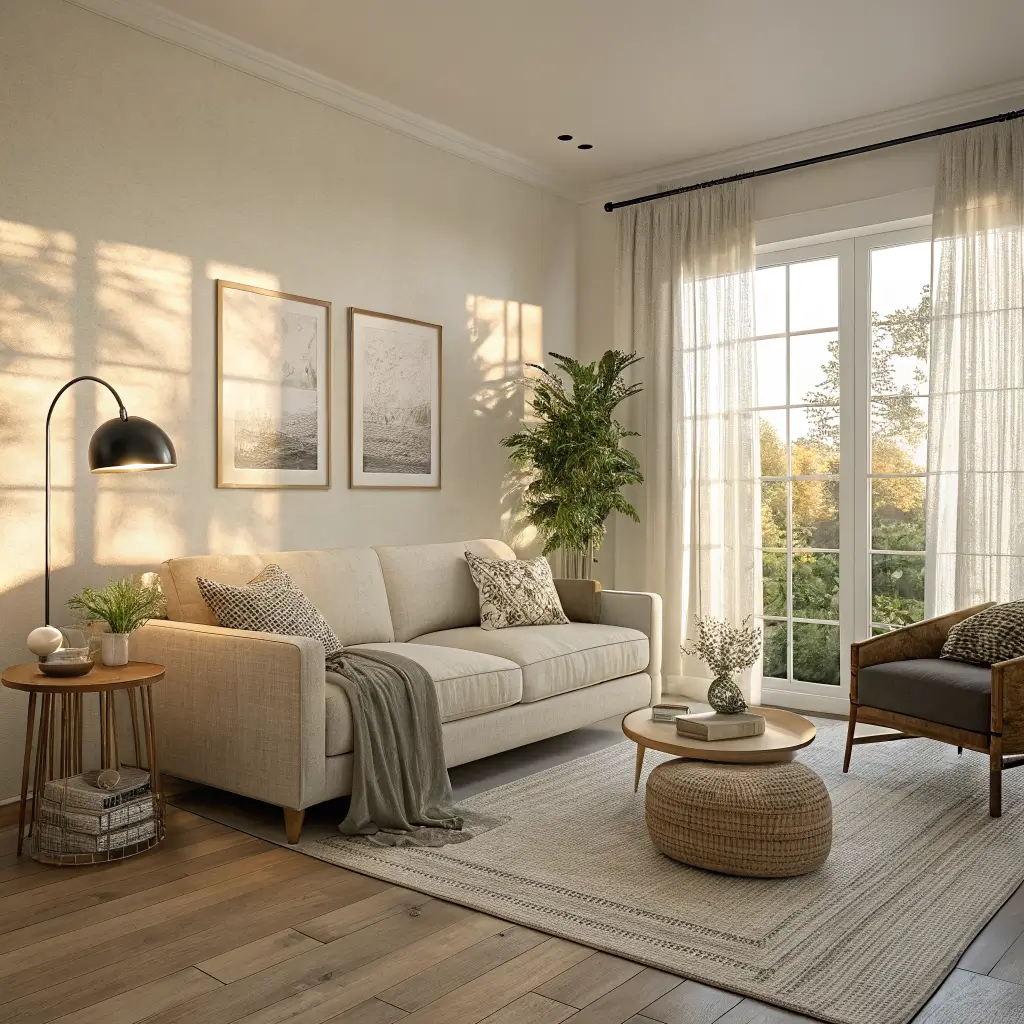
I lean Scandi-modern in small rooms because it’s built for this problem. Light woods, slim profiles, surfaces that bounce light, and pieces that do more than one job. You can push it cozier with wool and clay tones, or cleaner with white walls and black metal. Either way, the bones are the same: nothing bulky, nothing decorative-only, nothing fighting for attention.
Who this is for:
– Renters in a studio where the living room is also the entryway and sometimes the dining room
– Condo owners with a narrow 6-to-9-foot-deep living zone off the kitchen
– Anyone whose living room doubles as a guest room, office, or both
I’ll be honest about budgets because vague “affordable” articles waste everyone’s time.
Budget refresh ($150–$400), one weekend:
Cushion covers and throws ($15–$40 each at IKEA, H&M Home, Target), a slim LED floor lamp ($40–$90), ready-made curtains ($30–$80 a pair). This is the declutter-rearrange-restyle route. No new furniture.
Mid-range makeover ($800–$2,000), one to two weekends:
– Compact sofa or loveseat, 60–72″ wide: $400–$1,200 (IKEA, Article, West Elm)
– Storage ottoman: $100–$300
– Nesting tables or a stone-effect side table: $120–$400
– Wall-mounted shelves: $60–$200
– 5×7 or 6×9 rug: $120–$350
Full redesign ($3,000+), two to three weekends:
Slim modular sectional ($2,000–$4,000), porcelain feature wall ($6–$15/sq ft plus install), custom built-ins ($1,000+).
Skill level: measuring, flat-pack assembly, and hanging shelves are beginner-to-intermediate. Feature walls and built-ins are a pro job unless you’ve done it before.
Spend on the sofa. Save on tables and textiles. The sofa is the one piece that makes or breaks a small room, and it’s the piece people get most wrong.
What to look for:
– Width: 60–75″. Depth: 30–35″ max. Anything 38″+ deep will swallow the room.
– Thin or low arms. Rolled arms add 6–10″ of visual bulk and steal seat width.
– Exposed legs. Showing the floor underneath makes the room read bigger. Skirted sofas sit like a brick.
– Performance linen, woven poly, or leather in a light grey, taupe, or warm beige.
The first sofa I bought for a small space was a 38″-deep rolled-arm thing in dark charcoal. It looked great in the showroom and like a parked car in my apartment. I sold it at a loss and replaced it with a 68″ Article loveseat on tapered wood legs. Same room. Felt twice the size.
For ultra-narrow rooms (think railroad layouts): skip the sofa entirely. Two or three small lounge chairs along one wall preserve the walkway and don’t trap you into one fixed seating direction.
For studios: a sleeper sofa with bedding storage built into the base, or a sleeper chair if you’re really tight. Look at the storage cavity dimensions before you buy — half of them barely hold a duvet.
Every piece in a small room should be doing at least two things.
– Storage ottoman, 24–36″ long. Coffee table, footrest, extra seat, hides blankets and remotes. I keep a flat tray on top so drinks don’t wobble.
– Nesting tables. Pull out when you need surface, tuck away when you don’t.
– Stools, 12–18″ wide. Side table normally, seating when people come over.
– Floating media console. Mounting the TV and floating the console below clears visual floor space and makes the wall feel deeper.
Walls: warm whites and soft neutrals do the heavy lifting. Swiss Coffee, Chantilly Lace, a creamy greige. They reflect light without going cold and clinical the way pure white can.
If you want color, color-drench instead of accent-walling. Paint walls, trim, and ceiling the same muted tone — a soft sage, a clay, a dusty blue. It blurs the edges of the room and the eye stops registering where one surface ends and another begins. Counterintuitive, but it makes small rooms feel bigger, not smaller.
Accent colors I’d actually use right now:
– Hunter or olive green, repeated 3 times (pillow, plant pot, art)
– Muted terracotta or rust for warmth
– Black in small doses — frames, lamp bases, a curtain rod
Materials to mix:
– Light oak, birch, or ash for furniture and shelving
– A smooth surface (porcelain, glass, acrylic) so not every table reads as a heavy wood block
– Bouclé or a chunky weave on one accent piece — a pouf or a single pillow, not five
– Linen or cotton curtains, never blackout-heavy fabric in a small room
Overhead light alone makes small rooms look like waiting areas. You need three points of light minimum:
– Floor lamp by the sofa, slim base under 12″ wide
– A second source on the opposite side — table lamp, wall sconce, or picture light
– Use 2700K–3000K warm white bulbs. Cool white in a tiny room feels like a dentist’s office.
Plug-in wall sconces are my favorite small-room trick. They free up the table surface and pull the eye up the wall.
1. Measure first. Length, width, ceiling, door swings, window placement. Tape the sofa’s footprint on the floor with painter’s tape before you buy. Yes, really.
2. Pick the focal point. TV wall, feature wall, or fireplace — one of these, not all three.
3. Place the sofa. Along the longest wall in narrow rooms; floated slightly into the room if you have the depth.
4. Lay the rug. 5×7 or 6×9 for most very small rooms. Front legs of seating on the rug, back legs off is fine. Leave 6–8″ of bare floor between rug edge and wall. A rug that runs into the baseboards looks like a mistake.
5. Add tables. Leave 14–18″ between sofa and coffee table for leg room.
6. Mount shelves and TV. Get storage off the floor.
7. Hang curtains high and wide — rod 4–6″ above the window, extending 6–10″ past each side. The window will read taller and the wall taller with it.
8. Hang one big mirror over the sofa. Not a gallery. One piece, around two-thirds the width of the sofa.
9. Add one tall plant in a corner. A 5–6 foot fiddle-leaf, olive tree, or bird of paradise in the dead corner past the sofa.
10. Walk the room. If you bump anything or sidestep, move it.
Buying a sofa that’s too deep. Already covered, but it’s the #1 issue. Stay under 36″ deep.
Pushing every piece against the wall. Counterintuitive again — it doesn’t make the room bigger, it makes it feel like a doctor’s waiting room. Pull seating an inch or two off the wall if you can. In a narrow room you may not have the choice, but if you do, take it.
Too many small pieces. Three tiny side tables, a pouf, a magazine rack, two accent chairs, a plant stand. Each item individually is fine. Together it’s chaos. Fewer, slightly larger pieces always beat more small ones.
Ignoring the walls. If everything you own is sitting on the floor, the room will feel crowded no matter what. Shelves, art, sconces, mirror — get things up.
Too many focal points. A loud rug AND a gallery wall AND a colorful sofa AND an oversized plant. Pick one thing to be loud. Quiet the rest.
Mismatched wood tones and metals everywhere. Pick two wood tones max and one metal finish. Repeat them.
The reason I keep my base neutral is so I can swap the seasonal stuff for $40 and the room reads different.
– Spring/summer: linen pillow covers in cream and pale green, lighter throw, swap art for something with more white space
– Fall/winter: wool throw, bouclé or velvet pillow covers in rust or hunter green, candles out, a heavier rug if you’ve got storage for the lighter one
– Always: one fresh thing — eucalyptus stems in a vase, a new stack of books, a small ceramic on the shelf
The rule I actually follow: if something new comes in, something goes out. Small rooms punish hoarders.
One Last Thing About Scale
The single biggest shift in how my small rooms have looked came when I stopped buying “small” furniture and started buying correctly proportioned furniture. Those are not the same thing. A doll-sized loveseat and a doll-sized coffee table and a doll-sized rug all together look like a model home for hobbits. One properly scaled sofa, a real rug, one good lamp — that’s the room. Get those three right and the rest is just decoration.
The very small living room ideas that worked for my friend came from accepting that the room was 100 square feet and would never be a palace. She bought a loveseat instead of a sofa, added a nesting table that could expand when guests came, and hung a single large mirror that reflected the window. The walls were white, the rug was a light gray, and the only color was a single armchair in mustard. The room felt like a conversation, not a performance.