What You’re Working With and What It’ll Cost
The sweet spot for these ideas is anything under about 35 square feet — 3’x5′ powder rooms, 4’x6′ shower baths, tiny-house and ADU bathrooms closer to 20–25 square feet. If your bathroom is bigger than that, some of this still applies, but you have options I’d skip in a true micro bath (like a full vanity with legs).
Rough budget ranges I’ve seen hold up:
– Cosmetic refresh (paint, hardware, mirror, shower curtain, accessories): $250–$800, one weekend, 8–12 hours of actual work
– Mid-range update (floating vanity, new lighting, peel-and-stick tile): $1,000–$3,500, two to three weekends
– Full micro remodel (new shower base, tile, wall-hung toilet): $4,000–$10,000+, one to three weeks with trades
Real price points so you can plan:
– Bathroom-grade paint: $35–$70/gallon (one gallon is plenty)
– Peel-and-stick wallpaper: $40–$120/roll
– 18″–24″ floating vanity: $200–$650
– Wall-mount sink: $120–$400
– Recessed medicine cabinet: $80–$400 (lighted models toward the top)
– Subway tile: $2–$6/sq ft; peel-and-stick vinyl tile: $1.50–$4/sq ft
– Vanity light or pair of sconces: $60–$250
– Matching hardware set (faucet, towel bars, TP holder, hooks): $150–$450
Skill level reality check: painting, peel-and-stick, hardware swaps, floating shelves — beginner. Floating vanity, new sconces, medicine cabinet — intermediate, basic plumbing and electrical. Moving the toilet flange or building a wet room — hire someone.
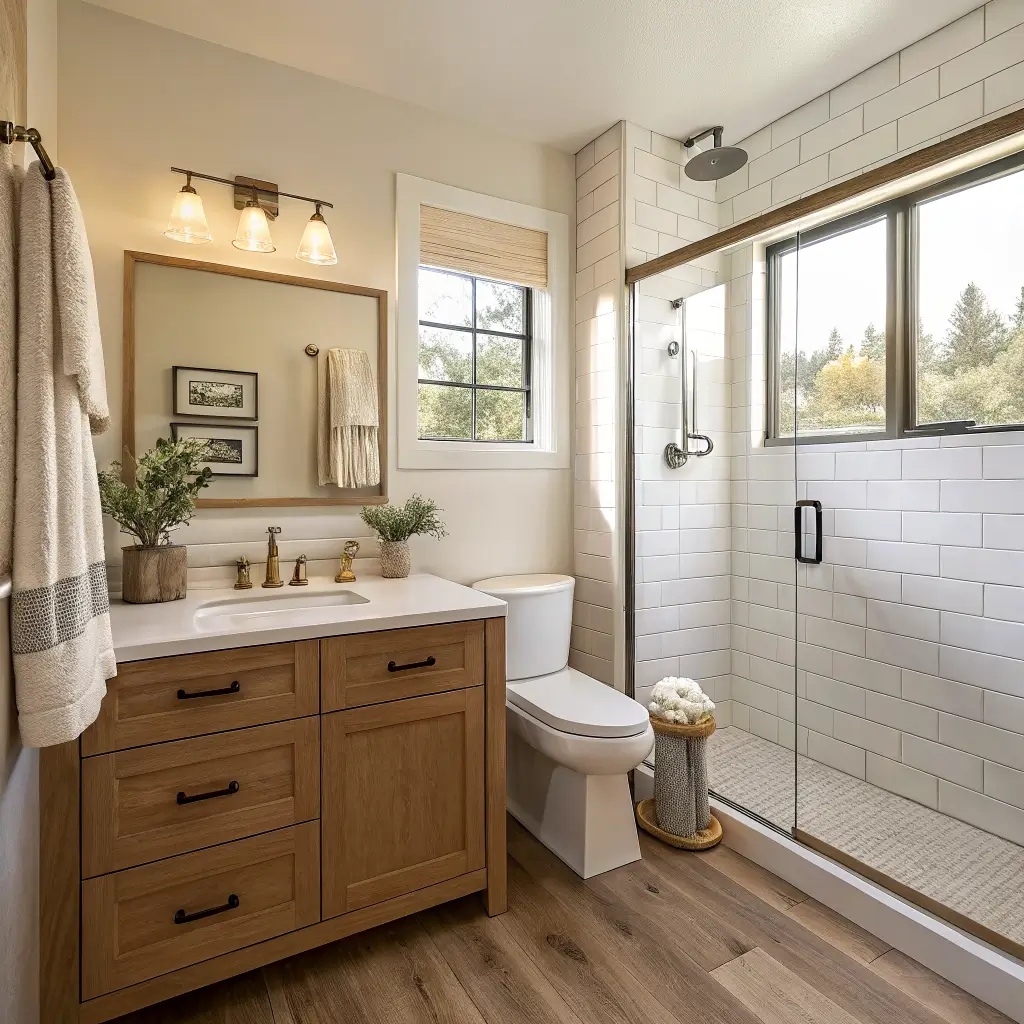
Picking a Style That Suits a Micro Bath
Four directions actually work in a very tiny bathroom. Pick one and commit, because mixing them in 30 square feet reads as indecision.
– Modern minimalist: wall-hung fixtures, flat-front vanity, matte black hardware. Best for: people who hate clutter and want a fast-to-clean room.
– Scandi light and airy: white walls, light oak vanity, soft greige textiles. Best for: dark interior baths with no window.
– Japandi / spa: warm woods, stone-look tile, off-white walls, ribbed glass. Best for: small ensuites attached to a bedroom.
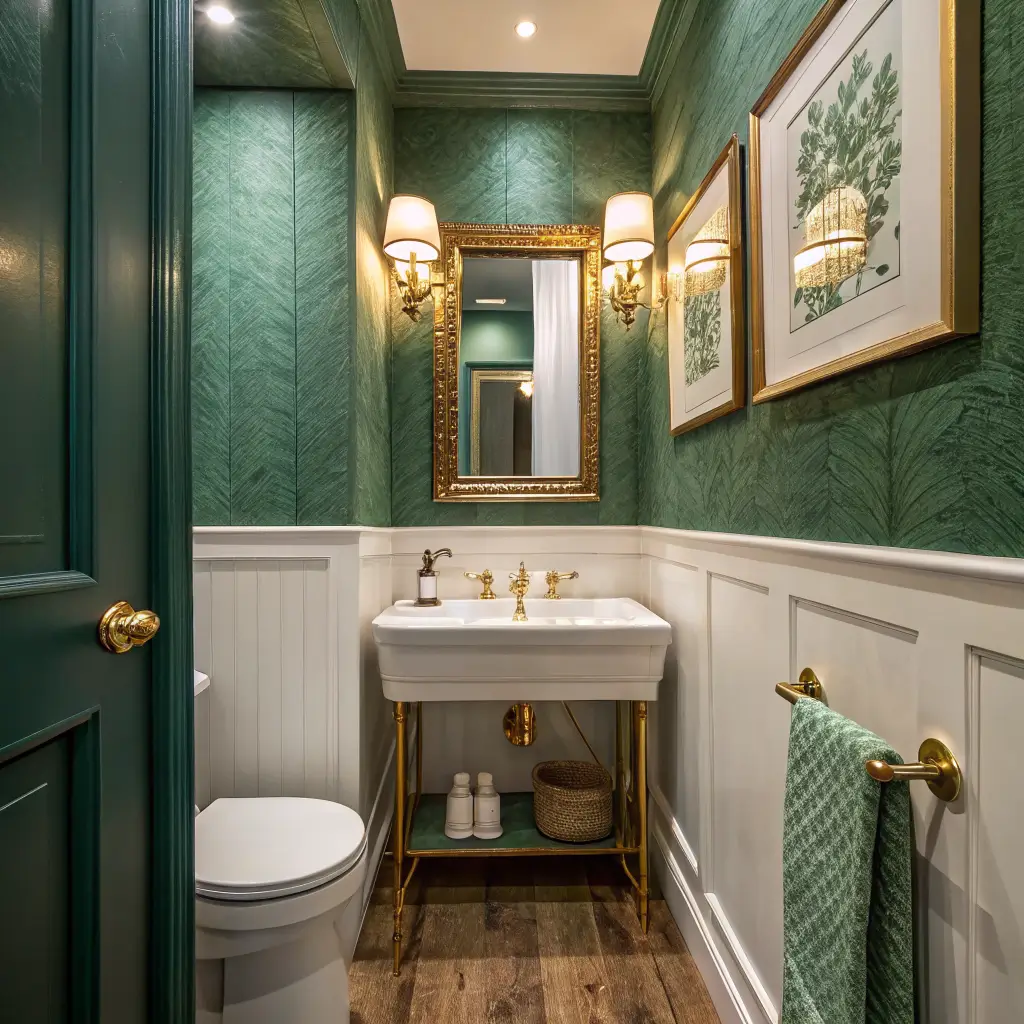
– Powder room jewel box: dark wallpaper on all four walls, brass fixtures, dramatic sconces. Best for: powder rooms only — no shower, no humidity, no tub.
The jewel box is the one most people get wrong. I tried a deep navy grasscloth in my own half bath and the grasscloth started to wave after a month because someone left the door closed during a shower in the adjacent room. Vinyl-coated wallpaper or a paintable textured option works; natural fiber doesn’t.
Colors that actually open up the space
For light-and-bright: warm white, Swiss coffee, pale dove gray, warm greige. Skip cool stark whites — they pick up every bit of fluorescent ugliness from your overhead light.
For drama in powder rooms: navy, emerald, charcoal, terracotta. Paint the walls, trim, and ceiling the same color. This is the single best move I’ve made in a small space. When the boundary between wall and ceiling disappears, the room reads taller, not smaller. Sounds backward. It works.
Materials that earn their place
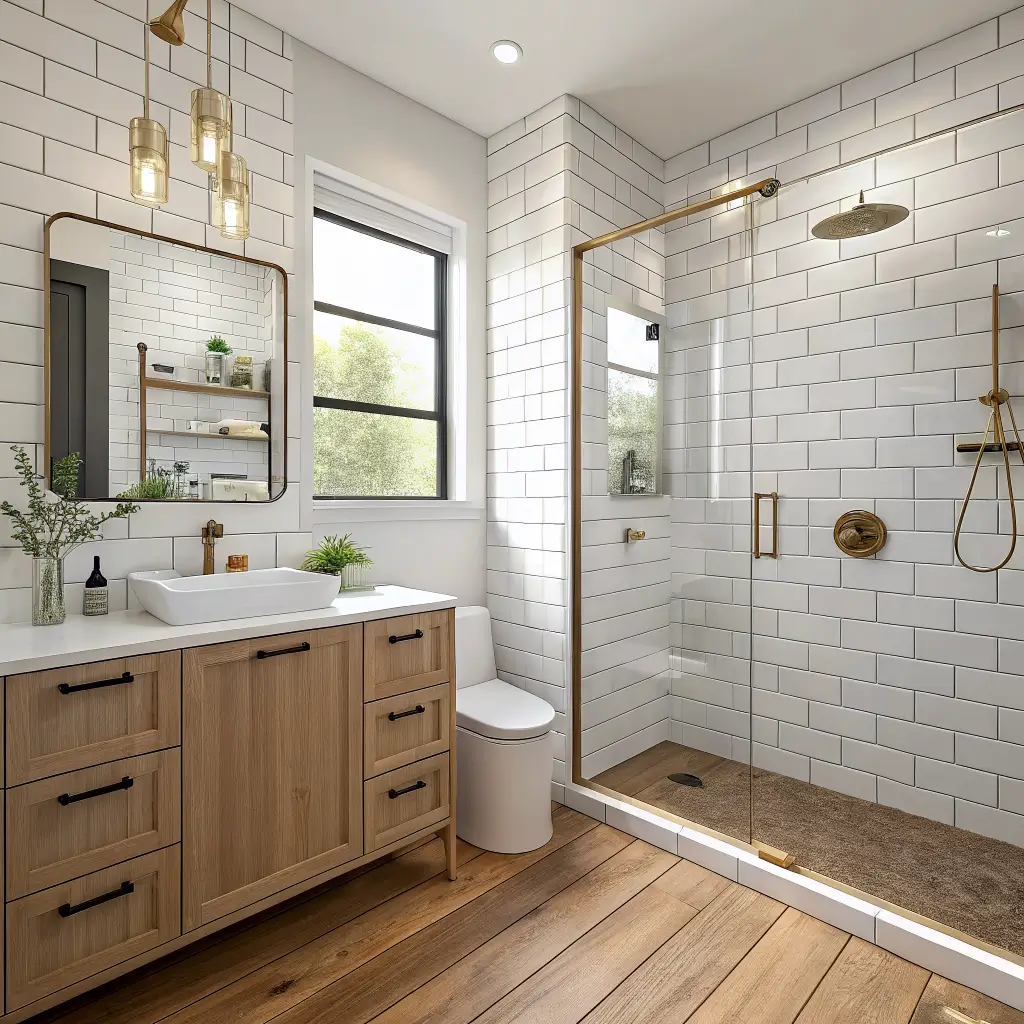
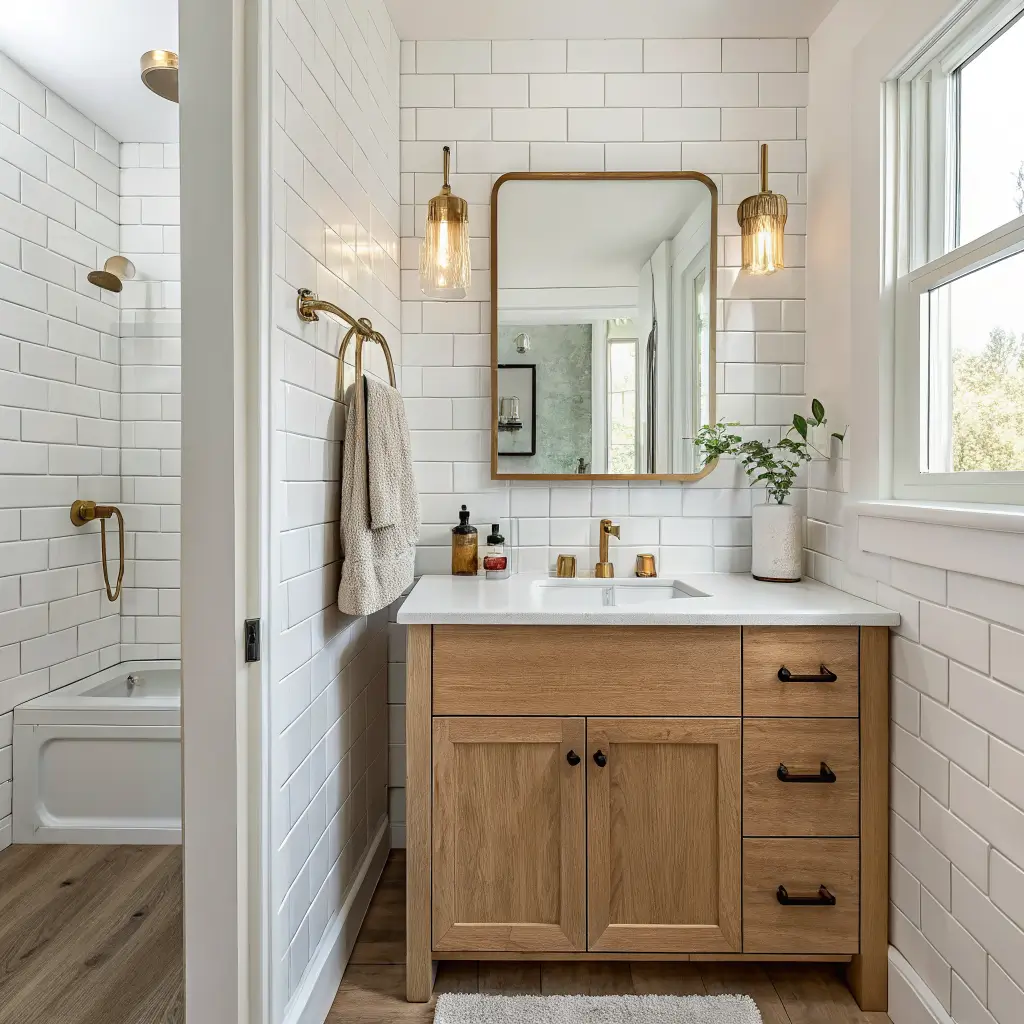
– White subway tile in a vertical stack instead of the standard horizontal brick pattern — draws the eye up
– Wood-look porcelain on the floor, ideally continued into the shower with no threshold
– Frameless glass shower panel instead of a framed door or curtain — non-negotiable in a true micro bath if budget allows
– Quartz or solid-surface vanity top because grout lines on a tiny counter look busy
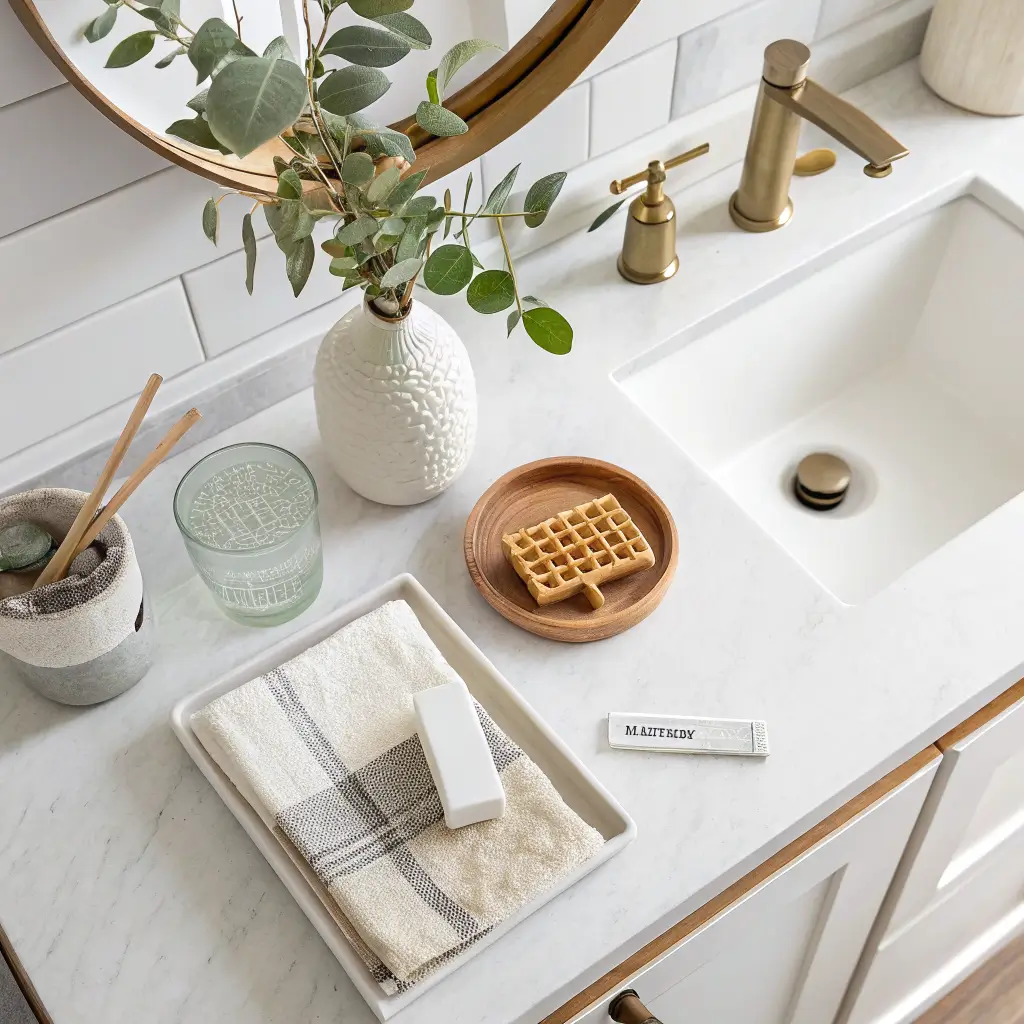
– Matte black, brushed nickel, or brushed brass for fixtures — pick one and use it everywhere
The Pieces That Make or Break the Room
Hero pieces
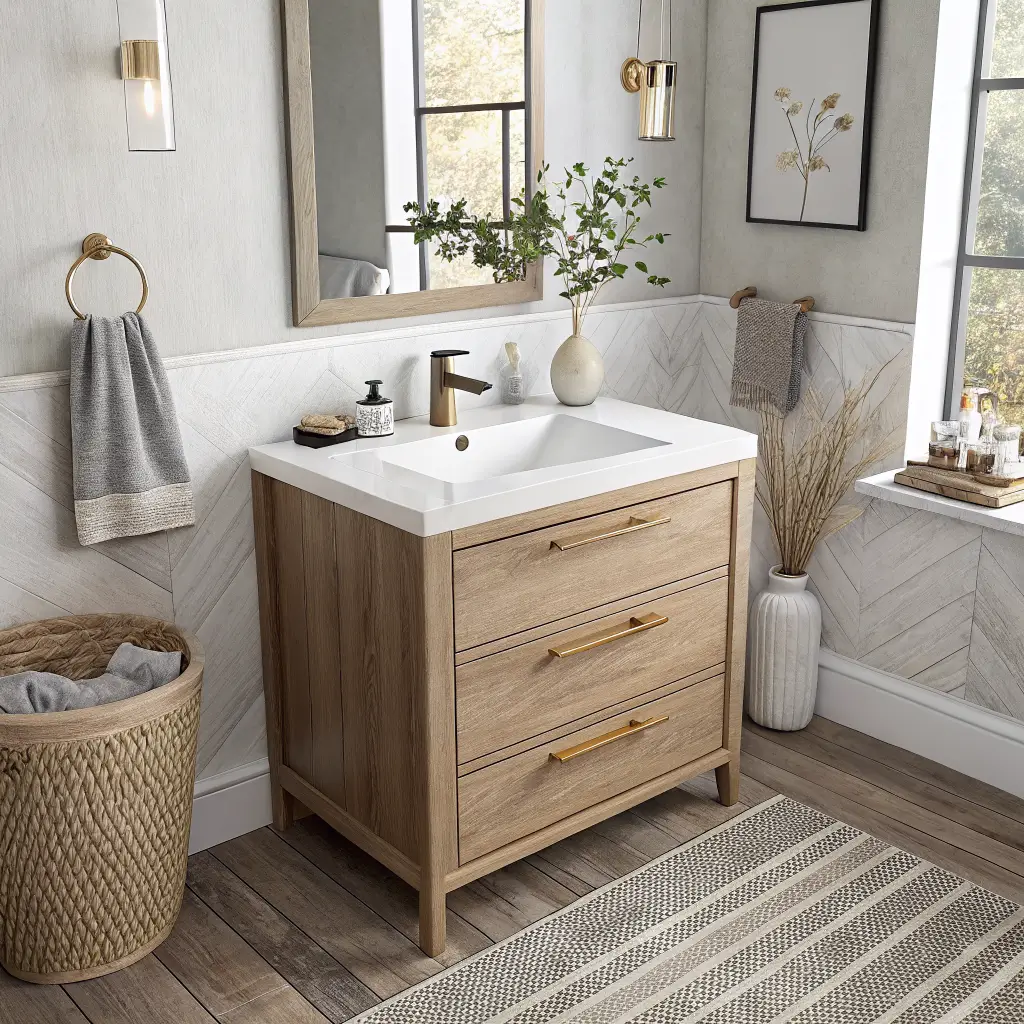
Floating vanity, 18″–30″ wide. Seeing the floor continue under the vanity is what makes a tiny bath feel bigger. A vanity with legs visually chops the room in half at knee level. I swapped a 30″ freestanding vanity for a 24″ wall-mount in my own bath and the room felt a full size larger — same footprint, no other changes.
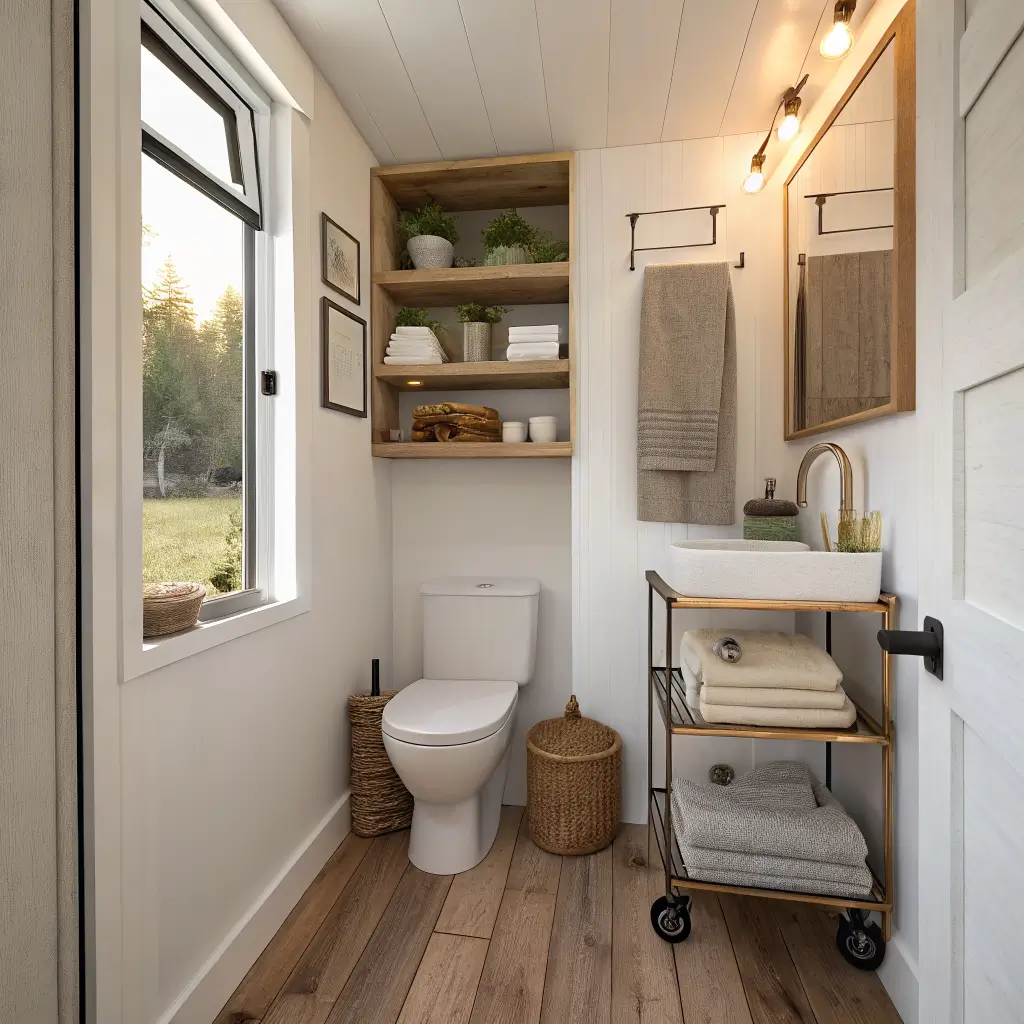
Compact wall-mount sink for true powder rooms. Some are only 10″–12″ deep. You lose counter space; you gain the ability to actually stand in the room.
Recessed medicine cabinet. Surface-mount works, but if your wall has a stud bay you can cut into, recessed gains you four inches of depth you didn’t know you had. Lighted versions with a built-in outlet are worth the extra $150 because you can ditch the separate vanity light.
Frameless glass shower panel. A single fixed panel (no door, water just goes around it) is cheaper than a sliding door and visually clears the room.
Storage that doesn’t shrink the room
– Over-toilet cabinet or two floating shelves — pick one, not both
– Built-in niche in the shower instead of a hanging caddy
– Back-of-door organizer for hair tools and cleaning supplies (the door is the most under-used surface in any tiny bath)
– A slim 6″–8″ rolling cart beside the toilet for backups
What I’d skip: ladder shelves (they take up corner space that should stay empty), freestanding linen towers, anything that sits on the floor and has legs.
The mirror move
Go bigger than feels right. A mirror that runs the full width of the vanity wall, floor of the wall to ceiling if you can swing it. This is what doubles a tiny space. The cute round mirror you saw on Instagram is going to make your 3’x5′ powder room feel like a phone booth.
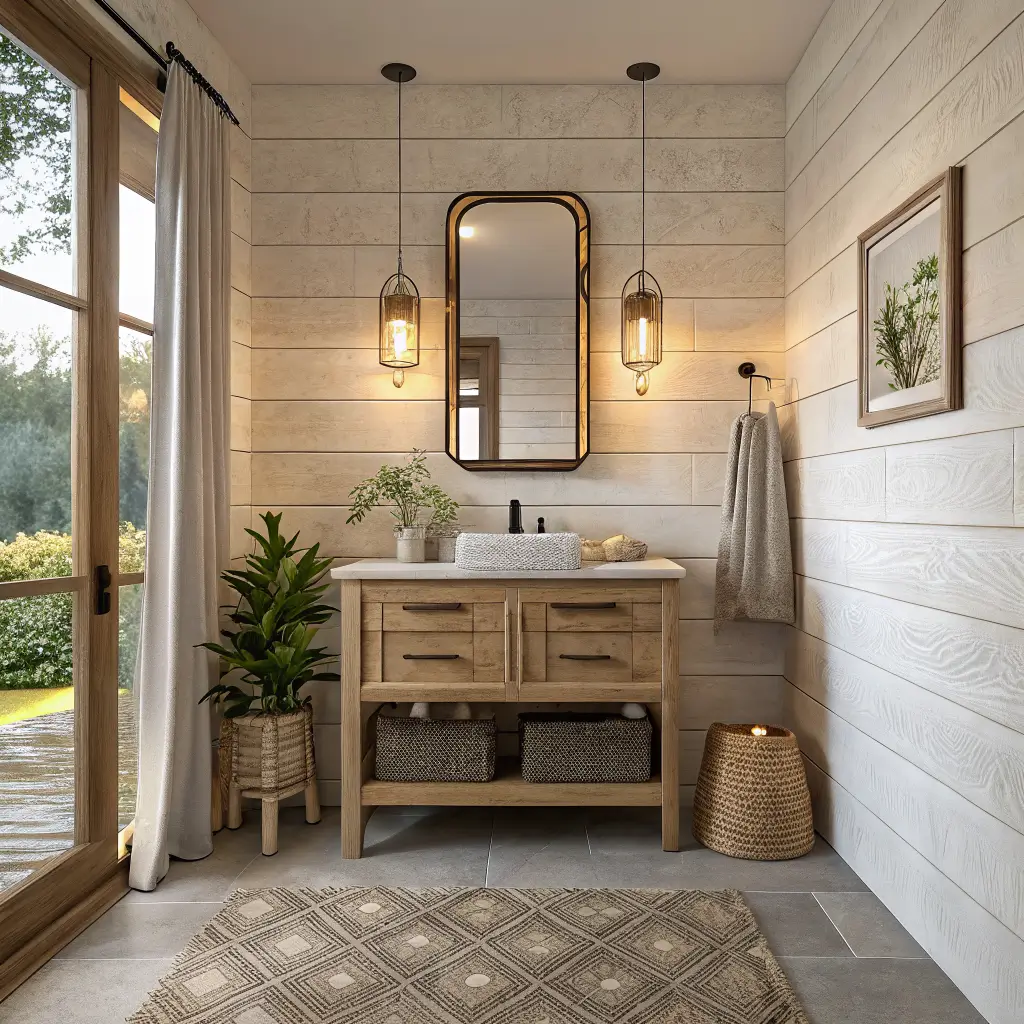
How to Actually Put It Together
Before you buy anything, measure
– Room width and length, twice
– Ceiling height
– Door swing — mark the arc on the floor with tape
– Existing plumbing rough-in locations
That tape arc tells you what won’t work. A 30″ vanity in a 4′-wide room often blocks the door. I’ve seen people order the vanity first and figure it out later. Don’t.
The order I’d work in
1. Envelope first. Paint walls, trim, and ceiling the same color (try a flat or matte finish on walls, satin on trim — bathroom-grade in both). Lay floor tile. If wallpapering, do it now.
2. Main fixtures. Floating vanity at 32″–34″ to the top. Compact round-front toilet if you’re replacing — it saves about two inches of front clearance. Shower base, then glass.
3. Storage and lighting. Medicine cabinet centered over the sink. Sconces (or a horizontal vanity light) mounted at 65″–70″ from the floor — face height, not crown-molding height. Bulbs at 2700K–3000K. Anything cooler than 3000K makes skin look terrible.
4. Surfaces and textiles. One small tray on the vanity with three items max. Two towels visible — one in use, one spare. A bath mat that doesn’t cover the whole floor.
5. Finishing. One plant (pothos or a ZZ if there’s no window — both survive low light and humidity). One piece of art, placed where you see it from the doorway.
Layering without crowding
The rule I use: one hero pattern, everything else solid. If your floor tile is a graphic cement-look pattern, your wallpaper is out. If you want bold wallpaper, your floor is plain. Contrast comes from texture — ribbed glass sconce shades next to a smooth vanity, matte tile next to a glossy faucet — not from competing prints.
For tiny baths with no window, this combo works almost every time: light walls, slightly darker floor, medium-tone wood vanity. Eye moves up and down instead of getting stuck.
Mistakes I’ve Made or Watched Other People Make
– A 36″ vanity in a 4′-wide room. Looks fine in the box. Opens onto the toilet in real life.
– One harsh overhead light. Cast shadows on my face every morning for two years before I added sconces. The fix took an afternoon.
– All open shelves, no closed storage. Counters end up holding everything because there’s nowhere to hide a tube of toothpaste. You need at least one drawer or cabinet door.
– A heavy dark shower curtain. Visually walls off a third of the room. Clear glass or a light solid curtain.
– Frosted or framed shower glass. Chops the sightline. Frameless clear, every time.
– Mixing three metal finishes. Chrome faucet, brass hooks, black towel bar — looks like you couldn’t decide. Pick one.
Keeping It From Drifting Over Time
A tiny bathroom shows clutter fast because there’s nowhere for it to hide. Two rules I follow:
– Capacity rule. If a shelf or tray is full, something leaves before something new arrives.
– Two-color textile rule. Towels, mat, curtain — stick to two colors plus white. Cheap to refresh, hard to mess up.
Easy seasonal swaps
– Hand towels and bath mat — lighter cotton or linen in spring and summer, waffled or ribbed in fall and winter
– A single stem in a bud vase — eucalyptus in winter, something leafy in summer
– One small art swap if you’re into that
Budget evolutions that punch above their cost
– Hardware swap. New cabinet pulls, TP holder, towel bar, and faucet in a single finish reads as a remodel. Total cost under $250 if you shop carefully.
– One peel-and-stick accent wall. The wall behind the toilet is the right spot — visible from the door, doesn’t get splashed.
– Plug-in towel warmer. $80–$150, no electrician needed, makes the room feel like a hotel.
The thing nobody tells you about a very tiny bathroom: once you stop trying to make it feel bigger than it is and start making it feel intentional, it stops bothering you. My 4’x6′ isn’t going to grow. But it now feels like a room I designed instead of a room I’m putting up with, and most of that came from editing things out, not adding more in.
Conclusion
The very tiny bathroom ideas that worked for me came from a room that was literally a closet with a toilet. I painted the walls white, added a corner sink, and hung a shelf above the door for toilet paper and a plant. The shower was a curtain on a rod, the floor was tile, and the only decoration was a small framed photograph of the ocean. It was not a room you lingered in. It was a room you used, and that was enough.
More Decor Ideas to Explore
- Very Small Living Room Ideas: How to Make 100 Square Feet Actually Work
- Very Small Laundry Room Ideas: How to Make a Closet-Sized Space Actually Work
- Tiny Ensuite Ideas: How to Make a Micro Bathroom Actually Work (and Look Good)
- Modern Coastal Decor: A Real-World Guide to Getting the Look Right (Without the Beach-Theme Cringe)