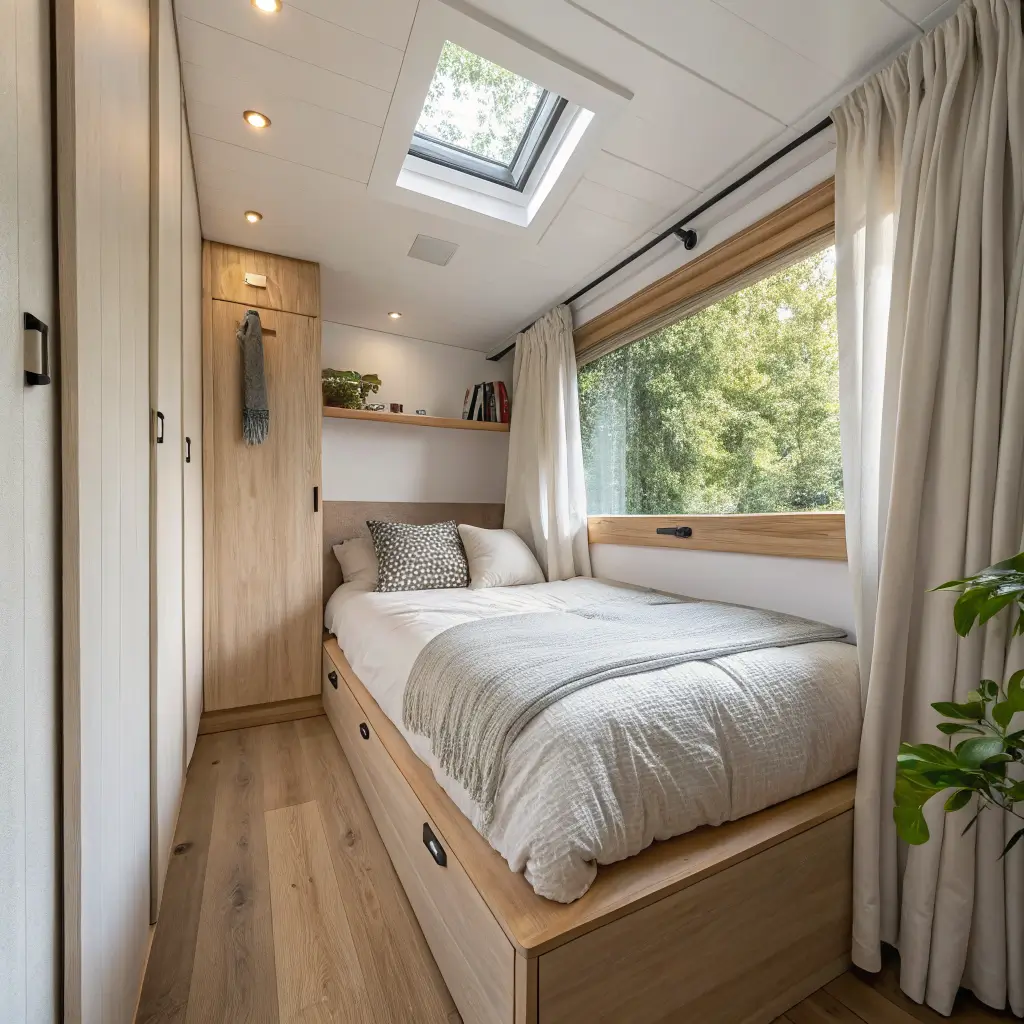
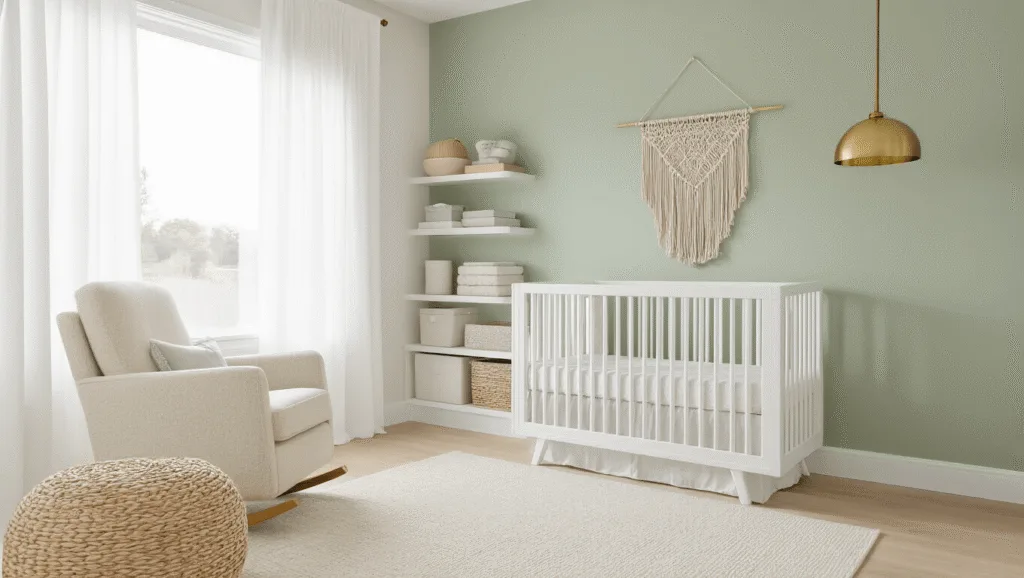
I call this style Compact Calm. It’s Scandi-leaning minimalism with softer edges — light wood, hidden storage, an upholstered or fabric-paneled headboard, layered lighting that isn’t all coming from the ceiling.
It’s for the boxy second bedroom in a city apartment. The converted attic with a sloping wall. The “guest room slash office slash where the laundry rack lives.” Rooms roughly 6–10 m² (65–110 sq ft), usually 2.0–2.4 m wide by 3.0–3.6 m long.
What it isn’t: maximalist, heavy, or precious. There’s no room for precious in a tiny bedroom.
Walls: soft white, pale greige, pistachio, or a pale blue-grey. Farrow & Ball’s Cornforth White and Benjamin Moore’s Pale Oak are the two I keep returning to.
An exception: if the room has zero natural light, I stop fighting it. Paint walls and ceiling the same saturated color (deep green, ink blue, plaster pink) and lean into the cocoon. Trying to “brighten” a dark room with white paint usually makes it look grey and sad.
Wood: light oak or birch. White-painted MDF is fine for budget builds — just match the undertone to your wall.
Texture: linen bedding, a low-pile wool or wool-blend rug, one boucle or rattan moment. That’s it.
Metal: antiqued brass or brushed nickel. Pick one and stick with it across sconces, knobs, and curtain hardware.
Budget: What This Actually Costs
I’ve done this on three different budgets. Here’s where the money goes.
– Platform bed frame from IKEA, Wayfair, or similar: $100–$250
– 2–4 under-bed storage bins: $20–$60
– A pair of plug-in wall sconces: $30–$100
– 5’×7′ rug: $80–$200
– Light curtains or a single roman shade: $40–$120
Mid-range — $800 to $2,000
– Storage bed (drawers or lift-up): $400–$1,000
– Tall narrow wardrobe or a small PAX configuration: $200–$600
– Blackout roman shade: $150–$400
– Ceiling fixture plus a pair of hardwired sconces: $150–$400
High-end — $2,000 to $7,000+
– Built-in wardrobes and a bed surround with integrated storage
– Custom upholstered headboard wall
– Designer wallpaper or grasscloth
Where I spend: the bed (it’s 80% of the room visually and functionally) and lighting. Where I save: nightstands, art, baskets, hardware. A $40 ceramic dish on the nightstand looks the same as a $200 one.
Skill level: Painting, hanging curtains, and assembling flat-pack are beginner work. Hardwiring sconces or installing built-ins is where I call someone.
This is the single most important call. In a tiny room, your bed needs to do the job a dresser would do in a bigger room.
I use a lift-up gas-strut bed in my current room. Under the mattress: off-season clothes, spare bedding, a suitcase, and the boxes of cables I refuse to throw out. That’s an entire dresser’s worth of stuff, gone.
Drawer storage beds are easier to access daily; lift-ups hold more but you have to clear the bed to get in. Pick based on what you’ll store.
Size note: in a room under 9 m², a full/double (135 cm wide) almost always beats a queen. The 15 cm of clearance you get back around the bed changes how the room feels more than the extra mattress width changes how you sleep.
A tall, narrow wardrobe
Go vertical. I look for something 200–236 cm tall and 50–75 cm wide. IKEA’s PAX in the narrow configurations works, but so do plenty of standalone armoires. Fit it with internal drawers and you can skip a chest entirely.
If you have a closet already, put a small dresser inside it. Frees the floor, keeps clothes in one place.
Skip the bedside tables, sort of
A normal nightstand eats 40–50 cm of floor width on each side of the bed. In a tiny room, that’s brutal.
What I do instead:
– Wall-mounted sconces above the bed, slightly higher than seated eye level, so the bedside surface stays clear
– A slim nightstand only on the side with floor space (25–35 cm wide, with a drawer — not open shelves)
– On the tight side, a small wall-mounted shelf or nothing at all
A real headboard moment
The wall behind the bed is your focal point whether you plan it or not. Options I’ve tried and rank in this order:
1. Wall-mounted upholstered panel (linen or boucle, mounted directly to the wall behind the pillows). Looks built-in. Costs $80–$250 to DIY.
2. Painted “headboard” zone — paint an arch or rectangle in a deeper tone behind the bed. Renter-friendly, costs $30.
3. One large piece of art above a low/no headboard.
4. Peel-and-stick wallpaper on just that wall.
I’d skip a fussy carved headboard. It adds visual weight without doing anything.
Center the bed on the most visible wall — usually the wall facing the door. This is the rule I break the least. Symmetry reads as calm, and your eye lands on the bed when you walk in, which is what you want.
In a very narrow room where centering means you can’t walk around, push the bed against one long wall. Single nightstand on the open side. Don’t try to wedge a second one in — it looks worse than asymmetry.
Avoid putting the bed under the window if you can. You lose the light wall to a headboard and the window dressing gets complicated.
The rug
One rug, big enough to extend under the front two-thirds of the bed. A 5’×7′ under a full or 6’×9′ under a queen. Tiny rugs floating in the middle of the floor make the room look smaller, not bigger — it’s the most common mistake I see.
If budget allows, wall-to-wall carpet or a near wall-to-wall rug erases the floor edges and the room reads larger.
Lighting in three layers
– Overhead: a semi-flush mount or a small pendant. The job here is to draw the eye up. Skip anything that hangs low.
– Bedside: wall sconces, plug-in or hardwired. Plug-ins with a cord channel cost $40–$80 a pair and look fine.
– Reflected: a mirror placed opposite or perpendicular to the window. This is the cheapest “the room feels bigger” trick that actually works.
Window treatments
Mount curtains to the ceiling, not just above the window frame. This single move adds visible height to the wall. Use a lightweight linen or cotton in a color close to your wall paint.
If curtains feel bulky, a flat roman shade in the window frame is cleaner. I use romans in rooms where the window is close to a corner and a curtain rod would crash into the adjacent wall.
Too many small pieces. Three tiny dressers, a chair, two nightstands, a little bookcase. Chops the room into clutter. Better: one big storage bed, one tall wardrobe, one nightstand.
Ignoring the walls entirely. Empty walls above the wardrobe, above the door, above the bed. Wall-mounted shelves above the door for books is a move I’ve used twice — completely dead space made useful.
Open shelving stuffed with stuff. Every visible bottle, book, and charger adds to the visual noise. Closed drawers, lidded baskets, a single tray for what stays out.
A wardrobe blocking the window. I did this once. Room felt like a cave. The window wall stays as clear as possible.
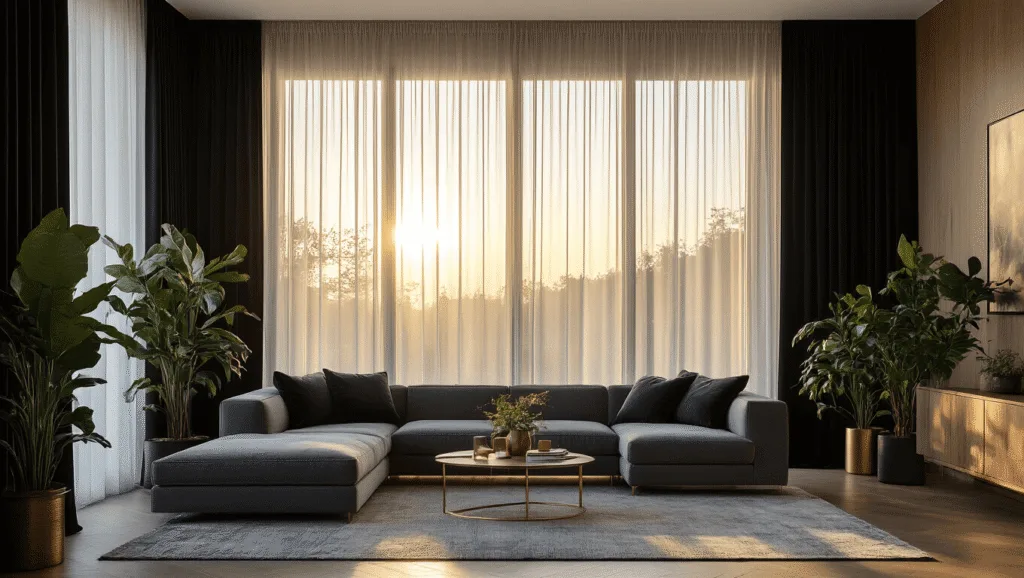
Heavy, dark curtains that puddle on the floor. Fine in a big room. In a small room, they look like drapes ate the wall. Hem them to just kiss the floor — about 1 cm above.
– Pillowcases and one throw, seasonally. Linen and cotton in summer; brushed flannel and a heavy wool throw in winter. Total cost: under $80 a year.
– Hardware on the wardrobe and nightstand. New brass pulls for $30 made my flat-pack PAX look custom.
– The lampshade on the overhead fixture. A linen drum shade swapped for a pleated one shifted the whole mood.
– Art. One big frame, prints rotated. A single 24″×36″ frame with rotating prints is more flexible than a gallery wall and a fraction of the work to change.
For renters: peel-and-stick wallpaper on the headboard wall, removable hooks behind the door for bags and robes, and a tension rod for the curtains. None of it leaves a mark.
What size bed for a tiny room? A full/double in anything under 9 m².
Storage bed vs. regular bed with bins underneath? Storage bed, every time, if the budget allows. Bins under a regular frame collect dust, are a pain to drag out, and look messy because you can see them. A storage bed hides everything.
Best paint color for a small bedroom? A warm off-white if you have decent light (Pale Oak, White Dove). A saturated cocoon color if you don’t (Hague Blue, Card Room Green). Cool greys in low light read as institutional — I’ve made that mistake.
Slanted ceilings? Build the bed into the lowest point so the slope becomes a canopy, not an obstacle. Paint walls and ceiling the same color so the angle disappears. Tall furniture goes on the full-height wall only.
No closet? Tall narrow wardrobe plus storage bed plus hooks on the back of the door. You’ll have more usable storage than most people with a small closet.
The real test of a tiny bedroom is whether you can walk in, drop your bag, and not feel like the walls are closing in. Get the bed right, get the light right, keep the surfaces clear. Everything else is decoration.
The tiny bedroom design that worked for me was a room under 110 square feet with a loft bed, a desk underneath, and a single window that looked at a brick wall. I painted the walls white, added a curtain to hide the closet, and hung a string of lights above the bed. The room felt like a nest, not a cage, because every inch had a purpose. That is the trick with small spaces — not to make them feel bigger, but to make them feel full.